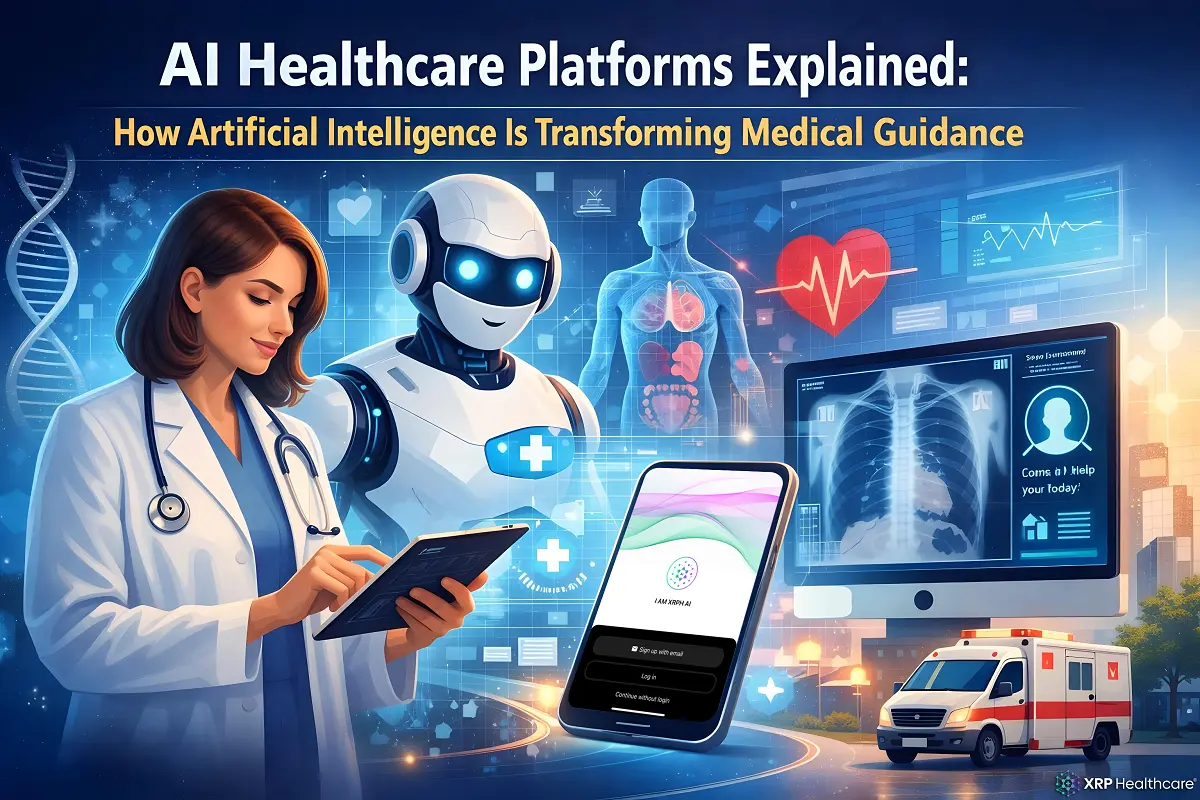
Introduction: The Rise of AI in Healthcare
Healthcare systems across the world are undergoing a profound transformation. Artificial intelligence is rapidly becoming one of the most powerful tools for improving healthcare access, efficiency, and decision-making. From symptom assessment to medical imaging analysis, AI technologies are increasingly assisting both patients and healthcare professionals. Today,
AI healthcare platforms are helping millions of people better understand symptoms, navigate healthcare systems, and access medical information instantly through smartphones and digital applications. As digital health continues to evolve, platforms like XRPH AI are exploring how artificial intelligence can support healthcare access while maintaining privacy-first architecture and real-world healthcare integration.
This article is part of the XRPH AI Healthcare Platform Knowledge Series exploring how artificial intelligence and digital health technologies are transforming global healthcare access.
What Is an AI Healthcare Platform?
An AI healthcare platform uses artificial intelligence to assist with healthcare-related information, guidance, and operational processes.
These platforms typically integrate several capabilities:
Symptom guidance and health education
Medical information analysis
Image-based condition assessment
Healthcare navigation tools
Multilingual patient interaction
Preventative health insights
Artificial intelligence processes large datasets and medical knowledge to provide structured responses and guidance faster than traditional systems. Importantly, these systems are designed to support healthcare decisions - not replace medical professionals.
Why AI Is Transforming Healthcare
Healthcare generates enormous amounts of data. Artificial intelligence allows this information to be processed, analyzed, and delivered in ways that were previously impossible. Researchers note that AI has the potential to fundamentally transform the practice of medicine and healthcare delivery through improved diagnostics, operational efficiency, and patient support systems.
Some of the most important advantages of AI healthcare platforms include:
Faster Access to Medical Information Patients can receive guidance within seconds instead of waiting hours or days for appointments.
Improved Healthcare Navigation AI systems help users understand symptoms, medications, and healthcare options.
Multilingual Medical Guidance Digital healthcare platforms can deliver information across languages, reducing barriers to care.
Preventative Healthcare Support AI can help identify patterns in symptoms and encourage earlier health interventions.
The Rapid Growth of AI Healthcare Technology
Artificial intelligence adoption in healthcare is accelerating globally. Industry research shows:
AI adoption across healthcare systems is expected to reach 30%-45% by 2030.
Nearly 86% of healthcare organizations already use AI technologies in some capacity.
The global AI healthcare market is projected to grow from tens of billions today to hundreds of billions of dollars over the next decade.
This rapid expansion reflects a growing recognition that AI can help healthcare systems address increasing patient demand, rising costs, and workforce shortages.
AI Does Not Replace Doctors
Despite rapid advancements, AI healthcare platforms are not intended to replace physicians. Instead, AI tools act as decision-support systems.
They help:
Provide preliminary health guidance
Organize medical information
Identify potential patterns or risks
Support preventative healthcare education
Doctors and healthcare professionals remain responsible for diagnosis and treatment decisions. AI simply helps extend healthcare knowledge and accessibility.
The Importance of Infrastructure in Digital Healthcare
Many digital health startups rely entirely on software. However, healthcare requires real-world infrastructure. Digital healthcare platforms are most effective when integrated with:
Licensed healthcare providers
Pharmacy networks
Healthcare supply chains
Medical professionals and institutions
Infrastructure ensures that digital guidance can translate into real healthcare action. This is why modern healthcare platforms increasingly combine AI technology with physical healthcare systems.
Introducing XRPH AI
XRPH AI is a digital healthcare platform designed to combine artificial intelligence with scalable healthcare infrastructure. The platform integrates:
AI health assessments
Image-based visible condition guidance
Women’s health tools
CalmXRPH™ stress support
Multilingual interaction
Counterfeit medicine awareness
Prescription Savings Card access across 68,000+ U.S. pharmacies
The system provides informational healthcare guidance only and does not replace licensed medical professionals. The application is primary, with additional ecosystem engagement layers designed around governance and responsible digital infrastructure.
Privacy and Trust in AI Healthcare
Trust is critical for digital healthcare adoption. XRPH AI operates under a privacy-first framework, including:
No storage of personal health information (PHI)
Transparent system architecture
Secure digital infrastructure
Protecting patient privacy ensures users can access healthcare information safely and responsibly.
The Future of AI Healthcare Platforms
The next generation of healthcare platforms will combine three critical elements:
Artificial intelligence for health guidance
Real-world healthcare infrastructure integration
AI alone cannot solve healthcare access challenges. But when combined with infrastructure, responsible governance, and scalable technology, it can dramatically expand global healthcare access.
FAQ SECTION
What is an AI healthcare platform?
An AI healthcare platform uses artificial intelligence to provide health information, symptom guidance, and medical insights through digital applications.
Can AI replace doctors?
No. AI systems assist healthcare professionals but do not replace licensed medical providers.
Why are AI healthcare platforms growing quickly?
Healthcare systems face increasing demand, workforce shortages, and rising costs. AI can help improve efficiency and access to medical information.
What is XRPH AI?
XRPH AI is a digital healthcare platform combining artificial intelligence, privacy-first architecture, and healthcare infrastructure integration. XRP Healthcare AI App is operated by XRP Healthcare M&A Holding Inc., focused on healthcare delivery, pharmacy infrastructure, and subscription monetization.
XRPH AI token is owned and governed by XRP Healthcare LLC and licensed for structured ecosystem utility only. The token does not represent equity, ownership, dividends, governance rights, or profit participation in XRP Healthcare M&A Holding Inc.