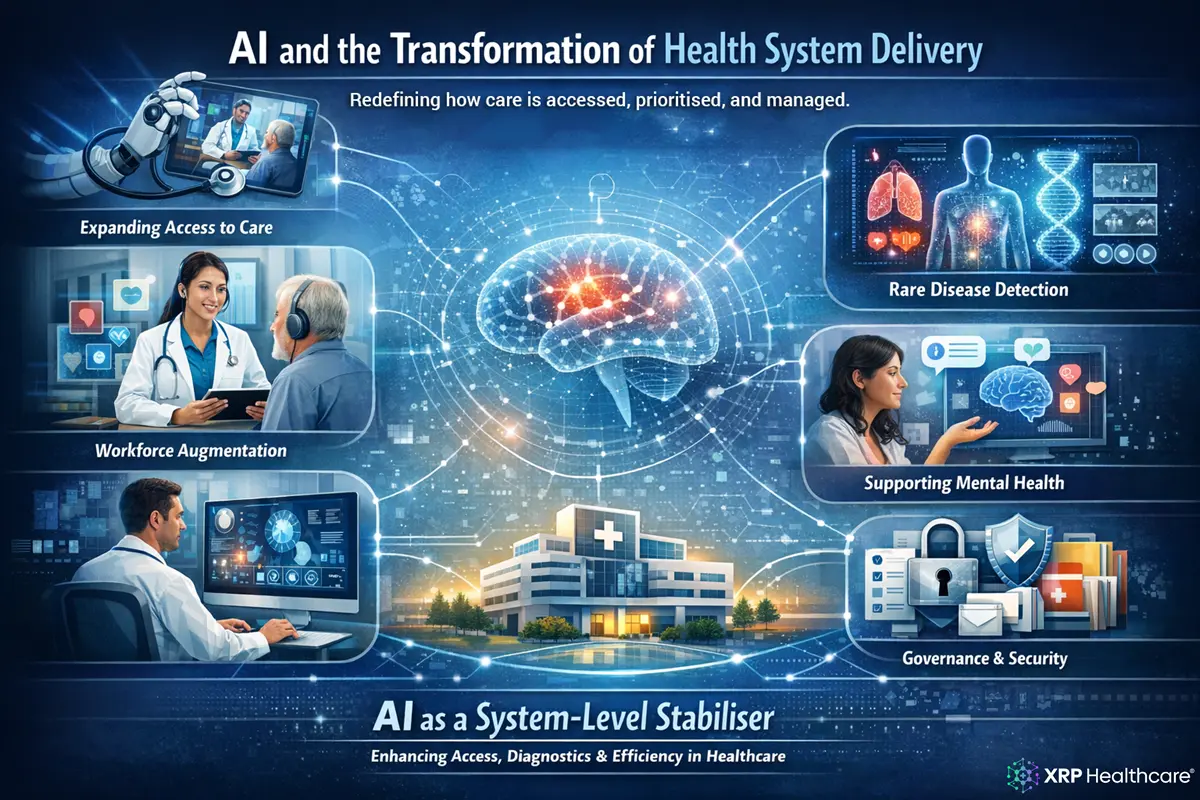
Introduction
AI in health system delivery is redefining how care is accessed, prioritised and managed. Healthcare systems face rising demand, workforce strain and operational fragmentation. Artificial intelligence is increasingly being integrated to stabilise these pressures and strengthen system-wide delivery models. When deployed responsibly, AI becomes part of healthcare infrastructure rather than a short-term innovation layer.
Expanding Access to Care
One of the primary pressures on modern healthcare systems is access inequality. AI in health system delivery supports:
Remote symptom assessment
Early risk detection
Virtual triage pathways
Scalable decision support
By automating preliminary analysis, AI allows health systems to extend reach without proportionally increasing staffing burden. Access becomes more equitable when systems operate more efficiently.
AI in Rare Disease Detection
Rare conditions are often underdiagnosed due to pattern complexity. AI in health system delivery enables detection of subtle correlations across patient datasets, supporting earlier intervention and referral. This strengthens:
Specialist allocation
Diagnostic clarity
Patient outcomes
System confidence
AI enhances detection capacity while maintaining clinical oversight.
Supporting Mental Health Infrastructure
Mental health demand continues to rise globally. AI tools are being used to assist with:
Early screening
Risk stratification
Symptom pattern recognition
Support triage workflows
Importantly, AI operates as a supportive layer, not a replacement for licensed professionals. System-level support improves resilience in overstretched care environments.
Workforce Augmentation and Stability
Healthcare workforce shortages create infrastructure strain. AI in health system delivery reduces repetitive administrative load, allowing clinicians to focus on higher-complexity care. This improves:
Operational continuity
Clinician satisfaction
Resource allocation
Patient throughput
Infrastructure-level stability depends on efficient resource use.
Governance and Responsible Deployment
AI must operate within structured oversight models. Deployment requires:
Clinical validation
Dataset transparency
Audit capability
Bias monitoring
Regulatory compliance
According to Harvard Business Review, healthcare organisations that embed governance frameworks early are more successful in scaling AI responsibly. External reference:https://hbr.org/ AI strengthens delivery only when it is governed.
Privacy and HIPAA-Grade Standards
Health system delivery relies on sensitive patient data. The XRPH AI App operates at a HIPAA-grade standard, incorporating encryption, structured access controls and privacy-first architecture. Responsible AI integration must prioritise:
Secure environments
Controlled data processing
Transparent security protocols
Trust is infrastructural.
AI as a System-Level Stabiliser
AI in health system delivery supports:
Early detection
Access expansion
Workflow efficiency
Consistency across facilities
Scalable decision support
When integrated responsibly, artificial intelligence becomes part of the delivery backbone of modern healthcare systems. It strengthens capacity without compromising oversight.
Related Infrastructure Articles
Frequently Asked Questions
What is AI in health system delivery?
AI in health system delivery refers to the integration of artificial intelligence into care access, triage and operational workflows across healthcare systems.
Does AI replace healthcare professionals?
No. AI supports clinicians by improving efficiency and detection while maintaining structured oversight.
How does AI improve access to care?
AI enables early risk detection, automated triage and scalable assessment tools that extend healthcare reach.
How is patient data protected?
The XRPH AI App operates at a HIPAA-grade standard with encryption and structured access controls.