Feb 16, 2026
Healthcare Infrastructure Gap: Why AI Must Bridge the Divide
Explore the global healthcare infrastructure gap and how responsible AI platforms like XRPH AI help bridge access and system inequality.
Retail network access is facilitated through agreements with United Networks of America (UNA). Display of pharmacy brand marks does not imply ownership, endorsement, or direct partnership with XRP Healthcare M&A Holding Inc.
Technology partnerships reflect collaborative or project-based cooperation. Display does not imply equity ownership or endorsement unless expressly stated.
Pharmaceutical and supply relationships reflect existing commercial arrangements within acquired operating entities. Display does not imply exclusivity or endorsement beyond standard commercial supply agreements.
Advisors provide professional services to XRP Healthcare M&A Holding Inc. No partnership or ownership interest is implied unless publicly disclosed.
All third-party trademarks remain the property of their respective owners. Display does not imply endorsement, ownership, or partnership unless expressly stated.
Feb 16, 2026
Explore the global healthcare infrastructure gap and how responsible AI platforms like XRPH AI help bridge access and system inequality.
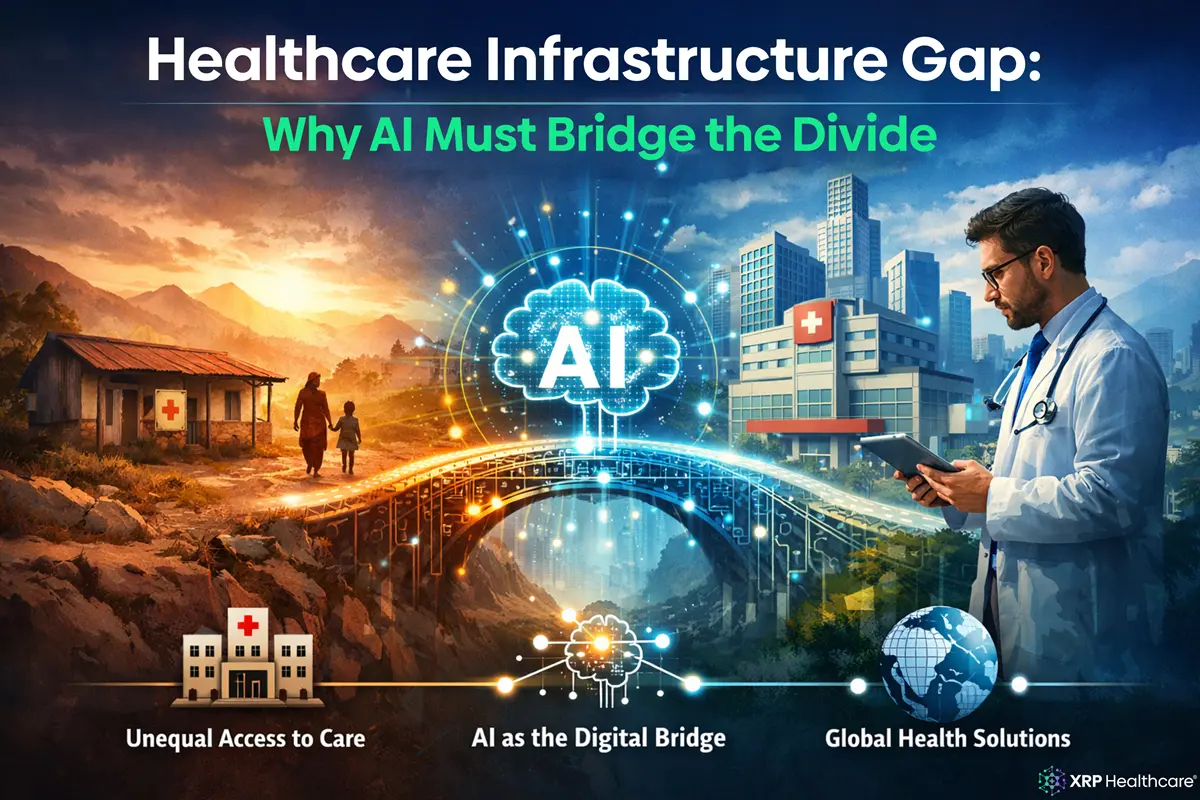
The healthcare infrastructure gap is one of the most pressing global challenges in modern medicine. While some regions benefit from advanced hospitals and specialist networks, others face limited clinical capacity, long travel distances, and delayed access to care. The healthcare infrastructure gap is not simply about resources - it is about access, scalability, and sustainable support. Artificial intelligence is increasingly positioned as a responsible digital layer capable of helping bridge this divide. XRPH AI has been designed with the healthcare infrastructure gap in mind, focusing on accessibility, context awareness, and system support.
The healthcare infrastructure gap refers to disparities in:
Clinic and hospital availability
Specialist access
Diagnostic capacity
Healthcare workforce distribution
Digital health integration
In many regions, physical expansion cannot keep pace with population growth and rising healthcare demand. This creates structural bottlenecks that delay early guidance and increase strain on healthcare systems. Addressing the healthcare infrastructure gap requires scalable solutions that extend beyond bricks and mortar.
Expanding hospitals and training clinicians takes time and capital. Even well-funded healthcare systems face workforce shortages and growing demand. The healthcare infrastructure gap therefore demands complementary solutions that:
Scale rapidly
Require minimal physical deployment
Operate across diverse regions
Support existing clinical pathways
Digital intelligence, when deployed responsibly, can provide this complementary layer.
Artificial intelligence does not replace healthcare infrastructure. Instead, it operates as a digital support layer accessible wherever connectivity exists. Responsible AI can:
Provide early-stage health understanding
Help users assess urgency
Encourage appropriate professional care
Improve preparedness before appointments
Reduce avoidable system congestion
When designed with context awareness, AI helps mitigate the impact of the healthcare infrastructure gap without disrupting clinical systems.
AI systems must recognise real-world constraints. Advice that assumes unlimited specialist access may widen frustration rather than improve care. Infrastructure-aware AI considers:
Regional healthcare access
Cultural communication patterns
Healthcare literacy differences
System capacity limitations
XRPH AI incorporates these principles to ensure guidance remains aligned with realistic next steps.
The healthcare infrastructure gap creates pressure at the earliest stages of care. By acting as a responsible first layer of guidance, AI can help distribute demand more effectively. Benefits include:
Improved clarity before appointments
Reduced unnecessary visits
Encouragement of timely care
Better patient communication
Rather than competing with healthcare professionals, AI strengthens system resilience.
The healthcare infrastructure gap will remain a global challenge for decades. Sustainable solutions must combine physical infrastructure development with intelligent digital support. Platforms that prioritise governance, privacy, restraint, and context awareness will become trusted contributors to healthcare ecosystems. XRPH AI reflects this approach - focusing on responsible scalability rather than disruption. Privacy & Healthcare-Grade Standards XRPH AI is built to healthcare-grade standards, emphasising privacy, ethical deployment, and responsible boundaries. The platform supports informed decision-making while reinforcing professional healthcare pathways. XRPH AI does not replace clinicians or provide diagnosis. It exists to improve understanding within real-world healthcare infrastructure constraints.
What is the healthcare infrastructure gap?
The healthcare infrastructure gap refers to disparities in access to hospitals, specialists, diagnostics, and digital healthcare systems.
How can AI help bridge the healthcare infrastructure gap?
AI can provide early-stage guidance, improve clarity, and support system efficiency without replacing clinical care.
Does AI replace healthcare infrastructure?
No. Responsible AI complements physical healthcare systems and strengthens early access.