Feb 27, 2026
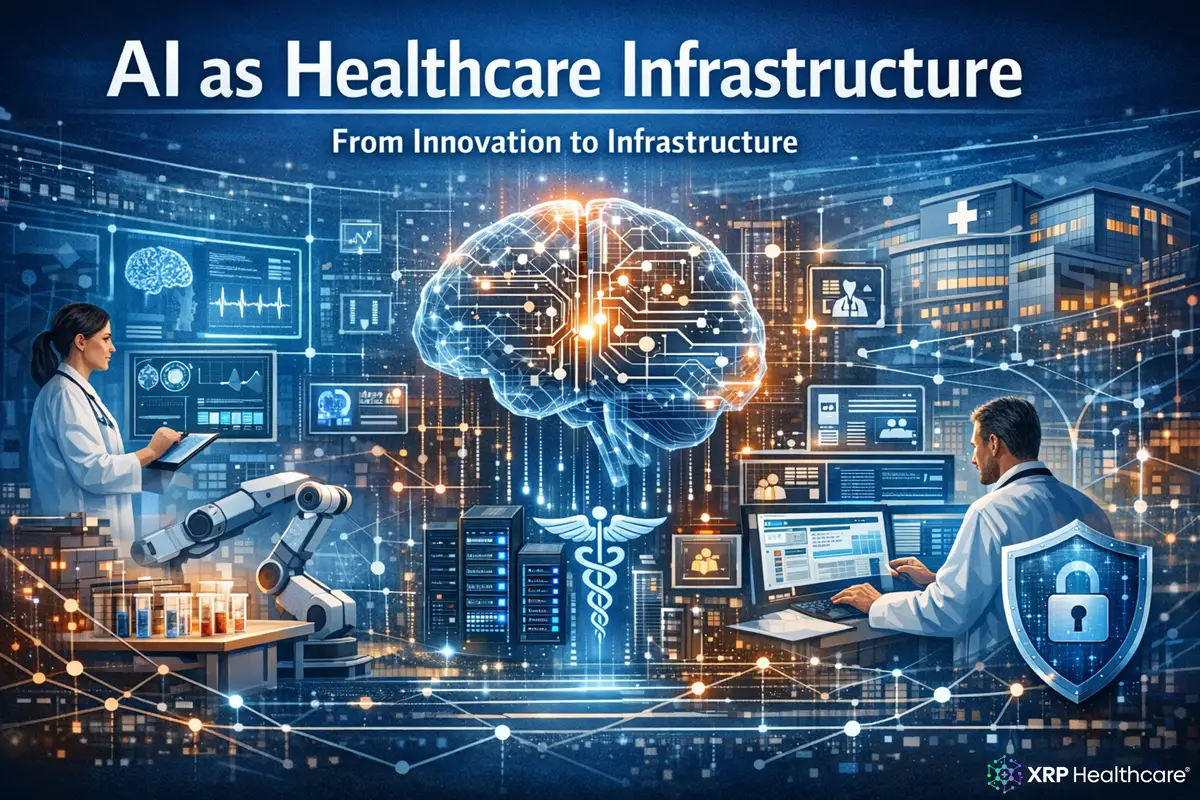
AI as Healthcare Infrastructure
Explore how AI is becoming healthcare infrastructure, strengthening diagnostics, governance, workflows and system delivery responsibly.
Retail network access is facilitated through agreements with United Networks of America (UNA). Display of pharmacy brand marks does not imply ownership, endorsement, or direct partnership with XRP Healthcare M&A Holding Inc.
Technology partnerships reflect collaborative or project-based cooperation. Display does not imply equity ownership or endorsement unless expressly stated.
Pharmaceutical and supply relationships reflect existing commercial arrangements within acquired operating entities. Display does not imply exclusivity or endorsement beyond standard commercial supply agreements.
Advisors provide professional services to XRP Healthcare M&A Holding Inc. No partnership or ownership interest is implied unless publicly disclosed.
All third-party trademarks remain the property of their respective owners. Display does not imply endorsement, ownership, or partnership unless expressly stated.
Feb 27, 2026
Explore how AI is becoming healthcare infrastructure, strengthening diagnostics, governance, workflows and system delivery responsibly.
AI as healthcare infrastructure represents a structural shift in how modern health systems operate. Artificial intelligence is no longer confined to research labs or pilot programs. It is moving into diagnostic workflows, governance models, triage systems and operational management.
The conversation is no longer about whether AI will be used in healthcare, but how it will be embedded safely and sustainably. Infrastructure is not visible. It is foundational. AI becomes infrastructure when it stabilises systems rather than merely enhancing them.
Infrastructure supports:
Stability
Consistency
Scalability
Governance
Predictability
AI as healthcare infrastructure refers to artificial intelligence embedded across these layers. It is not a tool sitting alongside systems. It is integrated within them. When AI informs diagnostics, workflow prioritisation and system governance simultaneously, it becomes infrastructural.
Healthcare systems face fragmentation. Variability in diagnostics, inconsistent triage standards, workforce strain and data silos create structural inefficiencies.
AI addresses these gaps through:
Pattern recognition at scale
Standardised triage logic
Automated workflow assistance
Predictive analytics for risk stratification
Related article:
https://www.xrphealthcare.ai/blog/healthcare-infrastructure-gap-ai-bridge/
AI reduces variability by introducing consistent analytical frameworks across facilities. Consistency strengthens infrastructure.
AI diagnostics are not merely supportive enhancements. They introduce systemic reliability. By analysing imaging and clinical data at scale, AI improves:
Early detection accuracy
Risk prioritisation
Cross-provider consistency
Outcome predictability
Related article:
https://www.xrphealthcare.ai/blog/ai-diagnostics-clinical-intelligence/
Diagnostic infrastructure determines downstream stability. AI strengthens that foundation.
Healthcare delivery depends on workflow efficiency. Administrative overload, documentation burden and triage delays weaken infrastructure. AI in clinical workflows improves:
Scheduling optimisation
Referral prioritisation
Automated documentation
Intelligent triage pathways
Related article:
https://www.xrphealthcare.ai/blog/ai-clinical-workflow-automation/
When workflows become more predictable, healthcare systems become more resilient. Infrastructure depends on predictability.
AI without governance remains experimental. AI governance in healthcare ensures:
Dataset validation
Bias monitoring
Clinical oversight
Regulatory compliance
Transparent audit processes
Related article:
https://www.xrphealthcare.ai/blog/ai-healthcare-future-governance/
According to Harvard Business Review, organisations that embed governance frameworks early are more likely to scale AI successfully across complex systems.
External reference:
Governance transforms AI from innovation into infrastructure.
Infrastructure must operate across the full care continuum. AI supports:
Rare disease detection
Mental health triage
Resource allocation modelling
Access expansion
System-level analytics
Related article:
https://www.xrphealthcare.ai/blog/ai-health-systems-care-delivery/
When integrated responsibly, AI improves access without destabilising oversight. System-wide integration marks infrastructural maturity.
Infrastructure cannot exist without trust. AI systems depend on secure data architecture. The XRPH AI App operates at a HIPAA-grade standard, incorporating encryption, structured access controls and privacy-first design principles. Security is not a feature. It is structural. Healthcare infrastructure must protect:
Patient confidentiality
Data integrity
Controlled access
Secure processing environments
Trust enables adoption. Adoption enables scale.
Healthcare institutions operate under regulatory, ethical and financial constraints. AI as healthcare infrastructure supports institutional stability by:
Reducing systemic inefficiencies
Improving diagnostic reliability
Standardising workflow processes
Supporting governance compliance
Enhancing data-driven decision-making
Infrastructure reduces volatility. AI strengthens that reduction when deployed responsibly.
AI infrastructure reshapes healthcare over time. As datasets expand and validation models mature, AI systems can:
Improve predictive modelling
Support population health analytics
Identify care pathway inefficiencies
Inform policy development
However, scaling must remain measured. Infrastructure evolves gradually. Sustainable AI integration requires:
Continuous validation
Oversight refinement
Security monitoring
Transparent governance
Rapid adoption without structure weakens systems. Measured integration strengthens them.
AI will not replace healthcare professionals. It will augment institutional capacity. The future of AI as healthcare infrastructure lies in:
Responsible integration
Embedded governance
Secure architecture
Clinician oversight
Operational resilience
Infrastructure is not about visibility. It is about reliability. AI becomes infrastructure when it strengthens reliability at every layer.
What does AI as healthcare infrastructure mean?
It refers to artificial intelligence embedded across diagnostic, workflow and governance systems to stabilise and scale healthcare operations.
How is AI different from traditional healthcare software?
AI systems continuously learn from data and support predictive analysis rather than operating as static rule-based software.
Why is governance critical to AI infrastructure?
Governance ensures safety, regulatory compliance and institutional trust.
How is patient privacy protected?
The XRPH AI App operates at a HIPAA-grade standard with encryption, structured access controls and privacy-focused system architecture.