Introduction
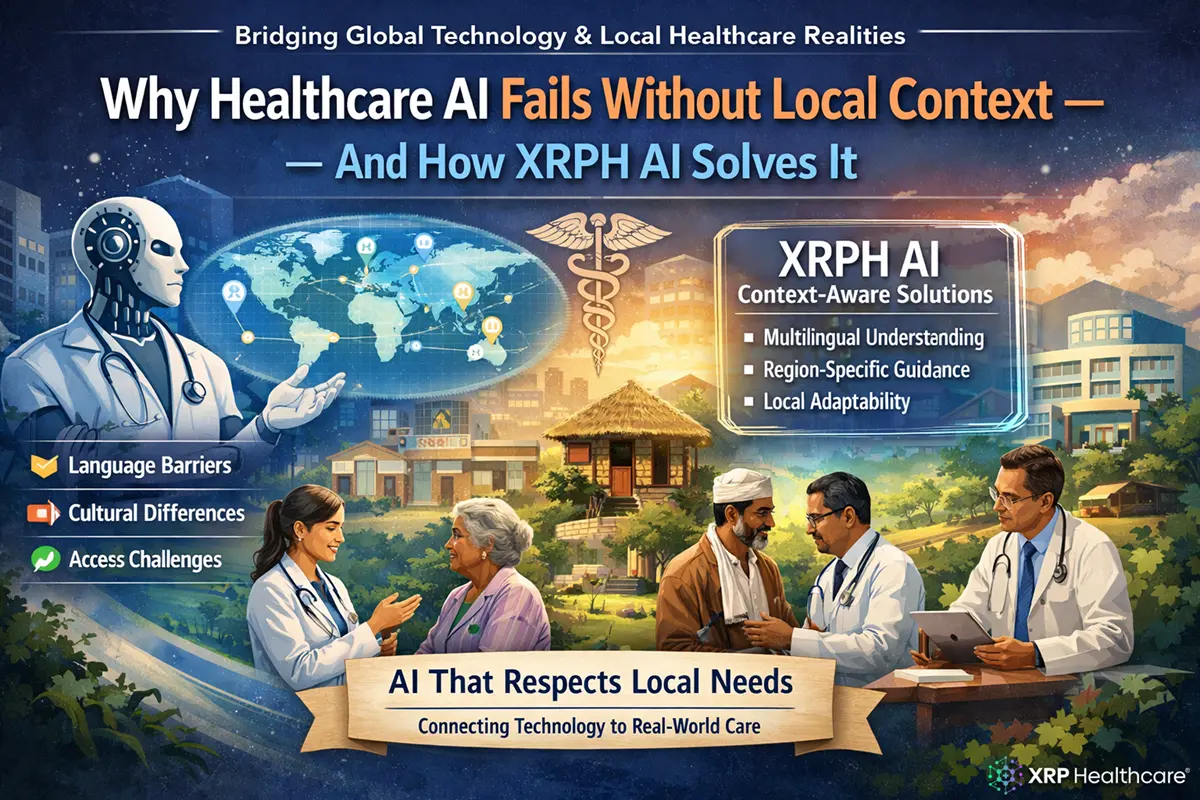
Artificial intelligence is advancing rapidly in healthcare, yet many AI-driven solutions struggle to gain meaningful adoption. The reason is rarely a lack of computational power or medical data. Instead, healthcare AI often fails because it overlooks the realities of local context-language, access, culture, infrastructure, and patient behaviour. Healthcare is not uniform.
What works in one region may be ineffective-or even harmful-in another. XRPH AI was designed with this reality in mind, recognising that successful healthcare intelligence must adapt to people, not expect people to adapt to technology.
The Problem With One-Size-Fits-All Healthcare AI
Many healthcare AI platforms are developed using datasets, assumptions, and workflows rooted in a narrow set of healthcare systems. When these models are deployed globally, cracks quickly appear.
Key challenges include:
Language barriers that prevent accurate symptom description
Cultural differences in how patients describe pain or illness
Infrastructure gaps where clinics, diagnostics, or specialists are not easily accessible
Healthcare literacy variations that affect how advice is interpreted
Without accounting for these factors, AI tools risk becoming technically impressive but practically irrelevant.
Why Local Context Determines AI Effectiveness
Healthcare decisions are deeply human. They are shaped by environment, belief systems, availability of care, and trust in institutions. AI that ignores these dimensions often produces guidance that feels disconnected from real-world conditions.
Local context influences:
How symptoms are described
When patients seek care
Whether advice is followed
Which care pathways are realistic
For AI to support healthcare meaningfully, it must understand not only medical data, but the conditions under which care decisions are made.
How XRPH AI Approaches Context-Aware Healthcare Intelligence
XRPH AI was built to operate across diverse healthcare environments by prioritising adaptability over rigid assumptions.
Its design focuses on:
Multilingual communication, allowing users to interact naturally
Region-aware guidance, reflecting realistic care options
Context-sensitive responses, aligned with local access and norms
Responsible boundaries, ensuring AI supports-not replaces-clinical judgement
Rather than forcing global users into a single healthcare model, XRPH AI adapts its guidance to reflect the realities users face.
Bridging Global Technology With Local Healthcare Realities
Healthcare AI succeeds when it acts as a bridge-connecting advanced technology with local healthcare ecosystems. XRPH AI supports this by recognising that effective guidance must align with what patients can actually do next. This approach enables:
More relevant health insights
Higher trust and engagement
Better decision-making at early stages of care
Reduced strain on healthcare systems
By respecting local context, XRPH AI helps ensure technology enhances access rather than widening gaps.
Why Context-Aware AI Is the Future of Digital Health
As AI becomes more embedded in healthcare, platforms that fail to account for local realities will struggle to scale sustainably. Context-aware intelligence is no longer optional-it is foundational. Healthcare AI must evolve from generic prediction engines into systems that understand people, environments, and limitations. XRPH AI reflects this shift, focusing on relevance, trust, and responsible deployment across diverse regions.
Privacy & Healthcare-Grade Standards
XRPH AI is built to healthcare-grade standards, with a strong emphasis on privacy, user safety, and responsible use. The platform is designed to support informed decisions while respecting data boundaries and regional healthcare frameworks.
XRPH AI does not replace medical professionals. It exists to enhance access, understanding, and early-stage guidance in a safe and ethical manner.
Related Reading
XRP Healthcare: Building Trustworthy, Patient-First AI for a Healthier Future
Why XRP Healthcare Is at the Forefront of the AI-Powered Healthcare Revolution
FAQs
Why does healthcare AI struggle in different regions?
Because healthcare systems, language, and access vary widely, and many AI tools are trained without considering these differences.
What makes XRPH AI different from generic healthcare AI platforms?
XRPH AI is designed to adapt to local context, offering guidance aligned with regional realities rather than assuming uniform access to care.
Can AI replace doctors in healthcare?
No. XRPH AI supports informed decision-making but does not replace professional medical advice or diagnosis.