Introduction
Artificial intelligence is rapidly changing how people access healthcare information.
Around the world, healthcare organisations are exploring how AI can improve health education, patient engagement, workflow efficiency and access to digital healthcare services.
While AI has attracted significant attention, its greatest long-term impact is unlikely to come from replacing healthcare professionals.
Instead, AI is expected to become an intelligent assistant that helps patients and clinicians manage information more effectively, improve communication and support better healthcare experiences.
Within the XRPHAI App, this philosophy already shapes the platform.
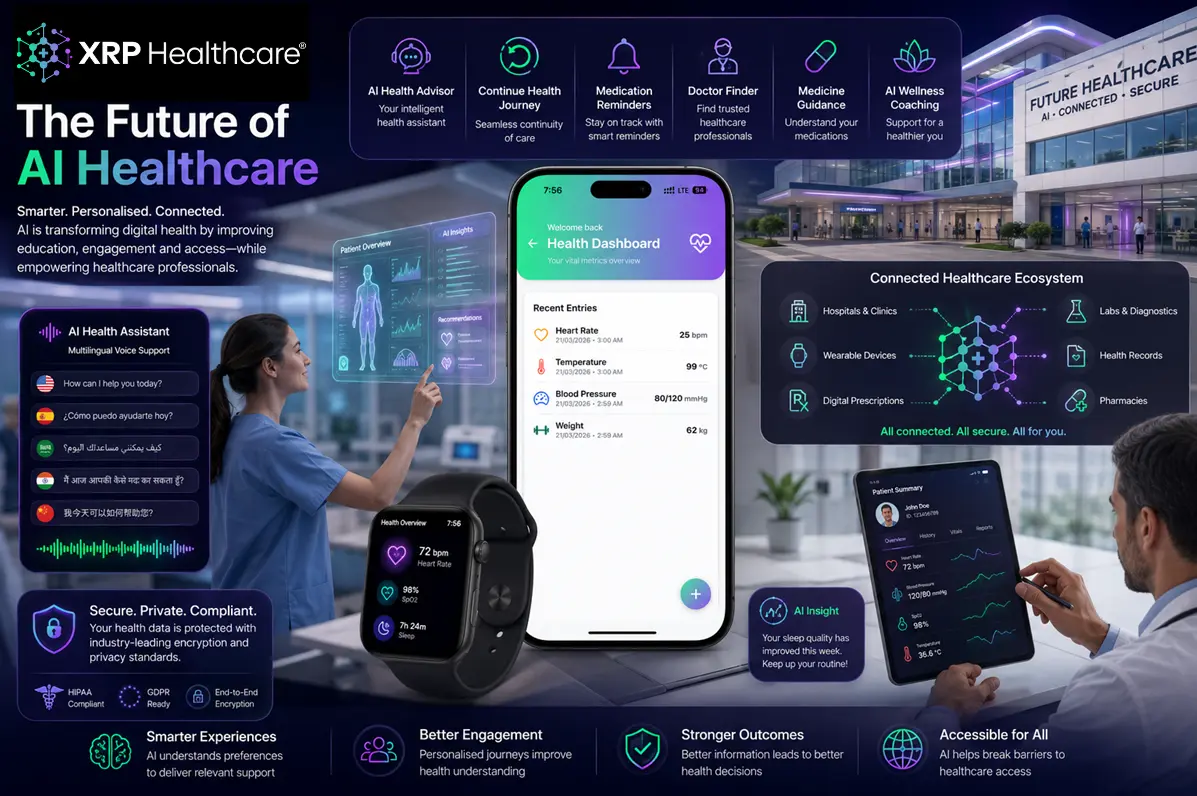
Features such as AI Health Advisor, Continue Health Journey, Medication Reminders, Doctor Finder, Medicine Guidance, AI Wellness Coaching and other connected tools are designed to help users organise healthcare while leaving diagnosis and treatment to qualified professionals.
As AI technology continues to mature, digital healthcare platforms are expected to become more personalised, more connected and more accessible.
The Evolution of Digital Healthcare
Healthcare has undergone significant digital transformation over the past two decades.
Progress has included:
Electronic medical records.
Telemedicine.
Mobile healthcare applications.
Wearable health devices.
Remote patient monitoring.
Digital prescriptions.
Online appointment booking.
Artificial intelligence represents the next stage in this evolution.
Rather than replacing existing systems, AI is increasingly being used to make healthcare information easier to organise, understand and access.
AI Will Support More Personalised Healthcare
One of the biggest developments will be greater personalisation.
Future AI healthcare platforms may help users organise:
Personal health goals.
Wellness plans.
Medication schedules.
Appointment preparation.
Preventive healthcare activities.
Educational content.
Long-term healthcare journeys.
Personalisation should always remain transparent and user-controlled.
It should not be confused with autonomous clinical decision-making.
Better Health Education
Access to understandable health information remains one of healthcare's biggest challenges.
Future AI systems are expected to improve health education by:
Explaining complex medical terminology.
Presenting information in simpler language.
Supporting multiple languages.
Providing voice interaction.
Organising trusted educational resources.
Helping users prepare for healthcare appointments.
Better understanding often leads to more productive healthcare conversations.
Connected Healthcare Journeys
Future digital healthcare will become less fragmented.
Instead of isolated healthcare interactions, users may experience continuous health journeys that connect:
AI healthcare conversations.
Medication reminders.
Wellness goals.
Preventive healthcare.
Appointment preparation.
Educational resources.
Long-term healthcare management.
Within the XRPHAI App, the Continue Health Journey feature already reflects this direction by allowing users to continue previous healthcare interactions.
Smarter Preventive Healthcare
Preventive healthcare is expected to become increasingly important.
Future AI tools may help users:
Organise healthier routines.
Maintain wellness goals.
Prepare for health screenings.
Follow medication schedules.
Access preventive healthcare education.
Continue healthy lifestyle programmes.
These tools are expected to support healthier behaviours without replacing professional healthcare advice.
Greater Accessibility
Artificial intelligence can also improve healthcare accessibility.
Future developments may include:
Real-time language translation.
Voice-controlled healthcare assistants.
Improved accessibility features.
Better support for visually impaired users.
Simpler healthcare interfaces.
Personalised learning experiences.
Making healthcare easier to access benefits patients across different ages, languages and technical abilities.
Responsible AI Will Become More Important
As AI becomes more capable, responsible development becomes even more important.
Future healthcare AI should prioritise:
Patient safety.
Transparency.
Privacy.
Security.
Human oversight.
Clinical governance.
Regulatory compliance.
Users should understand:
What AI can do.
What AI cannot do.
When professional healthcare is required.
Trust will become one of the defining factors in successful healthcare AI.
How the XRPHAI App Supports the Future of AI Healthcare
The XRPHAI App already brings together several AI-powered healthcare capabilities into one connected experience.
AI Health Advisor
Educational healthcare guidance.
Continue Health Journey
Long-term healthcare continuity.
AI Medication Reminders
Medication organisation.
AI Wellness Coaching
Healthy lifestyle support.
AI Preventive Care Plans
Preventive healthcare engagement.
AI Health Notifications
Timely healthcare reminders.
AI Health Reports
Structured educational summaries.
AI Health Insights
Better understanding of healthcare information.
Doctor Finder
Access to professional healthcare providers.
Together these features represent the direction that many future AI healthcare platforms are expected to follow.
AI Will Continue Supporting Healthcare Professionals
Despite rapid technological progress, healthcare professionals will remain central to patient care.
Doctors, nurses, pharmacists and specialists will continue to provide:
Diagnosis.
Treatment.
Clinical judgement.
Emergency care.
Human empathy.
Complex decision-making.
AI will increasingly support these professionals by helping patients become more informed and organised before healthcare interactions.
Challenges That Must Be Addressed
The future of AI healthcare also brings important responsibilities.
Healthcare organisations must continue addressing:
Data privacy.
Security.
AI transparency.
Clinical validation.
Regulatory compliance.
Accessibility.
Digital inclusion.
Ethical AI development.
Responsible innovation is essential for maintaining public trust.
Looking Beyond Today's Technology
Future AI healthcare platforms may include:
More advanced voice assistants.
Better multilingual healthcare support.
Connected wearable integration.
Improved healthcare summaries.
Personalised educational pathways.
Smarter healthcare organisation.
Better patient engagement.
More connected healthcare ecosystems.
Future capabilities should always be described accurately and only after they become available.
AI Supports-It Does Not Replace-Healthcare Professionals
Artificial intelligence is becoming a valuable healthcare tool.
However, it does not replace:
Doctors.
Nurses.
Pharmacists.
Specialists.
Clinical judgement.
Professional diagnosis.
Medical treatment.
Emergency healthcare.
The future of AI healthcare depends upon strong collaboration between technology and healthcare professionals.
Conclusion
Artificial intelligence is expected to become one of the defining technologies in modern healthcare.
By improving health education, healthcare organisation, patient engagement and digital accessibility, AI has the potential to make healthcare more connected and easier to navigate.
Within the XRPHAI App, AI Health Advisor, Continue Health Journey, Medication Reminders, Wellness Coaching, Preventive Care Plans, Health Reports and other connected features demonstrate how responsible AI can support-not replace-professional healthcare.
The future of AI healthcare is not about replacing people.
It is about helping people make better use of information while enabling healthcare professionals to continue delivering expert clinical care.
FAQ
What is the future of AI healthcare?
Artificial intelligence is expected to improve healthcare education, patient engagement, preventive healthcare and digital accessibility while supporting healthcare professionals.
Will AI replace doctors?
No. AI supports healthcare professionals by improving information management and patient engagement but does not replace diagnosis, treatment or clinical judgement.
What areas of healthcare will AI improve?
Future AI may support health education, appointment preparation, medication reminders, preventive healthcare, multilingual communication and long-term health journeys.
Is AI healthcare safe?
AI should be developed using strong privacy protections, transparency, human oversight and appropriate regulatory governance.
How does the XRPHAI App support the future of AI healthcare?
The XRPHAI App combines AI Health Advisor, Continue Health Journey, Medication Reminders, AI Health Reports, AI Health Insights, Wellness Coaching and preventive healthcare features into one connected digital healthcare experience.
Can AI provide medical treatment?
No. AI provides educational and organisational support but cannot replace qualified healthcare professionals or emergency healthcare services.