Introduction
Downloading a healthcare app is easy.
Continuing to use it consistently is harder.
A user may begin a wellness journey, set a medication reminder, ask an AI healthcare question or explore a preventive health feature.
Then life gets busy.
They stop opening the app.
The health journey remains unfinished.
This is a common challenge across digital healthcare.
The problem is not always that the user no longer cares about their health.
They may simply have lost momentum.
This is where AI reactivation can become useful.
AI reactivation is the process of helping inactive or less-engaged users reconnect with digital healthcare in a relevant, respectful way.
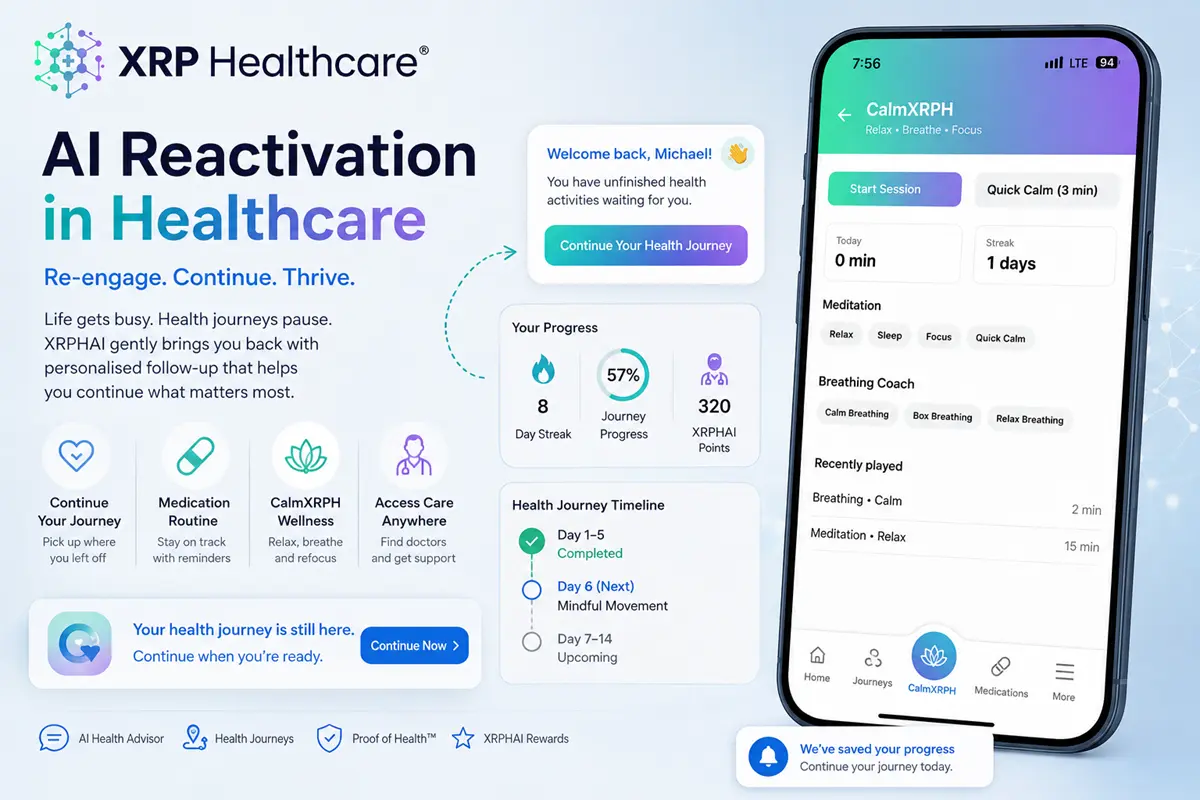
Within the XRPHAI App, reactivation can potentially help users return to unfinished Health Journeys, medication routines, wellness activities, AI healthcare conversations and other useful health actions.
The goal is not to create more notifications.
It is to make the right follow-up more useful.
What Is AI Reactivation in Healthcare?
AI reactivation in healthcare uses intelligent digital systems to identify when a user has disengaged and help them return to an appropriate healthcare or wellness activity.
This may involve:
Personalised follow-up
Health journey reminders
Medication routine prompts
Wellness re-engagement
Unfinished activity reminders
Relevant feature suggestions
Personalised educational content
Progress reminders
The emphasis should remain on helping rather than pressuring.
Why Users Stop Engaging With Healthcare Apps
People stop using healthcare apps for many reasons.
Examples include:
Busy schedules
Travel
Changing priorities
Too many notifications
Lack of immediate relevance
Forgetting the app exists
Completing an initial goal
Losing momentum
Feeling overwhelmed
A good reactivation system should not assume the reason.
Instead, it should provide a useful and low-friction opportunity to return.
Generic Notifications Are Not Enough
Traditional re-engagement often relies on broad messages such as:
“We miss you.”
or:
“Come back today.”
These messages may have little healthcare value.
AI allows a more relevant approach.
For example:
“You paused your 14-day wellness journey. Would you like to continue from Day 6?”
or:
“Your medication routine is still available if you would like to continue tracking it.”
The difference is context.
Reactivation Should Start With Value
A healthcare reactivation message should answer a simple question:
Why is returning useful to this user now?
Examples may include:
Continue an unfinished Health Journey
Resume a CalmXRPH routine
Review an existing medication schedule
Return to an earlier AI health conversation
Explore a relevant health feature
Continue a preventive-care activity
The strongest reactivation is connected to something the user has already chosen to do.
The Role of the XRPHAI App
The XRPHAI App is built around connected healthcare experiences rather than isolated one-time interactions.
That makes reactivation strategically important.
A user may have previously engaged with:
AI Health Advisor
Continue Health Journey
Medication Adherence
Medicine Verification
Doctor Finder
Prescription Savings
CalmXRPH
Wellness Journeys
Proof of Health™
XRPHAI rewards
Reactivation can help reconnect the user with the most relevant next step.
Continue Health Journey as a Reactivation Layer
The Continue Health Journey concept is especially important.
A user should not necessarily need to restart from the beginning.
If they previously discussed a health topic or completed part of a digital journey, the application can help them return to that context.
This may reduce friction.
Instead of:
Start again
the experience becomes:
Continue where you left off
That is a much stronger reactivation principle.
Reactivation and Wellness Journeys
Wellness Journeys are designed around repeated health-positive actions over time.
A user may begin a:
7-day journey
14-day journey
30-day journey
but stop halfway through.
Reactivation can help remind them that the journey is still available.
For example:
You completed 8 of 14 days. Continue when you're ready.
This acknowledges progress without creating unnecessary pressure.
Reactivation and Medication Adherence
Medication adherence is another area where continuity matters.
If a user has created an established medication routine and then stops interacting with it, the application may be able to surface that routine again.
However, medical safety is essential.
A reactivation prompt should never imply that a user should continue medication if:
A healthcare professional has stopped it
The prescription has changed
The user is uncertain about treatment
The medication is no longer relevant
Reactivation should support organisation, not make treatment decisions.
Reactivation and CalmXRPH
Not every reactivation needs to be medical.
Wellness can provide a softer route back into the app.
A user who previously used CalmXRPH may benefit from a simple prompt to return to:
Breathing
Affirmations
Mindfulness
Relaxation
Soundscapes
This can make reactivation feel supportive rather than transactional.
Reactivation and AI Health Advisor
Users may also return because they have another health question.
If a previous AI Health Advisor conversation is relevant, the app may help the user continue rather than start from scratch.
Context improves continuity.
The application should still clearly distinguish educational AI support from professional diagnosis and treatment.
AI Can Prioritise the Most Relevant Return Path
A user may have several unfinished activities.
AI can potentially help identify which reactivation path is most relevant.
For example, if a user has:
an incomplete wellness journey
an inactive medication routine
a previous health conversation
an unfinished CalmXRPH session
the system may select one useful prompt instead of sending four separate notifications.
This reduces noise.
One Good Notification Is Better Than Five Irrelevant Ones
Healthcare reactivation should not become notification spam.
Too many messages can cause users to:
Ignore notifications
Disable notifications
Uninstall the app
Lose trust
A strong reactivation system should optimise for usefulness, not volume.
Timing Matters
The same message may be useful at one time and annoying at another.
AI can potentially help improve timing based on:
User preferences
Previous engagement
Time of day
Journey activity
Notification settings
The user should remain in control of when and how the application contacts them.
Notification Preferences Must Be Respected
Users should be able to control:
Whether they receive reminders
Which reminders they receive
Notification frequency
Sensitive content visibility
Quiet hours where supported
Healthcare engagement should be permission-based.
Reactivation Is Not the Same as Retention
These concepts are related.
Retention
Keeping users engaged over time.
Reactivation
Bringing inactive users back.
A strong digital health platform should support both.
Retention reduces drop-off.
Reactivation creates a path back when drop-off happens.
Reactivation Should Not Create Guilt
Healthcare is personal.
Messages such as:
“You failed your journey.”
“You missed too many days.”
“You are falling behind.”
can be counterproductive.
A better approach is supportive.
Examples:
“Continue when you're ready.”
“Your journey is still here.”
“Pick up where you left off.”
The language matters.
Progress Can Be a Powerful Reactivation Signal
Users may be more likely to return if they are reminded of progress they have already made.
For example:
8 of 14 days completed
or:
5 healthy actions completed this week
This reinforces continuity.
The user sees that previous effort has not disappeared.
Proof of Health™ and Reactivation
The broader XRPHAI ecosystem includes Proof of Health™, which recognises eligible health-positive engagement.
Reactivation can help users return to health actions that contribute to this wider engagement framework.
However, the incentive should remain secondary to the health value.
The message should not become:
Come back just to earn tokens.
The primary value should remain:
Continue a useful health action.
XRPHAI Rewards and Reactivation
Eligible engagement may qualify for XRPHAI rewards under the application's current rules.
Rewards can add another layer of motivation.
But reward design should remain responsible.
A reactivation system should not encourage:
Unnecessary medical activity
Obsessive app usage
Repeated actions with no health value
Unsafe medication behaviour
Rewards should recognise meaningful eligible engagement.
Reactivation After an Incomplete Health Journey
An incomplete journey is one of the clearest reactivation opportunities.
The system may know:
Journey selected
Days completed
Activities completed
Last interaction
Remaining journey steps
This makes the follow-up relevant.
The message is connected to something the user already chose.
Reactivation After Medication Routine Drop-Off
If a medication adherence routine stops, the system should handle it carefully.
A safe prompt might say:
“Your medication tracking routine has been inactive. If this medication is still part of your current treatment, you can review or update your schedule.”
That is safer than:
“You need to start taking your medicine again.”
Digital health reactivation must remain within clear clinical boundaries.
Reactivation After CalmXRPH Inactivity
Wellness reactivation can be simpler.
For example:
“Return to a 5-minute CalmXRPH breathing session.”
This creates a low-friction way to re-enter the healthcare ecosystem.
A user may then continue into other health activities naturally.
Reactivation and Personalisation
The best reactivation message for one user may be completely wrong for another.
AI can potentially personalise:
Feature highlighted
Timing
Message type
Health journey
Reminder frequency
Language
Preferred interaction mode
Personalisation should remain transparent and based on appropriate user data and preferences.
Reactivation and Voice AI
Voice may also become a useful reactivation channel within the app.
For example, a returning user may ask:
“What was I doing last time?”
or:
“Continue my health journey.”
The AI assistant can help reduce the friction of finding the previous activity manually.
Reactivation and Multilingual Healthcare
Language can influence whether users engage with digital health.
Personalised reactivation may become more effective when users receive prompts in their preferred language.
Healthcare terminology should still remain clear and carefully translated.
Reactivation and Accessibility
A reactivation experience should work for different types of users.
This may include support for:
Voice interaction
Clear visual hierarchy
Larger text
Simple navigation
Reduced cognitive load
Accessible notification language
The objective is to make returning easy.
The Reactivation Agent
Within the future XRPHAI agent architecture, the Reactivation Agent is designed to focus specifically on bringing users back into useful health engagement.
Its role is not simply to send messages.
A more advanced Reactivation Agent may eventually help determine:
Which users need re-engagement
Which unfinished activity is most relevant
Which feature provides the best return path
When to contact the user
When not to contact the user
Which message is least intrusive
What next step is most useful
This turns reactivation into an intelligent product capability.
Reactivation Agent vs Generic Marketing Automation
A healthcare Reactivation Agent should be very different from a conventional marketing retargeting system.
Marketing automation may optimise for:
Opens
Clicks
Purchases
A healthcare reactivation system should prioritise:
Health relevance
User consent
Appropriate frequency
Safety
Helpful next actions
Long-term trust
Engagement metrics still matter.
But they should not override healthcare responsibility.
Reactivation and User Segmentation
Different inactive users may require different approaches.
Potential segments may include:
Recently inactive
Long-term inactive
Paused journey users
Medication routine users
CalmXRPH users
AI Health Advisor users
Premium subscribers
Free users
The system can potentially tailor reactivation accordingly.
Not Every Inactive User Should Be Reactivated the Same Way
A user who completed a goal may not need the same message as someone who abandoned it.
A user who disabled notifications should not be treated like someone who simply forgot to return.
Context matters.
Responsible reactivation means understanding when not to send another prompt.
Reactivation and Premium Features
Some users may previously have engaged with premium functionality.
Reactivation can remind users of relevant features they already have access to.
However, the primary message should still be useful rather than purely commercial.
Healthcare value should come first.
Reactivation and Revenue
Reactivation can indirectly improve the economics of digital healthcare.
When inactive users return, the platform may see:
Higher engagement
More completed journeys
Better feature discovery
Greater premium retention
More referral activity
But revenue should be a consequence of useful engagement.
It should not become the sole objective of health-related reactivation.
Measuring Reactivation Success
Useful metrics may include:
Reactivated users
Journey continuation rate
Return-to-app rate
Notification opt-out rate
Feature re-engagement
Premium reactivation
Longer-term retention after return
The strongest metric is not merely:
Did the user open the app?
A better question is:
Did the user return to something useful?
Reactivation Quality Matters More Than Click Rate
A high notification click-through rate can be misleading.
If users click but immediately leave, the reactivation may not be valuable.
More meaningful measures include:
Completed activity
Continued journey
Useful health interaction
Return within following days
Reduced churn
This aligns product metrics with actual health engagement.
Privacy and Reactivation
Reactivation systems may rely on behavioural data.
That creates privacy responsibilities.
Users should understand:
What engagement data is used
Why reminders are personalised
How notifications can be controlled
How data preferences can be changed
Personalisation should never feel like surveillance.
Sensitive Notification Content
Healthcare notifications may reveal information if shown on a lock screen.
A reactivation system should therefore avoid exposing sensitive health details unnecessarily.
Instead of:
“You have not taken your blood pressure medication.”
a privacy-conscious message might say:
“You have a health routine waiting.”
where appropriate.
Users should control notification detail where supported.
AI Reactivation Does Not Replace Medical Follow-Up
Reactivation is a digital engagement function.
It should not be confused with clinical follow-up.
If a user requires:
Diagnosis
Treatment review
Medication adjustment
Urgent medical attention
they should engage with an appropriate healthcare professional.
AI reactivation helps reconnect users with the app.
It does not replace clinical care.
The Connected XRPHAI Reactivation Loop
The broader engagement loop can be understood as:
User Becomes Inactive
↓
Reactivation Agent Identifies Relevant Return Path
↓
Personalised Prompt
↓
User Returns
↓
Health Journey / Medication / CalmXRPH / AI Health Advisor
↓
Useful Health Action
↓
Proof of Health™
↓
Eligible XRPHAI Reward
↓
Continued Engagement
The goal is to make returning useful.
Reactivation Should Lead Somewhere Meaningful
A poor reactivation experience ends at the home screen.
A strong one leads directly to the relevant action.
For example:
Notification
“Continue your 14-day wellness journey.”
↓
Tap
↓
Journey resumes at next relevant step
The fewer unnecessary steps, the better.
The Future of AI Reactivation in Healthcare
Future healthcare reactivation systems may become increasingly sophisticated.
Potential capabilities include:
Predicting disengagement risk
Selecting personalised reactivation paths
Adapting timing
Choosing preferred channels
Prioritising unfinished health journeys
Coordinating AI agents
Learning from reactivation outcomes
These capabilities should be described as future-facing until confirmed live.
Why Reactivation Matters to the XRPHAI Ecosystem
XRPHAI is designed around ongoing engagement rather than one-time healthcare interactions.
That means the user lifecycle matters.
The platform needs to support:
Discovery
↓
Onboarding
↓
Health Engagement
↓
Habit Formation
↓
Retention
↓
Reactivation when needed
Reactivation completes the loop.
Without it, users who disengage may simply disappear from the health journey.
Conclusion
AI reactivation can transform healthcare engagement from generic reminders into more relevant, personalised follow-up.
Users leave digital health applications for many reasons.
The best response is not more notification volume.
It is greater relevance.
Within the XRPHAI App, reactivation can help users return to:
Health Journeys
Medication routines
AI Health Advisor conversations
CalmXRPH
Preventive health activities
Proof of Health™
Eligible XRPHAI rewards
The future Reactivation Agent can potentially make this process more intelligent by identifying the most useful return path for each user.
The principle should remain simple:
Do not pressure the user to come back.
Give them a useful reason to return.
That approach can strengthen engagement, support continuity and help the XRPHAI App become a more persistent part of everyday digital healthcare.
FAQ
What is AI reactivation in healthcare?
AI reactivation in healthcare uses intelligent digital systems to help inactive users reconnect with useful health activities, unfinished journeys or previously used digital healthcare tools.
Why do users stop engaging with healthcare apps?
Users may disengage because of busy schedules, travel, changing priorities, notification fatigue, completed goals or lost momentum. Reactivation should not assume one universal reason.
How is AI reactivation different from generic notifications?
Generic notifications often send broad messages. AI reactivation can potentially use context such as unfinished journeys, previous activity and user preferences to provide a more relevant return path.
How is reactivation different from retention?
Retention focuses on keeping active users engaged over time. Reactivation focuses on helping users who have already become inactive return to useful engagement.
What is the XRPHAI Reactivation Agent?
The Reactivation Agent is part of the future XRPHAI agent architecture designed to identify relevant ways to help inactive users reconnect with useful health journeys and app features. Capabilities should be described as live only once officially implemented.
Can AI reactivation help users continue Health Journeys?
Yes, where supported. A reactivation experience can help users return to an unfinished Health Journey rather than requiring them to begin again.
Can AI reactivation restart medication?
AI reactivation should not independently instruct a user to restart medication. It can help surface an existing medication-tracking routine, but medication decisions remain with the user and appropriate healthcare professionals.
How does CalmXRPH fit into reactivation?
CalmXRPH can provide a lower-friction wellness return path through breathing, affirmations, relaxation or mindfulness activities where those features are available.
Can reactivated users receive XRPHAI rewards?
Eligible health-positive engagement may qualify for XRPHAI rewards under current application rules. Rewards should remain secondary to the health value of the activity.
Does AI reactivation replace medical follow-up?
No. Reactivation is an engagement and continuity function. It does not replace diagnosis, treatment, medication review or professional clinical follow-up.