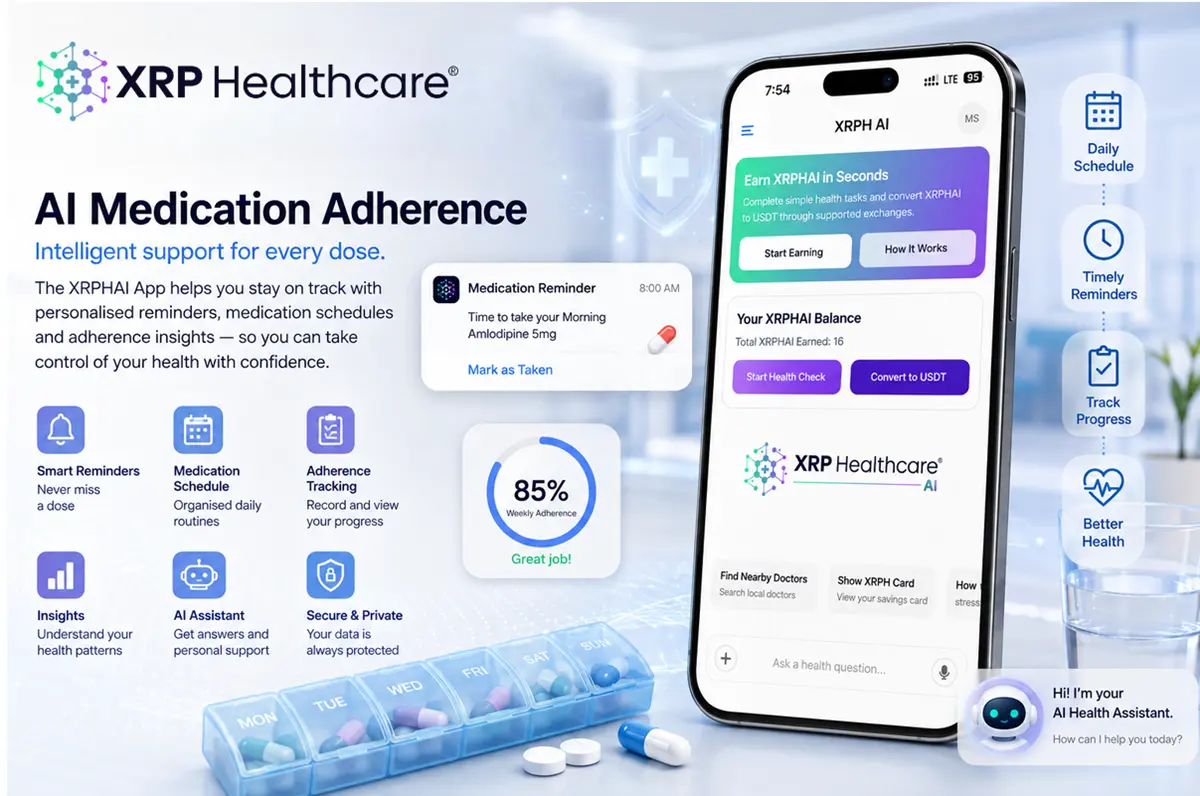
Introduction
Taking medication can sound simple.
Take the right medicine.
Take the right amount.
Take it at the right time.
Repeat according to the prescribed schedule.
But real life is rarely that simple.
People travel.
Schedules change.
Work becomes busy.
A dose may be forgotten.
Several medicines may need to be taken at different times.
Someone may remember that they need to take medication but struggle to remember whether they have already taken it.
These everyday challenges are part of the wider issue of medication adherence.
Digital healthcare technology can help make medication routines easier to organise.
And artificial intelligence creates the possibility of moving beyond a basic alarm toward more personalised adherence support.
The XRPHAI App is being developed around this broader principle: AI healthcare should not simply answer questions. It should help people take useful actions throughout their everyday health journey.
Medication adherence is one important part of that vision.
What Is Medication Adherence?
Medication adherence generally refers to the extent to which someone takes medication according to the agreed or prescribed instructions provided by their healthcare professional.
This can include:
Taking the correct medication
Taking the correct dose
Taking it at the appropriate time
Following the prescribed frequency
Following relevant instructions
Continuing treatment for the recommended period
Adherence is therefore broader than simply remembering that a medication exists.
It involves following the intended treatment routine.
Why Can Medication Adherence Be Difficult?
There is no single reason people may struggle with medication routines.
Different users face different challenges.
These can include:
Forgetfulness
Busy schedules
Travel
Shift work
Multiple medications
Different dosing times
Changes in daily routine
Difficulty keeping track of previous doses
Complicated medication schedules
A person does not necessarily need more medical information.
Sometimes they need better organisation.
This is where digital health tools can become useful.
From Medication Alarm to Medication Assistant
Traditional medication reminders are relatively simple.
At a specified time:
Alarm → Take medication
That can be useful.
But modern digital health technology can potentially create a more intelligent experience.
Instead of simply generating an alarm, a healthcare application can help users manage the wider routine around their medication.
For example:
Medication Schedule
↓
Reminder
↓
User Action
↓
Completion Recorded
↓
Adherence History
↓
Future Support
The objective is not to make decisions for the patient.
It is to help the patient follow the treatment plan already established with their healthcare professional.
What Is AI Medication Adherence?
AI medication adherence describes the use of artificial intelligence and intelligent digital health systems to support people in following medication routines.
Depending on the system and its approved capabilities, this may involve:
Personalised reminders
Medication schedules
Completion tracking
Behavioural patterns
Follow-up prompts
Routine support
Educational information
Adherence insights
The important distinction is that AI should support the routine rather than independently change the treatment.
Why Personalisation Matters
People do not live identical lives.
One user may wake at 6:00 a.m.
Another may work overnight.
One may take one medication each day.
Another may need to manage several prescribed medications.
A generic reminder system treats all these users similarly.
AI creates the possibility of more personalised support.
For example, future systems may learn that a particular reminder time consistently results in missed or delayed acknowledgement.
The application could potentially help the user improve the organisation of their routine.
This should always remain within appropriate safety boundaries.
The XRPHAI App and Medication Adherence
The XRPHAI App brings multiple digital healthcare capabilities into one connected environment.
Medication adherence forms part of this broader health journey.
Rather than treating medication reminders as an isolated utility, adherence can connect with the wider user experience.
That can include:
AI healthcare interaction
Health journeys
Medication organisation
Wellness routines
Health-related engagement
Rewards for eligible actions
Other healthcare tools within the application
This creates a more connected approach to everyday health engagement.
Medication Reminders
One of the most straightforward adherence tools is the medication reminder.
A user may need a reminder:
Once per day
Several times per day
On specific days
Around an established routine
The objective is simple:
Help reduce accidental missed doses.
However, reminders should reflect the medication schedule the user has been instructed to follow.
An AI healthcare application should not independently determine a prescription schedule.
Recording Medication Completion
A reminder becomes more useful when a user can record what happened.
For example:
Reminder received
↓
Medication taken
↓
User confirms completion
↓
Adherence record updated
This can help users answer an everyday question:
“Did I already take this?”
For people managing repeated routines, this can be useful.
The Importance of User Confirmation
A digital application should not automatically assume a medication has been taken simply because a reminder was delivered.
There is an important difference between:
Reminder sent
and
User confirmed completion
The adherence record should reflect that distinction.
This creates more meaningful information for the user.
Medication Adherence and Health Journeys
Medication adherence can also fit naturally within a broader Health Journey.
A health journey may include different actions that help users build more consistent routines.
For example:
Morning
Medication reminder
↓
Afternoon
Wellness activity
↓
Evening
Medication completion or health check-in
↓
Journey Progress
This turns individual actions into a more connected health experience.
Building Healthy Routines
Consistency is often easier when an action becomes part of an established routine.
Digital healthcare applications can support this by helping users connect health actions with regular parts of their day.
Examples might include:
Morning routine
Meal times where relevant to prescribed instructions
Evening routine
Bedtime routine
The application supports organisation.
The healthcare professional remains responsible for clinical guidance.
Medication Adherence and Streaks
Streaks can provide a simple visual representation of consistency.
For example:
Day 1 ✓
Day 2 ✓
Day 3 ✓
Day 4 ✓
This may help some users stay engaged with a routine.
But medication adherence should never become a game in which maintaining a streak is more important than following medical instructions.
If a healthcare professional changes or stops a medication, the digital routine should change accordingly.
Proof of Health™
The broader XRPHAI ecosystem is designed around the concept of Proof of Health™ - recognising eligible health-positive actions and engagement within the application.
Medication adherence can potentially contribute to this broader engagement model where appropriate and where the action qualifies under the application's reward rules.
The important principle is that rewards should encourage responsible engagement.
They should never encourage users to take unnecessary medication or alter prescribed treatment.
XRPHAI Rewards and Healthy Engagement
The XRPHAI ecosystem introduces a different idea into digital health:
rewarding eligible health engagement.
Traditional healthcare applications often ask users to:
Log information
Complete routines
Return regularly
Build healthy habits
but provide little direct recognition for that engagement.
The XRPHAI model is designed to create an additional incentive layer through XRPHAI rewards for eligible activity.
Medication adherence may form part of the wider engagement architecture where applicable.
Rewards Must Never Influence Dosage
This principle is critical.
A user must never receive an incentive to:
Take extra medication
Increase dosage
Take medication unnecessarily
Ignore medical advice
Continue medication after being told to stop
Rewards should recognise eligible adherence-related engagement.
They should never incentivise medication consumption itself.
AI Follow-Up Support
One potential advantage of AI healthcare technology is the ability to support users beyond the initial reminder.
For example, if a user repeatedly fails to acknowledge a reminder, a digital system could potentially encourage them to review their routine.
The system should not conclude why the medication was missed.
There may be many reasons.
Instead, it can help the user identify that the routine may need attention.
Missed Medication Does Not Have One Universal Answer
A common question is:
“I missed my medication. What should I do?”
There is no single safe answer that applies to every medication.
The correct action can depend on:
The medication
Dose
Timing
How long ago the dose was missed
Other medications
Individual circumstances
Users should follow the instructions supplied with their medication and seek guidance from an appropriate pharmacist, doctor or healthcare professional when necessary.
An AI adherence system should not simply tell every user to take a missed dose immediately.
Medication Safety Must Come Before Engagement
Engagement is useful.
Safety is essential.
Any digital medication adherence experience should clearly distinguish between:
Helping organise a prescribed routine
and
Giving instructions that could alter treatment
The first can be valuable digital health support.
The second may require qualified clinical oversight.
Medication Adherence and Medicine Verification
Medication adherence begins with knowing what medication the user is dealing with.
The wider XRPHAI App includes Medicine Verification capabilities designed to help users access useful information about medicines and packaging.
Over time, connections between medicine information and medication-management tools could potentially create a more streamlined experience.
For example:
Identify / Verify Medicine
↓
Review Relevant Information
↓
Medication Routine
↓
Reminder
↓
Completion
↓
Adherence History
Any clinical instructions should still come from appropriate healthcare sources.
Counterfeit Medicine Awareness
Medication adherence assumes the user has access to the correct medicine.
Counterfeit or suspicious medicines create an entirely different safety problem.
Digital tools that help users examine medication information, packaging or relevant identifiers can therefore complement adherence tools.
The two functions solve different problems:
Medicine verification
helps users understand what they have.
Medication adherence
helps users follow the intended routine.
Medication Adherence and Prescription Savings
Cost can also affect whether people consistently access prescribed medication.
The XRPHAI ecosystem includes access to Prescription Savings functionality for eligible users in the United States.
This addresses a different part of the medication journey.
The broader experience can therefore connect:
Medication Access
↓
Prescription Savings
↓
Medication Information
↓
Adherence Support
↓
Ongoing Health Engagement
This is more useful than treating every healthcare feature as an isolated tool.
Connecting Patients With Pharmacies
Pharmacists are an important source of medication guidance.
Digital healthcare applications can help users connect the digital medication journey with real-world healthcare resources.
Where appropriate, this may include helping users identify pharmacies or other healthcare providers.
Technology can make access easier.
It should not remove healthcare professionals from the process.
Medication Adherence and Doctor Finder
Some medication questions require professional medical guidance.
The Doctor Finder capability within the XRPHAI ecosystem can help users locate healthcare professionals where appropriate.
This creates an important escalation pathway.
AI can help with organisation and general information.
Healthcare professionals remain essential when clinical judgement is required.
Voice AI and Medication Routines
Voice interaction may make medication management easier for some users.
Instead of navigating several screens, a user may potentially interact naturally with the healthcare assistant.
For example:
“Show me my medication schedule.”
or
“Have I marked today's medication as completed?”
Voice interfaces can reduce friction, particularly when users are already engaged in another activity.
Any voice-generated medication information should follow the same safety principles as text-based interactions.
Accessibility
Medication-management technology should be usable by as many people as possible.
Accessibility considerations may include:
Clear typography
Simple navigation
Voice interaction
Large touch targets
Understandable language
Multilingual support
Clear reminder states
Good healthcare technology should reduce complexity rather than add to it.
Multilingual Medication Support
Healthcare is global.
Medication information may need to be understood by users across different languages and regions.
AI creates opportunities for multilingual interaction.
However, medication-related translation must be handled carefully.
Ambiguity around:
Dosage
Frequency
Timing
Warnings
can create safety risks.
Clinical instructions should remain grounded in reliable source information.
AI Should Know Its Limits
A trustworthy AI healthcare assistant should not pretend certainty where certainty does not exist.
For medication-related questions, the system may need to recommend professional guidance.
Examples include questions about:
Changing dosage
Stopping medication
Drug interactions
Severe side effects
Allergic reactions
Pregnancy and medication
Overdose
Unexpected symptoms
AI should help users recognise when escalation is appropriate.
Medication Adherence and Privacy
Medication information can be sensitive.
Digital health applications should therefore apply strong privacy principles.
These include:
Data minimisation
Secure transmission
Appropriate access controls
Clear user permissions
Secure authentication
Limiting unnecessary exposure of health-related information
A medication reminder should not create unnecessary privacy risk.
Notification Privacy
Even the wording of a notification matters.
A lock-screen notification may be visible to other people.
Applications should therefore consider whether sensitive medication details need to appear directly in notifications.
Users should have appropriate control over notification settings where supported.
Medication Adherence Analytics
Aggregated adherence information can potentially help users understand their own behaviour.
For example:
Completion consistency
Frequently missed reminder periods
Routine patterns
Journey progress
The purpose should be to help users understand their habits.
It should not create unsupported medical conclusions.
AI and Behavioural Patterns
AI systems can potentially identify patterns that simpler reminder systems cannot.
For example:
A user may consistently acknowledge morning reminders but frequently miss evening reminders.
That pattern could indicate that the evening routine is less consistent.
The system could potentially help the user recognise this.
It should not automatically infer a medical reason.
The Human Role Remains Essential
AI medication adherence technology should strengthen the relationship between people and appropriate healthcare resources.
It should not attempt to replace:
Doctors
Pharmacists
Nurses
Other qualified healthcare professionals
The strongest model is collaborative:
Healthcare professional
provides clinical guidance.
↓
Digital health application
helps organise the routine.
↓
AI
supports engagement and personalisation.
↓
User
remains informed and involved.
From Reactive Healthcare to Everyday Support
Traditional healthcare often becomes most visible when something goes wrong.
AI healthcare applications create an opportunity to support users between healthcare encounters.
Medication adherence is a good example.
The user does not necessarily need a doctor every morning to remind them about an established routine.
But they may benefit from digital support that helps them stay organised.
This is where AI can add practical everyday value.
The XRPHAI Connected Health Loop
Medication adherence becomes more powerful when connected to the wider XRPHAI experience.
A simplified journey could become:
AI Healthcare Assistant
↓
Medication / Health Action
↓
User Completion
↓
Health Journey Progress
↓
Proof of Health™
↓
Eligible XRPHAI Reward
↓
Continued Engagement
The objective is to create a healthier engagement loop rather than a collection of disconnected healthcare tools.
AI Medication Adherence and Personalised Healthcare
The longer-term potential of AI healthcare lies in personalisation.
Not personalisation that independently changes medical treatment.
But personalisation that makes health-support tools more relevant to the individual.
This may include:
Preferred interaction method
Reminder preferences
Routine patterns
Language
Accessibility settings
Relevant health journeys
Engagement preferences
The same healthcare application can therefore become more useful to different people without pretending that everyone has identical needs.
What AI Medication Adherence Should Not Do
Responsible systems need clear boundaries.
AI medication adherence should not independently:
Prescribe medication
Change dosage
Stop medication
Diagnose a condition
Override a doctor or pharmacist
Recommend taking extra doses to preserve a streak
Reward unnecessary medication consumption
Present uncertain information as clinical fact
These boundaries increase trust.
The Future of AI Medication Adherence
Medication adherence is likely to evolve beyond static reminders.
Future digital health experiences may increasingly combine:
AI personalisation
Voice interaction
Medication schedules
Health journeys
Wearable data where appropriate
Pharmacy connectivity
Prescription support
Behavioural insights
Multilingual assistance
Responsible rewards
The goal should remain practical:
Help people manage their established healthcare routines more effectively.
Why Connected Healthcare Matters
The greatest opportunity is not necessarily another standalone medication reminder application.
It is connecting adherence to a broader healthcare experience.
Within XRPHAI, that broader environment can bring together capabilities such as:
AI healthcare assistance
Medication adherence
Medicine Verification
Prescription Savings
Doctor Finder
Health Journeys
CalmXRPH
Proof of Health™
XRPHAI rewards
The value comes from the connections between these capabilities.
A health action can lead naturally to the next useful action.
Conclusion
Medication adherence is one of the clearest examples of how AI can support everyday healthcare without attempting to replace healthcare professionals.
People may struggle with medication routines because of forgetfulness, complex schedules, travel or changes in everyday life.
Digital reminders can help.
But AI creates the possibility of a more personalised and connected experience.
Within the XRPHAI App, medication adherence can form part of a wider health journey that connects medication organisation, healthcare information, professional healthcare access, wellness engagement, Proof of Health™ and eligible XRPHAI rewards.
The principle must remain clear:
AI supports the routine.
Healthcare professionals provide clinical guidance.
The user remains in control.
That combination can help transform medication adherence from a simple alarm into part of a more intelligent, connected and supportive digital healthcare experience.
FAQ
What is AI medication adherence?
AI medication adherence uses artificial intelligence and digital health technology to help users organise established medication routines, receive reminders, record completion and understand adherence patterns.
How can AI help people remember medication?
AI-enabled systems can support medication schedules, reminders, completion tracking and personalised engagement based on user preferences and routine patterns.
Can AI decide when I should take medication?
AI medication-adherence tools should support the schedule established through appropriate medical guidance rather than independently prescribing or changing when medication should be taken.
What should I do if I miss a medication dose?
There is no universal answer for every medication. Follow the instructions provided with your medication and seek guidance from an appropriate pharmacist, doctor or healthcare professional when necessary.
Can AI change my medication dosage?
No. Users should not change, stop or increase medication based solely on an AI application. Medication changes should be discussed with an appropriate healthcare professional.
How does medication adherence fit into the XRPHAI App?
Medication adherence can form part of the broader XRPHAI health experience alongside AI healthcare support, Health Journeys, Medicine Verification, Doctor Finder, Prescription Savings, Proof of Health™ and eligible rewards.
Can medication adherence contribute to Proof of Health™?
Eligible adherence-related engagement may contribute to the broader Proof of Health™ framework where supported by the application's rules.
Can users receive XRPHAI rewards for medication adherence?
Eligible health engagement may qualify for XRPHAI rewards where supported. Rewards should recognise responsible engagement and must never encourage users to take unnecessary medication or alter prescribed treatment.
Does the XRPHAI App replace a doctor or pharmacist?
No. XRPHAI provides digital health, informational, organisational and wellness support. Doctors, pharmacists and other qualified healthcare professionals remain essential for diagnosis, treatment and medication decisions.