Introduction
A free healthcare user does not automatically become a paying subscriber.
They need a reason.
That reason should not be:
“Because the app wants more revenue.”
It should be:
“Because the premium version now provides value that matters to me.”
This distinction is fundamental.
Digital health platforms often attract users through free healthcare tools.
Those tools create the first layer of trust.
The challenge comes later:
How do you convert an engaged free user into a paying subscriber without making the experience feel manipulative?
This is where AI premium conversion in healthcare can help.
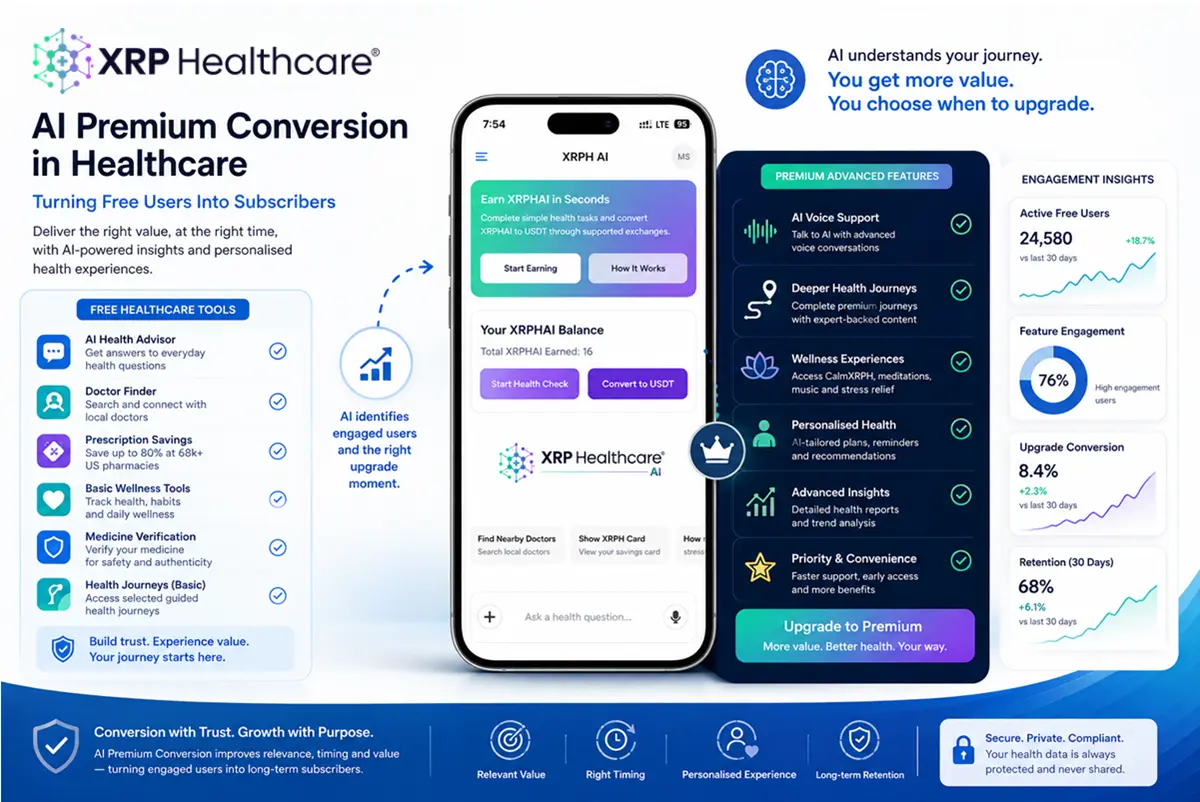
Artificial intelligence can potentially identify when a user has experienced enough value, which premium features may be relevant and when an upgrade opportunity is most appropriate.
Within the XRPHAI App, premium conversion can sit between engagement and long-term retention.
The sequence becomes:
Useful Free Experience
↓
Repeated Engagement
↓
Relevant Premium Value
↓
Transparent Upgrade Opportunity
↓
Premium Subscription
The objective is not to force conversion.
It is to make the upgrade decision easier to understand.
---
What Is AI Premium Conversion in Healthcare?
AI premium conversion in healthcare uses artificial intelligence and behavioural insights to improve the transition from free digital health usage to paid subscription services.
This may include understanding:
Which features a user engages with
How often they return
Which Health Journeys they complete
Which premium features are relevant
When an upgrade prompt may be useful
Which subscription benefits should be explained
Whether the user is likely to churn after conversion
The purpose is to improve relevance.
---
Premium Conversion Is Different From Revenue Optimisation
Blog 23 introduced AI Revenue Optimisation in Healthcare.
The two concepts are related but distinct.
Revenue Optimisation Agent
Looks broadly across:
subscriptions
partner services
retention
referrals
enterprise opportunities
other commercial pathways
Premium Conversion Agent
Focuses specifically on:
How do we help the right free user understand the value of becoming a premium subscriber?
This narrower focus allows more specialised optimisation.
---
Premium Conversion Starts With Product Value
A user should not need to pay before understanding why the app is useful.
The strongest conversion path is:
Free Value
↓
User Achieves Something Useful
↓
Trust Develops
↓
Need for More Advanced Functionality Emerges
↓
Premium Value Is Explained
↓
User Decides
Conversion becomes a natural progression.
---
Free Users Need a Complete Experience
A common mistake in subscription products is making the free experience deliberately frustrating.
Healthcare is not the right environment for that approach.
Free users should still receive genuine utility.
Examples may include access to:
AI healthcare interaction
core health information
Doctor Finder
Prescription Savings
selected wellness tools
selected Health Journey functionality
medication support
Medicine Verification
other currently available free features
Premium should expand value.
It should not make basic healthcare support artificially unusable.
---
What Should Premium Mean?
A premium healthcare subscription needs a clear value proposition.
Potential premium value may include, where available:
More advanced AI functionality
Increased voice access
Deeper personalisation
Expanded Health Journeys
Enhanced wellness experiences
Additional CalmXRPH functionality
Advanced insights
Greater convenience
Other premium features officially available in the app
The key question is:
What does the user gain by upgrading?
If that answer is unclear, conversion will remain difficult.
---
The Premium Conversion Agent
Within the future XRPHAI agent architecture, the Premium Conversion Agent is designed to focus on the free-to-paid user journey.
Its potential responsibilities include:
Identifying users who have experienced strong product value
Understanding which premium feature is most relevant
Selecting the right upgrade moment
Personalising premium messaging
Reducing conversion friction
Supporting trial experiences where applicable
Improving post-conversion retention
Learning which upgrade pathways perform best
The agent should optimise the experience around relevance.
---
Who Should See an Upgrade Prompt?
Not every user should receive the same upgrade prompt at the same time.
Potential signals could include:
Frequent app usage
Repeated AI Health Advisor interaction
Health Journey completion
Strong CalmXRPH engagement
Voice feature interest
Repeated use of a free feature with a relevant premium extension
High retention
These signals may indicate that premium value is easier for the user to understand.
---
First-Session Paywalls Can Damage Trust
A new user may not yet understand the platform.
If they immediately encounter aggressive upgrade prompts, they may leave before experiencing healthcare value.
A stronger sequence is:
Onboarding
↓
First Useful Action
↓
Second Useful Action
↓
Habit / Engagement Begins
↓
Premium Opportunity
This gives the user context.
---
Contextual Premium Conversion
The best upgrade prompt may depend on what the user is doing.
For example:
A user actively using CalmXRPH may be more interested in additional wellness experiences.
A user frequently using Voice AI may care about expanded voice interaction.
A user completing several Health Journeys may value deeper personalisation or additional journey functionality.
The premium message should reflect the current context.
---
Generic Upgrade Prompt
A generic prompt might say:
Upgrade to Premium.
The user still has to ask:
Why?
---
Contextual Upgrade Prompt
A stronger prompt might say:
You have completed several Health Journey activities. Premium includes additional personalised experiences where available.
The value proposition is clearer.
The user understands why the subscription may matter.
---
Timing Is Part of Conversion
A good offer at the wrong time can still fail.
Potentially useful conversion moments include:
After a valuable interaction
After completing a Health Journey milestone
When requesting a premium-only feature
After repeated engagement
When the user actively explores advanced functionality
Poor timing might include:
During a stressful health query
Before the user experiences any value
While the user is trying to access urgent healthcare information
Repeatedly after the user has declined
Healthcare conversion should respect context.
---
Do Not Monetise Moments of Fear
A user may open a healthcare app because they are anxious.
They may be trying to understand:
symptoms
medication
side effects
a potential health concern
This is not the moment for an aggressive premium upsell.
Commercial systems should avoid exploiting uncertainty or fear.
Critical healthcare information should not be withheld simply to improve subscription conversion.
---
Premium Conversion and AI Healthcare Personalisation
AI personalisation can strengthen conversion.
A platform may understand that one user values:
wellness
while another values:
medication organisation
and another values:
AI health conversations
The upgrade experience can therefore highlight different premium benefits.
This makes the subscription more relevant.
---
Premium Conversion and Health Journeys
Health Journeys are particularly valuable because they create sustained interaction.
A user who completes several journey activities has already demonstrated engagement.
Potential premium messaging may focus on:
deeper journey personalisation
more journey options
advanced progress insights
expanded wellness activities
where those benefits are available.
---
Premium Conversion and CalmXRPH
CalmXRPH can create a clear wellness-related premium pathway.
Free users may begin with lightweight sessions.
Premium functionality could potentially extend the experience through:
more affirmation categories
additional soundscapes
longer sessions
additional voice choices
personalised experiences
advanced guided sessions
Only features actually available should be described as live.
---
Voice AI and Premium Conversion
Voice interaction can be another strong premium differentiator.
A user who repeatedly uses or attempts to access voice functionality may already understand its value.
A contextual upgrade message can therefore explain relevant premium voice benefits.
The experience should remain transparent.
Users should understand:
whether voice is limited
what premium adds
how much it costs
---
Premium Conversion and AI Health Insights
Users who regularly review health summaries, insights or journey progress may value deeper analysis.
Where advanced insights form part of premium functionality, they can become a relevant conversion pathway.
The platform should not imply that premium AI produces clinically superior diagnosis.
Premium should mean better product experience, not medically superior truth.
---
Premium Healthcare Must Not Create a Clinical Hierarchy
A free user should never receive the impression:
Free AI = unsafe or inferior clinical care
while:
Premium AI = medically correct
Healthcare safety standards should remain consistent.
Premium can add:
convenience
personalisation
usage
advanced tools
experience
but should not create misleading claims of superior diagnosis or treatment.
---
Trial Experiences
Trials can help users understand premium value before committing.
Potential models may include:
limited-time premium trial
feature-specific trial
temporary access after a milestone
Trials should clearly explain:
duration
price after the trial
cancellation
which features are included
Transparency is essential.
---
Free-to-Paid Conversion Funnel
A healthy premium funnel may look like:
App Install
↓
Onboarding
↓
First Useful Healthcare Action
↓
Repeat Engagement
↓
Feature Discovery
↓
Premium-Relevant Behaviour
↓
Contextual Upgrade Prompt
↓
Premium Subscription
↓
Ongoing Premium Value
↓
Retention
Each stage affects the next.
---
Conversion Rate Is Not the Only Metric
The obvious premium metric is:
Free-to-paid conversion rate
But this alone is not enough.
A platform should also track:
Subscription retention
Trial-to-paid conversion
Cancellation rate
Refunds
Premium feature usage
Time to conversion
User satisfaction
Support complaints
A high conversion rate followed by high churn suggests a problem.
---
The Importance of Post-Conversion Value
Premium conversion is not the end of the journey.
It is the beginning of a paid relationship.
The user must continue receiving value.
Otherwise:
Conversion
↓
Disappointment
↓
Cancellation
This damages lifetime value.
---
The Premium Conversion Agent Should Also Care About Retention
A good conversion agent should not optimise only for the payment event.
It should consider whether users remain satisfied afterwards.
For example, an aggressive message may increase subscriptions temporarily.
But if those users cancel quickly, the approach may be counterproductive.
---
Premium Conversion and Reactivation
The Reactivation Agent can also help return users who were previously engaged but never upgraded.
However, the sequence matters.
A reactivated user should first receive:
Useful return value
before:
Premium conversion pressure
The correct sequence is:
Reactivation
↓
Useful Engagement Restored
↓
Premium Value Reintroduced Where Relevant
---
Premium Conversion and Revenue Optimisation
The relationship between the three commercial agents becomes:
Reactivation Agent
Brings inactive users back.
↓
Revenue Optimisation Agent
Identifies where commercial value and user value align.
↓
Premium Conversion Agent
Optimises the actual free-to-paid journey.
This creates specialised commercial intelligence rather than one agent trying to do everything.
---
Premium Conversion and Referral Growth
Premium users can potentially become strong advocates.
A user who is satisfied with the product may be more likely to:
refer friends
share the app
become an ambassador
create positive word of mouth
This connects Premium Conversion with the future AI Referral & Ambassador Agent.
Referral should follow value.
---
Premium Conversion and XRPHAI Rewards
Rewards may contribute to overall engagement.
However, premium subscriptions and XRPHAI rewards should remain separate concepts.
Users should not be told:
Subscribe to earn guaranteed tokens.
or:
Premium membership guarantees greater financial returns.
Instead, premium value should be based on app features and user experience.
Eligible rewards remain governed by separate engagement rules.
---
Proof of Health™ and Premium
Proof of Health™ recognises eligible health-positive engagement where supported.
Premium may enhance the surrounding user experience.
But basic health-positive actions should not be artificially distorted simply to drive subscription conversion.
The health behaviour remains primary.
---
Premium Conversion and Doctor Finder
Doctor Finder should remain useful as a healthcare access tool.
If premium functionality is ever associated with provider discovery, it must not create misleading clinical ranking.
A premium user should not receive a provider labelled as medically superior simply because of subscription status.
---
Premium Conversion and Prescription Savings
Prescription Savings represents direct practical user value.
This type of utility can strengthen the overall perception of the XRPHAI ecosystem.
However, subscription messaging should accurately distinguish:
free functionality
premium functionality
partner-powered services
Users should understand what they are paying for.
---
Pricing Transparency
A premium offer should clearly show:
Subscription price
Billing period
Whether renewal is automatic
Trial terms
Cancellation terms
Included features
Hidden pricing creates friction and distrust.
---
Cancellation Should Be Clear
Sustainable subscription businesses do not need to trap users.
Users should be able to understand how to cancel their subscription according to applicable platform and payment rules.
The objective should be:
retain users because they receive value
not:
retain users because cancellation is difficult.
---
Avoid Dark Patterns
Premium conversion should not use:
Hidden cancellation
Fake urgency
False countdowns
Misleading button hierarchy
Preselected paid options without clarity
Confusing billing language
Fear-based health claims
Repeated unavoidable pop-ups
These tactics may improve short-term conversion but damage long-term trust.
---
Upgrade Prompt Frequency
Users who repeatedly decline premium offers should not be shown the same prompt constantly.
A good system should potentially adjust:
frequency
timing
message type
feature context
The user should remain in control.
---
AI Can Learn Which Premium Benefits Matter
Different premium benefits may drive conversion for different users.
Potential value themes include:
convenience
voice interaction
deeper personalisation
wellness
journey support
advanced insights
AI can potentially identify which value proposition resonates most strongly with each segment.
---
User Segmentation
Potential premium conversion segments may include:
New free users
Highly engaged free users
Health Journey users
CalmXRPH users
Voice AI users
Medication support users
Reactivated users
Former premium users
Each group may require a different experience.
---
Reactivated Users
A reactivated user may already understand the platform.
But they may have left because:
value was unclear
they became busy
they did not need the app temporarily
they never discovered premium features
AI can potentially tailor the next premium opportunity around the new context.
---
Former Premium Users
Former subscribers may require a win-back approach rather than a first-time conversion journey.
Possible value-led messages might include:
new features
improved personalisation
expanded Health Journeys
new wellness experiences
where those changes are genuinely live.
Do not invent product updates solely for conversion.
---
Premium Conversion and User Lifetime Value
The goal should not be the largest possible number of immediate upgrades.
A stronger objective is:
high-quality premium users who stay because the product consistently helps them.
Long-term subscription retention often creates more value than one-month conversions.
---
Premium Conversion and Trust
Healthcare users may be particularly sensitive to commercial intent.
The platform should clearly distinguish:
healthcare guidance
free features
premium features
sponsored services
partner offers
Users should never wonder whether a recommendation exists because it is medically useful or because it generates revenue.
---
Commercial Intelligence Must Stay Separate From Clinical Intelligence
The Premium Conversion Agent should understand:
engagement
subscription behaviour
premium feature relevance
It should not determine:
diagnosis
medication
treatment
emergency guidance
clinical risk
Commercial and clinical reasoning must remain separated.
---
Privacy and Premium Conversion
Personalised conversion may rely on behavioural information.
This should be handled carefully.
A system may need to know that a user:
frequently uses CalmXRPH
to show relevant premium wellness benefits.
It does not necessarily need detailed medical history.
Use the minimum information required.
---
Sensitive Health Data Should Not Become Sales Data
A healthcare platform should not exploit sensitive health information to create pressure.
For example:
“Your health condition means you should upgrade now.”
would be inappropriate.
Commercial personalisation should remain grounded in product engagement rather than fear.
---
A/B Testing Premium Conversion
A digital health platform can test different subscription experiences.
Potential experiments may include:
Upgrade timing
Feature descriptions
Trial length
Page layout
CTA wording
But tests should never remove important medical disclaimers or safety information simply because doing so improves conversion.
---
Measuring Quality of Conversion
A strong premium conversion strategy should track both commercial and experience metrics.
Commercial:
Conversion rate
Revenue
Retention
Churn
Lifetime value
Experience:
Feature usage
Satisfaction
Support tickets
Refunds
Cancellation reasons
App engagement
This creates a more complete picture.
---
The Premium Conversion Flywheel
A sustainable premium loop can be:
Useful Free Experience
↓
User Trust
↓
Personalised Feature Discovery
↓
Relevant Premium Opportunity
↓
Subscription
↓
Useful Premium Experience
↓
Retention
↓
Referral / Advocacy
↓
More Users
Premium conversion works best when each stage reinforces the next.
---
Premium Conversion and the Wider Agent System
The broader XRPHAI commercial-agent architecture can be understood as:
Reactivation Agent
Brings inactive users back.
Revenue Optimisation Agent
Identifies where revenue opportunities align with user value.
Premium Conversion Agent
Optimises the free-to-paid experience.
AI Referral & Ambassador Agent
Supports user-led growth.
Partner Marketplace Agent
Matches users with relevant partner services.
Enterprise Agent
Supports institutional opportunities.
Advertiser Agent
Manages appropriate commercial advertising.
Each has a different objective.
---
The Premium Conversion Agent Should Not Act Alone
The strongest system will coordinate across agents.
For example:
A user returns through the Reactivation Agent.
The Revenue Optimisation Agent identifies premium potential.
The Premium Conversion Agent presents a relevant upgrade.
Later, a satisfied premium user may enter the Referral & Ambassador journey.
This creates a coordinated lifecycle.
---
The XRPHAI Premium Conversion Loop
A simplified ecosystem flow could be:
Free XRPHAI User
↓
Useful AI Healthcare Experience
↓
Health Journey / CalmXRPH / Voice / Other Feature
↓
Repeated Engagement
↓
Relevant Premium Value Identified
↓
Contextual Premium Offer
↓
User Chooses to Subscribe
↓
Ongoing Premium Value
↓
Retention
↓
Referral / Continued Ecosystem Engagement
The user should always remain free to decline.
---
The Future of AI Premium Conversion in Healthcare
Future premium-conversion systems may become increasingly sophisticated.
Potential capabilities include:
Predicting premium readiness
Personalised upgrade timing
Feature-specific offers
Dynamic trial experiences
Churn-aware conversion
Intelligent win-back campaigns
More personalised subscription journeys
Any XRPHAI-specific capabilities should only be described as live once officially implemented.
---
Premium Conversion Should Feel Like Progress
The ideal premium experience should not feel like:
“The free app stopped working, so now I have to pay.”
It should feel like:
“I am getting value from this platform, and premium gives me more of what I already find useful.”
That distinction can determine whether conversion strengthens or damages trust.
---
Conclusion
AI premium conversion can help digital healthcare platforms turn engaged free users into paying subscribers through relevance rather than pressure.
Within the XRPHAI App, premium conversion can potentially build on:
AI healthcare engagement
Health Journeys
CalmXRPH
Voice AI
personalisation
Health Insights
reactivation
Proof of Health™
wider ecosystem participation
The future Premium Conversion Agent can focus specifically on identifying the right user, the right premium value proposition and the right moment to present it.
But the principles must remain clear.
Free users should still receive meaningful value.
Premium benefits should be transparent.
Users should be able to decline or cancel without manipulation.
Commercial optimisation should never influence clinical guidance.
When those boundaries are respected, premium conversion can become a natural progression from healthcare value to sustainable digital health growth.
FAQ
What is AI premium conversion in healthcare?
AI premium conversion in healthcare uses artificial intelligence and behavioural insights to help digital health platforms present relevant paid subscription opportunities after users have experienced value from the free product.
How is premium conversion different from revenue optimisation?
Revenue optimisation covers the wider commercial model, including subscriptions, partners, retention and other revenue pathways. Premium conversion focuses specifically on converting suitable free users into paying subscribers.
What is the XRPHAI Premium Conversion Agent?
The Premium Conversion Agent is part of the future XRPHAI agent architecture designed to improve the free-to-paid subscription journey through better timing, personalisation and premium feature relevance.
How can AI improve healthcare subscription conversion?
AI can potentially identify which premium benefits matter to a user, determine more appropriate upgrade moments and personalise how premium value is explained.
Should free users still receive meaningful healthcare value?
Yes. Premium should expand the product experience rather than make core free healthcare support intentionally frustrating or unsafe.
Can premium users receive medically superior AI guidance?
Premium status should not determine the safety or clinical accuracy of healthcare information. Paid features may provide additional functionality, convenience, personalisation or usage, but commercial status should remain separate from medical guidance.
How should healthcare app trials be presented?
Trials should clearly disclose their duration, what features are included, the price after the trial, whether renewal is automatic and how users can cancel.
Can AI use sensitive health information to pressure users to upgrade?
No. Health anxiety, diagnoses or sensitive medical information should not be exploited to pressure users into purchasing a subscription.
How does reactivation relate to premium conversion?
Reactivation helps inactive users return to useful engagement. Premium conversion should only follow later where a relevant paid benefit becomes useful to the reactivated user.
How do XRPHAI rewards relate to premium subscriptions?
XRPHAI rewards and premium subscriptions are separate layers. Premium should be sold based on product value, while eligible rewards follow the application's separate engagement rules.