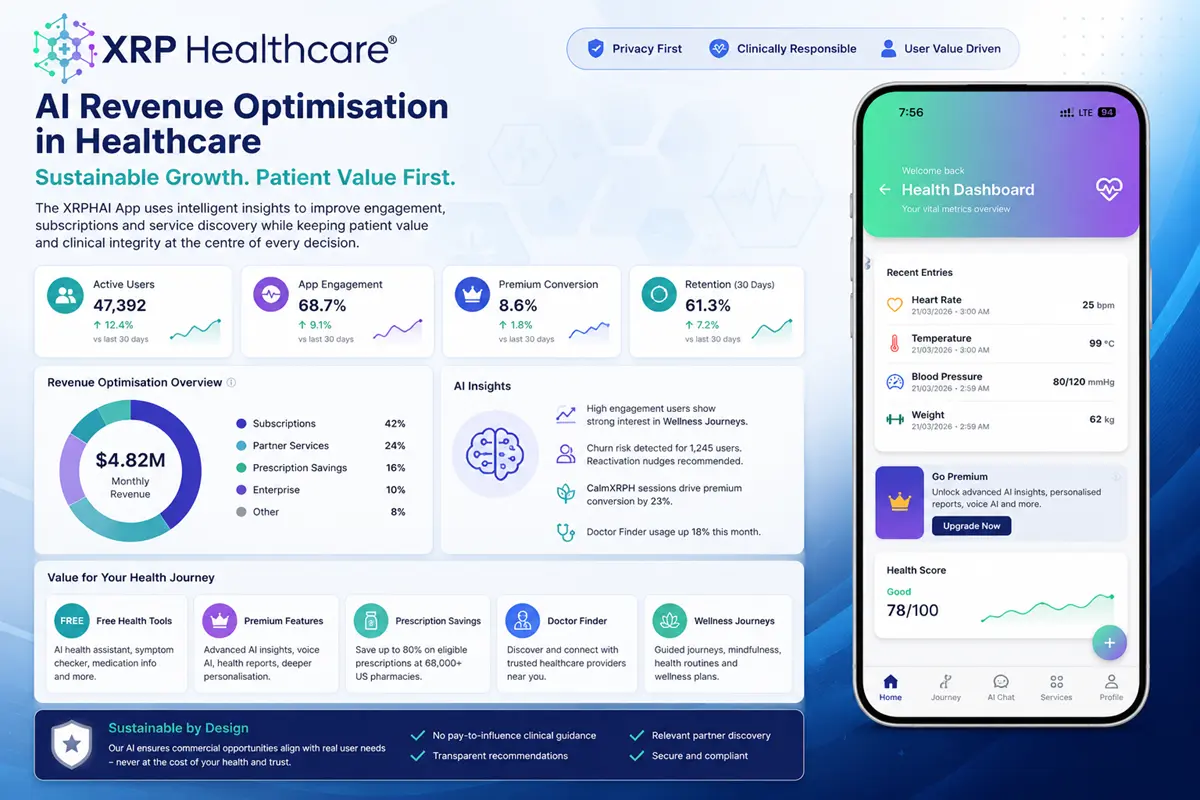
Introduction
Healthcare technology needs sustainable economics.
Building an AI healthcare application requires ongoing investment in:
Artificial intelligence
Infrastructure
Security
Product development
Customer support
Compliance
Data services
User acquisition
Healthcare partnerships
A digital health platform that creates genuine patient value but cannot support its own operating costs may struggle to scale.
At the same time, healthcare is not an ordinary consumer category.
Users may be vulnerable.
Health decisions can have real consequences.
This means monetisation must be designed differently.
The objective should not be to maximise revenue from every interaction.
It should be to create a sustainable business model around healthcare experiences that users genuinely value.
This is where AI revenue optimisation in healthcare becomes important.
Within the XRPHAI App, intelligent systems can potentially help identify the most relevant opportunities for premium conversion, healthcare services, partner discovery and continued engagement while maintaining a clear separation between commercial optimisation and clinical guidance.
The principle is simple:
Create value first. Monetise relevance second.
What Is AI Revenue Optimisation in Healthcare?
AI revenue optimisation in healthcare uses artificial intelligence and behavioural data to improve how a digital health platform generates sustainable revenue.
This can involve understanding:
Which features users value
Which users may benefit from premium services
Which healthcare services are relevant
Which users are likely to disengage
Which subscription experiences create value
Which partner offers are useful
Which journeys improve long-term engagement
The purpose is not simply to increase prices or show more promotions.
It is to align commercial opportunities with genuine user needs.
Why Revenue Optimisation Matters
Digital healthcare platforms have significant operating costs.
They may need to fund:
AI inference
Software engineering
Clinical content
Infrastructure
Security
Customer support
Marketing
Regulatory work
Partnerships
Revenue helps sustain these services.
However, poor monetisation can damage trust.
Examples include:
Excessive advertising
Irrelevant upselling
Confusing subscriptions
Hiding useful healthcare features behind unnecessary paywalls
Commercial recommendations presented as medical guidance
Responsible revenue optimisation avoids these mistakes.
Healthcare Monetisation Is Different From Ordinary E-Commerce
In retail, an optimisation system might simply ask:
What is most likely to make this person buy?
Healthcare requires a different question:
What is genuinely useful to this person, and is there an appropriate commercial service connected to that need?
That distinction matters.
A healthcare platform should never recommend unnecessary services purely because they generate more revenue.
Patient value and safety remain the priority.
The Revenue Optimisation Agent
Within the future XRPHAI agent architecture, the Revenue Optimisation Agent is designed to focus on improving the economics of the platform.
Its role can potentially include:
Understanding user engagement
Identifying relevant premium opportunities
Improving subscription retention
Surfacing valuable partner services
Supporting reactivation
Improving feature discovery
Analysing conversion pathways
Reducing unnecessary friction
The agent should optimise the commercial journey around the user.
It should not influence clinical judgement.
Revenue Optimisation Starts With Engagement
A user who receives no value from a healthcare app is unlikely to pay for it.
This makes engagement the foundation of monetisation.
A simplified relationship is:
Useful Healthcare Experience
↓
Repeated Engagement
↓
Trust
↓
Feature Discovery
↓
Premium Value Becomes Clear
↓
Conversion Opportunity
Revenue becomes a consequence of value.
The Relationship Between Reactivation and Revenue
Blog 22 introduced the Reactivation Agent.
Reactivation and revenue optimisation are closely connected.
A user who stops opening the app cannot:
Continue Health Journeys
Discover premium features
Use partner services
Renew a subscription
Generate referral value
Reactivation helps restore the relationship.
Revenue optimisation then helps identify which relevant services may provide additional value.
The sequence is:
Reactivation
↓
Useful Engagement
↓
Value Discovery
↓
Appropriate Revenue Opportunity
This is stronger than trying to monetise an inactive user immediately.
Free Value Must Remain Strong
A successful healthcare platform should provide meaningful value before asking users to upgrade.
Free functionality may help users:
Ask health questions
Explore healthcare tools
Find doctors
Access prescription savings
Build health routines
Explore medication information
Participate in health journeys
The free experience establishes trust.
Premium services should expand the experience rather than make the free version intentionally frustrating.
Premium Should Mean More Value
A premium subscription should answer:
What additional value does the user receive?
Potential premium value may include:
More advanced AI functionality
Expanded voice usage
Deeper personalisation
Additional health journey capabilities
Enhanced analytics
Additional wellness experiences
Other premium features officially available within the app
Premium conversion works best when the difference is clear.
AI Can Improve Premium Discovery
Users may not know every feature available inside an application.
AI can potentially surface relevant premium functionality based on context.
For example, if a user regularly interacts with a particular health feature, the system may explain an advanced premium capability related to that experience.
This is more useful than showing the same upgrade banner to everyone.
Contextual Upgrade Prompts
Timing matters.
Consider two approaches.
Generic Prompt
Upgrade to Premium now.
This appears regardless of what the user is doing.
Contextual Prompt
You have completed several Health Journey activities. Premium includes additional personalised journey features where available.
The second prompt explains relevance.
The user understands why the upgrade may matter.
Revenue Optimisation and Personalisation
AI healthcare personalisation can improve monetisation because different users value different features.
One person may care most about:
Voice AI
Another:
Medication support
Another:
Wellness Journeys
Another:
Doctor Finder
Another:
Prescription Savings
A personalised platform can surface the most relevant value proposition rather than treating every user identically.
Subscription Conversion
Subscriptions can provide predictable recurring revenue.
However, subscription growth requires more than placing a paywall in front of the user.
Users need to understand:
What they receive
Why it is useful
What it costs
How to cancel
Which features remain free
Transparency strengthens trust.
Subscription Retention Is as Important as Conversion
Getting a user to subscribe once is not enough.
The platform needs to continue delivering value.
A healthy subscription lifecycle looks like:
Premium Conversion
↓
Useful Premium Experience
↓
Repeated Value
↓
Retention
↓
Renewal
If users subscribe and quickly cancel, conversion numbers alone can be misleading.
AI Can Identify Churn Risk
AI can potentially help identify patterns associated with declining engagement.
For example:
Fewer app sessions
Reduced use of premium features
Abandoned Health Journeys
Lower interaction frequency
These signals may indicate that the user is receiving less value.
The correct response should not automatically be another sales message.
The system may instead help the user rediscover a useful feature.
Revenue Optimisation and Health Journeys
Health Journeys can create sustained engagement over multiple days.
This makes them strategically important.
A user participating in a 7-, 14- or 30-day journey has a reason to return.
That continued engagement can support:
Feature discovery
Premium awareness
Wellness activity
Proof of Health™
Eligible XRPHAI rewards
Retention
Health value remains the primary purpose.
Commercial value emerges from stronger engagement.
CalmXRPH and Premium Wellness
CalmXRPH can potentially become an important premium-value layer.
The broader CalmXRPH vision can include experiences such as:
Affirmations
Guided breathing
Mindfulness
Relaxation
Soundscapes
Personalised sessions
Different durations
Voice options
Some functionality may remain free while deeper experiences can potentially support premium monetisation.
Any premium structure should reflect actual live functionality.
Voice AI as Premium Value
Voice interaction can significantly change the healthcare app experience.
Typing a healthcare question requires active screen interaction.
Voice can make the experience more natural.
Potential premium value may include:
Expanded voice interaction
Longer voice sessions
More advanced voice guidance
Additional personalisation
Again, only confirmed live features should be described as currently available.
Doctor Finder and Commercial Value
Doctor Finder primarily exists to help users access healthcare professionals.
That core purpose should remain clear.
However, provider discovery can also create future partnership or referral opportunities where legally and ethically appropriate.
Commercial relationships must never distort healthcare recommendations.
Providers should not be presented as clinically superior simply because of a commercial agreement.
Prescription Savings
Prescription Savings demonstrates how healthcare utility and business value can coexist.
Users receive potential savings on eligible prescriptions in the United States.
The platform creates a useful healthcare service.
Commercial sustainability can then emerge from the underlying partnership model.
The important principle is alignment:
The user receives value.
The platform can generate value.
This is stronger than monetisation that adds no healthcare benefit.
Partner Marketplace Opportunities
A future Partner Marketplace Agent can create another revenue layer.
Potential categories could include:
Healthcare services
Wellness products
Telemedicine
Pharmacy services
Insurance-related services
Healthcare memberships
Other approved partner offerings
The agent should prioritise relevance.
It should not simply display whichever partner pays the highest commission.
Relevance Before Commission
This principle should be fundamental.
Imagine two services:
Service A
Pays a larger commission but has little relevance to the user.
Service B
Pays a smaller commission but closely matches the user's expressed need.
A responsible healthcare recommendation system should prioritise relevance and user benefit.
Commercial incentives should not distort health-related guidance.
Sponsored Content Must Be Clear
If a recommendation is sponsored or commercially influenced, users should be able to understand that.
Transparency may include labels such as:
Sponsored
Partner
Advertisement
Commercial offer
The exact terminology should comply with applicable rules.
Users should never be misled into believing a paid placement is an independent clinical recommendation.
Advertising and Healthcare
Advertising may eventually represent another revenue channel.
However, healthcare advertising requires careful controls.
The platform should avoid:
Misleading claims
Unsafe health products
Manipulative targeting
Commercial content disguised as medical advice
Inappropriate use of sensitive health information
Revenue does not justify reducing trust.
The Advertiser Agent
Within the longer-term XRPHAI architecture, an Advertiser Agent can potentially manage appropriate advertising opportunities.
Its responsibilities could include:
Campaign suitability
Placement relevance
User experience
Category restrictions
Performance
Disclosure
The Advertiser Agent should operate under clear safety and privacy rules.
Enterprise Revenue
Consumer subscriptions are only one revenue model.
A healthcare platform may also generate enterprise revenue.
Potential enterprise opportunities can include:
Healthcare organisations
Employers
Insurance partners
Pharmacy networks
Healthcare providers
Wellness programmes
Other institutional partners
The future Enterprise Agent can help support this side of the ecosystem.
B2C and B2B Revenue Can Coexist
A diversified digital healthcare business can potentially include:
B2C
Premium subscriptions
Partner services
Digital health services
B2B
Enterprise relationships
Healthcare partnerships
Institutional programmes
Platform integrations
A diversified model can reduce dependence on a single revenue source.
Referral and Ambassador Revenue
The future AI Referral & Ambassador Agent can help expand the platform through user and partner referrals.
Referral systems may support:
User acquisition
Ambassador programmes
Influencer partnerships
Community growth
The system should protect against abuse and misleading healthcare promotion.
Revenue Optimisation and Referrals
AI can potentially identify users who are genuinely engaged and may be appropriate candidates for referral programmes.
This is stronger than asking every new user immediately to invite friends.
The progression becomes:
User Receives Value
↓
User Becomes Engaged
↓
User Understands Platform
↓
Referral Opportunity
This improves authenticity.
XRPHAI Rewards and Monetisation
XRPHAI rewards can strengthen the engagement loop.
Eligible health-positive actions may provide rewards.
These rewards can help encourage:
Continued participation
Health Journey completion
App engagement
Eligible ecosystem actions
However, token rewards should not become a substitute for the core healthcare value proposition.
The app should remain useful even if a user is not primarily motivated by rewards.
Rewards and Revenue Are Different Layers
It is important to distinguish:
Revenue
Money or economic value generated by the platform.
Rewards
Benefits distributed to eligible users for supported engagement.
These are separate economic flows.
The reward architecture should support engagement without creating misleading expectations of financial returns.
The XRPHAI Economic Loop
A simplified ecosystem loop can look like:
Useful AI Healthcare Experience
↓
User Engagement
↓
Health Journey / Health Action
↓
Proof of Health™
↓
Eligible XRPHAI Reward
↓
Retention
↓
Premium / Partner / Referral Opportunity
↓
Platform Revenue
↓
Continued Product Development
The purpose of monetisation is to strengthen the long-term ecosystem.
AI Revenue Optimisation Should Not Manipulate Vulnerability
Healthcare platforms may interact with users during stressful moments.
A person may be:
worried about symptoms
searching for a doctor
trying to understand medication
managing a chronic condition
These moments should not be exploited commercially.
An AI revenue system should never use fear or uncertainty to pressure a user into purchasing a service.
No Pay-to-Influence Clinical Guidance
A fundamental rule should apply:
Clinical or health guidance must not change because a commercial partner pays more.
For example:
A sponsored product should not be presented as medically superior simply because it generates revenue.
Commercial optimisation and healthcare guidance need clear boundaries.
Revenue Optimisation and Privacy
Revenue optimisation may use behavioural signals.
That creates privacy responsibilities.
The platform should be careful about:
Sensitive health data
Profiling
Advertising
Partner targeting
Data sharing
Personal health information should never be treated like ordinary advertising data.
Data Minimisation
AI systems should use only the information necessary for the intended optimisation purpose.
For example, the system may need to know:
User frequently uses Wellness Journeys
to surface relevant premium wellness features.
It does not necessarily need detailed clinical information.
Minimising unnecessary data strengthens privacy.
Revenue Optimisation and Trust
Trust may ultimately be one of the most valuable assets in digital healthcare.
Users should understand:
Why something is being recommended
Whether it costs money
Whether it is sponsored
Which features are free
Which features are premium
Whether commercial relationships are involved
Transparency can increase long-term value.
Measuring Revenue Optimisation
Useful metrics may include:
Free-to-premium conversion
Premium retention
Subscription churn
Revenue per active user
Partner conversion
Referral conversion
Feature engagement
Reactivation-to-conversion rate
Lifetime value
However, commercial metrics should be evaluated alongside health engagement and user trust.
Revenue per User Is Not Enough
A healthcare platform could increase short-term revenue while damaging long-term value.
For example:
Aggressive upselling may increase monthly revenue temporarily.
But it may also increase:
App deletion
Subscription cancellations
Notification opt-outs
Loss of trust
AI revenue optimisation should therefore consider longer-term outcomes.
Lifetime Value and Long-Term Engagement
A user who remains engaged for several years may be more valuable than someone pushed into a one-month subscription they quickly cancel.
This changes the optimisation objective.
Instead of:
Maximise today's transaction
the platform should aim to:
Maximise sustainable lifetime value by continuously creating genuine user value.
Revenue Optimisation and User Segments
Different users may have different commercial journeys.
Potential segments include:
New free users
Highly engaged free users
Premium users
Lapsed premium users
Reactivated users
Health Journey users
CalmXRPH users
Prescription Savings users
Doctor Finder users
AI can potentially tailor the commercial experience to these contexts.
New Users Should Not Be Over-Monetised
A new user may still be trying to understand the product.
Immediate aggressive monetisation can reduce trust.
A healthier onboarding sequence may be:
Discover Value
↓
Complete Useful Action
↓
Understand Platform
↓
Experience Repeated Value
↓
See Relevant Premium Opportunity
This gives the user a reason to convert.
Reactivated Users Need Different Treatment
A returning user should not necessarily be greeted immediately with:
Upgrade now.
The first objective is to restore value.
For example:
Continue your Health Journey
may be more appropriate.
Once engagement returns, a relevant premium opportunity can be introduced naturally.
Premium Users Need Ongoing Value
Revenue optimisation does not end once someone pays.
Premium users require:
Useful features
Clear benefits
Continued innovation
Good support
Low friction
Otherwise, churn increases.
The Revenue Optimisation Agent should therefore care about retention as much as acquisition.
Win-Back Opportunities
If a premium user cancels, AI may potentially help understand whether a useful win-back opportunity exists.
Possible approaches may include:
reminding users of valuable features
explaining new functionality
offering an appropriate return pathway
Win-back should remain respectful.
Users who do not wish to return should not be endlessly targeted.
Revenue and User Control
Users should always be able to:
Decline an offer
Remain on free services where available
Manage subscriptions
Control marketing communications
Understand charges
Cancel according to applicable terms
Commercial success should not depend on creating confusion.
Revenue Optimisation and AI Agents
The Revenue Optimisation Agent will eventually work alongside other specialised XRPHAI agents.
Reactivation Agent
Brings inactive users back.
↓
Revenue Optimisation Agent
Identifies relevant monetisation opportunities.
↓
Premium Conversion Agent
Optimises the premium upgrade journey.
↓
Referral & Ambassador Agent
Supports organic growth.
↓
Partner Marketplace Agent
Connects relevant services.
↓
Enterprise Agent
Supports institutional opportunities.
↓
Advertiser Agent
Manages appropriate advertising opportunities.
Each agent has a different objective.
Together they form a broader commercial intelligence layer around the XRPHAI App.
The Revenue Optimisation Agent Should Not Control Everything
Specialisation matters.
The Revenue Optimisation Agent should not independently decide:
medical guidance
diagnosis
medication
health risk
emergency escalation
Those functions belong within appropriate healthcare and safety systems.
Revenue intelligence should remain separated from clinical intelligence.
AI Can Optimise the Funnel
A digital healthcare funnel may look like:
App Discovery
↓
Registration
↓
First Useful Health Action
↓
Repeat Engagement
↓
Health Journey
↓
Premium Feature Discovery
↓
Subscription
↓
Retention
↓
Referral / Partner Engagement
AI can analyse where users disengage and identify opportunities to improve each transition.
Improving the Funnel Without Dark Patterns
Revenue optimisation should not rely on manipulative interface design.
Avoid:
Hidden cancellation
Misleading countdowns
False scarcity
Preselected purchases
Confusing pricing
Fear-based health messaging
Clear design strengthens long-term trust.
Revenue Optimisation and Product Development
Revenue data can also inform the product roadmap.
If users consistently pay for certain high-value experiences, that may indicate areas worthy of further investment.
If a premium feature receives little usage, the team can ask:
Is the feature useful?
Is it easy to discover?
Is the value proposition clear?
Is the experience good enough?
Revenue optimisation therefore informs product strategy.
The Importance of Experimentation
Digital platforms can test different experiences.
Examples include:
Upgrade timing
Feature explanations
Subscription presentations
Trial structures
Onboarding sequences
Experiments should be conducted responsibly.
Healthcare safety information should never be reduced or hidden simply to improve conversion.
AI Revenue Optimisation and A/B Testing
AI may potentially help identify which experiences perform best for different user segments.
But optimisation should consider more than conversion.
Evaluation should also include:
User satisfaction
Retention
Support complaints
Opt-outs
Trust signals
The highest-converting experience is not always the best experience.
Sustainable Healthcare Monetisation
The strongest healthcare business models align three things:
Patient Value
*
Platform Sustainability
*
Partner Value
If one party benefits while another consistently loses, the model becomes difficult to sustain.
AI can help identify where those interests align.
The XRPHAI Revenue Flywheel
A responsible revenue flywheel may look like:
Useful Free Healthcare Tools
↓
Growing User Engagement
↓
Health Journeys and Personalisation
↓
Higher Retention
↓
Relevant Premium / Partner Opportunities
↓
Revenue
↓
Investment in Better AI Healthcare Features
↓
Greater User Value
↓
More Engagement
This is the type of loop that can support durable growth.
The Future of AI Revenue Optimisation in Healthcare
Future healthcare revenue systems may become increasingly intelligent.
Potential capabilities include:
Real-time churn prediction
Personalised premium recommendations
Dynamic feature discovery
Better partner matching
Automated win-back journeys
Enterprise lead identification
Referral optimisation
Revenue forecasting
Any XRPHAI-specific functionality should be described as live only when officially implemented.
Revenue Should Follow Health Value
The most important principle is not technical.
It is strategic.
Users should feel:
This healthcare platform helps me.
before they feel:
This healthcare platform wants me to buy something.
If that order is reversed, trust suffers.
If the order is correct, commercial growth can become a natural extension of user value.
Conclusion
AI revenue optimisation can help digital healthcare platforms become financially sustainable without sacrificing patient trust.
Within the XRPHAI App, revenue optimisation can potentially connect:
User engagement
Reactivation
Health Journeys
Premium functionality
Prescription Savings
Doctor Finder
CalmXRPH
Partner services
Referrals
Proof of Health™
XRPHAI rewards
The future Revenue Optimisation Agent can help identify where genuine user value and commercial opportunity align.
But the boundaries must remain clear.
Revenue should never control clinical guidance.
Commercial incentives should never exploit health concerns.
Users should understand when something is paid, sponsored or promotional.
And most importantly:
Healthcare value should come first.
When monetisation follows useful engagement rather than replacing it, AI can support a digital healthcare model that is both commercially sustainable and genuinely valuable to the people using it.
FAQ
What is AI revenue optimisation in healthcare?
AI revenue optimisation in healthcare uses artificial intelligence and behavioural data to improve how digital health platforms generate sustainable revenue through subscriptions, premium services, partner opportunities and improved retention.
Why does healthcare monetisation need different safeguards from ordinary e-commerce?
Healthcare decisions can affect wellbeing and may involve sensitive information. Commercial optimisation should therefore prioritise transparency, patient value and safety rather than simply maximising purchases.
What is the XRPHAI Revenue Optimisation Agent?
The Revenue Optimisation Agent is part of the future XRPHAI agent architecture designed to identify relevant opportunities to improve platform revenue while remaining separate from clinical decision-making.
How does reactivation support healthcare revenue?
Reactivation can help inactive users return to useful healthcare experiences. Once value and engagement are restored, relevant premium or partner opportunities may become more appropriate.
Can AI improve premium subscription conversion?
Potentially. AI can help surface relevant premium features according to user engagement and context rather than showing identical upgrade prompts to every user.
Should revenue optimisation influence Doctor Finder recommendations?
No. Commercial relationships should not determine clinical relevance or imply that a provider is medically superior. Sponsored placements, where used, should be clearly disclosed.
Can healthcare apps use sensitive health data for advertising?
Sensitive health information requires strong privacy protections. Commercial personalisation should use only appropriate data under relevant permissions, safeguards and applicable requirements.
How do XRPHAI rewards relate to platform revenue?
XRPHAI rewards recognise eligible ecosystem engagement where supported, while platform revenue comes from commercial activities such as subscriptions, partnerships or other business models. They are separate economic layers.
Can commercial optimisation influence medical guidance?
No. Revenue opportunities, sponsorships and commissions should remain separate from diagnosis, treatment, medication guidance and clinical recommendations.
What makes healthcare monetisation sustainable?
Sustainable healthcare monetisation aligns genuine user value, platform economics and responsible commercial relationships over the long term rather than maximising short-term transactions.