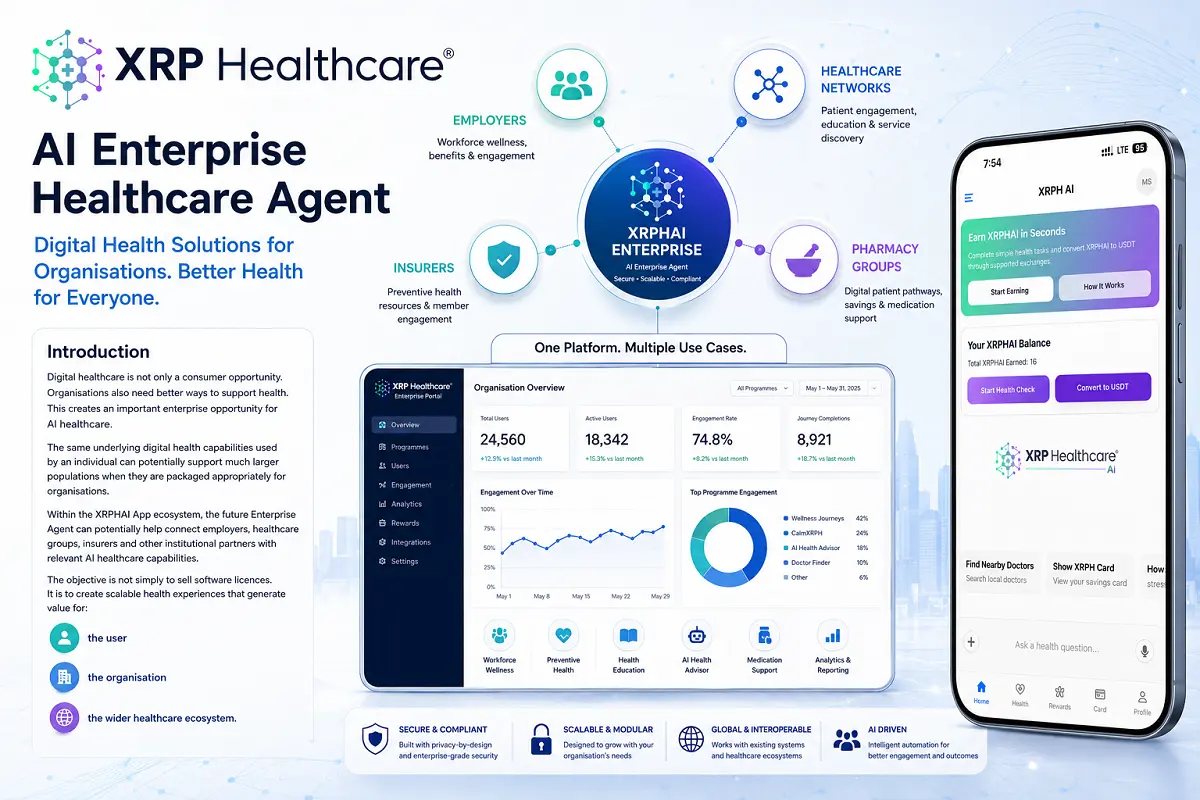
Introduction
Digital healthcare is not only a consumer opportunity.
Organisations also need better ways to support health.
Employers want stronger workforce wellbeing.
Healthcare networks want better digital engagement.
Insurers may want members to access useful preventive-health resources.
Pharmacy groups may want more efficient digital patient pathways.
Corporate wellness programmes need technology that can operate at scale.
This creates an important enterprise opportunity for AI healthcare.
The same underlying digital health capabilities used by an individual can potentially support much larger populations when they are packaged appropriately for organisations.
Within the XRPHAI App ecosystem, the future Enterprise Agent can potentially help connect employers, healthcare groups, insurers and other institutional partners with relevant AI healthcare capabilities.
The objective is not simply to sell software licences.
It is to create scalable health experiences that generate value for:
the user
the organisation
and
the wider healthcare ecosystem.
What Is an AI Enterprise Healthcare Agent?
An AI Enterprise Healthcare Agent is an intelligent system designed to support organisational relationships within a digital health platform.
Its potential functions may include:
Identifying relevant enterprise use cases
Supporting organisation onboarding
Matching programmes to organisational needs
Managing enterprise relationships
Coordinating user access
Supporting population-level engagement
Helping organisations understand programme performance
Connecting appropriate ecosystem services
The Enterprise Agent operates at an organisational layer rather than acting as an individual medical decision-maker.
Who Could Use Enterprise AI Healthcare?
Potential organisational users may include:
Employers
Healthcare networks
Hospitals
Pharmacy groups
Insurers
Wellness providers
Corporate health programmes
Government-linked health initiatives
NGOs
Universities
Large membership organisations
Different organisations may require different types of digital health support.
Employers
Employers increasingly invest in workforce health and wellbeing.
Potential objectives may include:
Wellness engagement
Preventive health
Health education
Stress-management support
Access to healthcare tools
Employee benefits
Health programme participation
A digital healthcare platform can provide one scalable access point.
AI Healthcare for Employees
An employee-facing healthcare experience could potentially provide access to:
AI Health Advisor
Health Journeys
CalmXRPH
Wellness Coach
Doctor Finder
Prescription Savings where eligible
Medication support
Preventive health tools
The organisation supports access.
The user retains control of their personal healthcare experience.
Employers Should Not See Private Health Activity
This boundary is fundamental.
An employer should not automatically receive access to:
Individual diagnoses
Medication usage
AI healthcare conversations
Doctor Finder searches
Wellness Journal details
Sensitive health questions
Simply because the organisation sponsors access to the platform.
Enterprise access must not become employee surveillance.
Aggregate Insights
Organisations may potentially receive appropriate aggregate programme information.
For example:
Programme participation rate
Overall engagement
Journey completion at an aggregated level
Feature adoption
General programme utilisation
Such analytics should be designed so they do not unnecessarily expose identifiable personal health information.
Individual Health Privacy vs Enterprise Reporting
The distinction can be understood as:
User-Level Health Experience
Private to the user except where they explicitly choose or are appropriately required to share information.
Enterprise-Level Reporting
High-level, aggregate or appropriately authorised programme information.
This separation is essential for trust.
Healthcare Networks
Healthcare networks may use digital health platforms differently from employers.
Potential use cases could include:
Patient engagement
Health education
Pre-appointment support
Post-visit digital engagement
Wellness programmes
AI information access
Service discovery
The platform can complement existing healthcare services.
Hospitals
Hospitals may benefit from digital engagement tools that help patients between physical encounters.
For example:
Hospital visit
↓
Digital healthcare engagement
↓
Health information
↓
Wellness Journey
↓
Appropriate follow-up resources
AI can help extend the patient experience beyond the hospital walls.
AI Should Not Replace Hospital Clinical Systems
An enterprise AI healthcare platform should not automatically attempt to replace:
Electronic Health Records
Clinical decision-support systems
Hospital Information Systems
Pharmacy management systems
The XRPHAI App performs a different role.
It provides digital healthcare engagement and user-facing support.
Integration Rather Than Replacement
A stronger enterprise strategy is often:
existing healthcare infrastructure
+
new digital health capabilities
rather than:
replace everything
Organisations have already invested heavily in existing systems.
Interoperability and defined integrations can reduce disruption.
Insurers
Insurance organisations may also have reasons to support digital healthcare engagement.
Potential objectives can include:
Preventive health participation
Health education
Wellness programmes
Member engagement
Digital healthcare access
Any insurer relationship requires particularly careful privacy and governance boundaries.
Insurance Must Not Become Health Surveillance
A healthcare app should not allow an insurer to automatically access sensitive individual health activity simply because the insurer pays for the service.
Information-sharing should follow:
Clear purpose
Appropriate consent
Applicable requirements
Data minimisation
Strong governance
The commercial relationship does not remove privacy rights.
Pharmacy Groups
Pharmacy networks may also become relevant enterprise partners.
A digital health ecosystem may support connections around:
Prescription Savings
Medicine Verification
Counterfeit Medicine awareness
Nearby Pharmacy
Medication adherence
Health information
These functions can create useful digital-to-physical healthcare journeys.
Pharmacy Enterprise Partnerships
A pharmacy group might potentially use XRPHAI to:
Increase digital customer engagement
Support medication education
Connect eligible savings programmes
Improve access pathways
Support approved digital campaigns
Any clinical or medication information must remain carefully governed.
The Enterprise Agent
Within the future XRPHAI architecture, the Enterprise Agent is designed to manage institutional opportunity.
Its role may potentially include:
Enterprise lead identification
Organisation qualification
Use-case matching
Programme configuration
Partner onboarding
Commercial relationship management
Enterprise analytics
Renewal support
This is different from a healthcare advisory agent.
The Enterprise Agent Should Understand Organisational Need
An employer may want:
workforce wellness
A pharmacy group may want:
medication and prescription engagement
A healthcare network may want:
patient digital engagement
An insurer may want:
preventive-health participation
The Enterprise Agent should not treat every organisation identically.
Enterprise Programme Matching
AI can potentially match organisations with the most relevant XRPHAI capabilities.
For example:
Employer
→ Wellness Journeys
→ CalmXRPH
→ Wellness Coach
Pharmacy Group
→ Prescription Savings
→ Medicine Verification
→ Medication Adherence
Healthcare Network
→ AI Health Advisor
→ Doctor Finder
→ Health Journeys
The exact configuration should reflect the organisation's needs and available live features.
Enterprise Packages
A future enterprise offering could potentially include configurable packages.
Examples might include:
Employee Wellness
Digital Patient Engagement
Pharmacy Engagement
Preventive Health
Healthcare Access
However, package names and commercial terms should only be treated as real once formally launched.
One Platform, Different Use Cases
The value of a modular digital healthcare platform is flexibility.
The same underlying XRPHAI ecosystem can support different organisational goals without requiring a completely separate product for every industry.
The experience can be configured.
Enterprise Onboarding
Organisational onboarding is more complex than consumer onboarding.
Potential steps may include:
Organisation qualification
Use-case definition
Commercial agreement
Privacy and governance review
Programme configuration
User access setup
Launch
Performance monitoring
Ongoing optimisation
The Enterprise Agent can potentially coordinate this lifecycle.
Enterprise User Access
Organisations may provide users access through:
Invitation codes
Organisation links
Group programmes
Employee benefits portals
Partner landing pages
Other approved mechanisms
Access should remain simple for the individual user.
Enterprise Segmentation
The platform may need to distinguish different enterprise populations.
For example:
Employees
Patients
Pharmacy customers
Insurance members
Students
Community participants
Each group may require different experiences.
Personalisation at Scale
One advantage of AI is that an enterprise programme does not necessarily need every user to receive exactly the same experience.
An employer may sponsor a wellness programme.
But individual employees can still have different:
Wellness Journeys
CalmXRPH preferences
Activity choices
Language
Session lengths
Enterprise sponsorship and individual personalisation can coexist.
Enterprise Wellness Journeys
Wellness Journeys are particularly suitable for organisational programmes.
For example, an employer could sponsor access to a:
30-Day Workplace Wellness Journey
The activity library might include:
Short movement
Breathing
Hydration awareness
Gratitude
Relaxation
Screen breaks
Sleep-routine awareness
Users can participate through the XRPHAI App.
Workplace Wellness Should Not Become Mandatory Medical Behaviour
Employee wellness programmes should avoid coercion.
Users should not be pressured into:
Revealing medical conditions
Sharing diagnoses
Taking specific medication
Completing inappropriate activities
Disclosing private wellness preferences
Participation structures should respect user autonomy.
CalmXRPH for Organisations
CalmXRPH can potentially provide useful enterprise wellness experiences.
Examples could include:
Short workplace breathing sessions
Stress-management breaks
Mindfulness sessions
Relaxation
Morning or evening wellbeing content
These experiences can be offered at scale.
Enterprise Wellness and Premium Value
Enterprise access may also become one route through which users receive premium functionality.
For example, an employer or insurer could potentially sponsor premium access for eligible users.
This creates a B2B2C model:
Organisation pays
↓
User receives enhanced access
The exact model should reflect future commercial structure.
Enterprise vs Consumer Premium
Consumer Premium
Individual subscribes directly.
Enterprise-Sponsored Access
Organisation pays for user access according to enterprise agreement.
The user experience may overlap.
The payment relationship differs.
Enterprise and Prescription Savings
Prescription Savings may be particularly relevant to employers, healthcare organisations and pharmacy partners in the United States.
A programme could help eligible users access prescription savings tools.
Savings should never be guaranteed.
Programme eligibility and participating pharmacy rules still apply.
Enterprise and Doctor Finder
Doctor Finder can help organisations provide access pathways without creating a closed provider recommendation system.
For example:
An employer may give employees access to Doctor Finder.
The employer should not determine which doctor the employee chooses unless the programme explicitly operates within a defined network.
Transparency is important.
Enterprise and Medication Adherence
Medication adherence tools may support users who already have established medication routines.
Enterprise programmes should be particularly careful here.
An employer should not receive:
Medication names
Dose information
Adherence history
unless there is a legitimate, authorised clinical context and appropriate legal basis.
Medication Adherence Should Remain User-Controlled
An enterprise sponsor may pay for access.
That does not mean the sponsor owns the user's medication information.
The distinction must remain clear.
Enterprise and AI Health Advisor
AI Health Advisor can provide scalable information access.
For organisations with large populations, this can help users explore general healthcare questions without every question becoming a live support ticket.
The AI still needs appropriate safety and escalation boundaries.
Enterprise and Preventive Healthcare
Preventive healthcare is another natural enterprise use case.
Organisations may support general programmes around:
Healthy routines
Wellness education
Screening awareness
Lifestyle engagement
Early health awareness
The AI platform can help organise and personalise these experiences.
Proof of Health™ in Enterprise Programmes
Proof of Health™ can potentially provide a framework for recognising eligible health-positive engagement.
In an enterprise context, this might support:
Programme participation
Journey completion
Eligible wellness actions
However, organisations should not receive unnecessary detail about individual health behaviour.
Enterprise Rewards
Eligible enterprise participants may potentially receive XRPHAI rewards according to programme rules where supported.
However, rewards should not create coercion.
An employee should not feel forced to disclose health information or perform excessive activities merely to receive benefits.
Rewards and Workplace Power Dynamics
Employers hold economic power over employees.
This makes programme design important.
A reward system should not create a situation where workers believe:
My employer will know if I don't complete health activities.
The user experience should make privacy boundaries clear.
Aggregate Enterprise Rewards Reporting
Where organisations sponsor programmes, reporting may focus on aggregate metrics such as:
Total eligible activities
Participation rates
Programme engagement
rather than revealing detailed individual activity.
Enterprise Analytics
Organisations need to understand whether programmes are working.
Potential aggregate metrics may include:
Activation rate
Active users
Journey participation
Wellness engagement
Feature adoption
Retention
Programme completion
General satisfaction
Metrics should be selected according to the use case.
Enterprise Analytics Should Not Become Clinical Scoring
An employee should not be assigned a hidden:
health score
for their employer based on personal app usage unless a clearly legitimate and appropriately governed use case exists.
Digital engagement metrics are not automatically measures of employee health.
No Employment Decisions From Wellness Usage
A person's XRPHAI engagement should not be used casually to determine:
Hiring
Firing
Promotion
Salary
Disciplinary action
Healthcare and employment decisions require strong legal and ethical boundaries.
Enterprise Personalisation
AI can potentially personalise programme experiences while keeping enterprise reporting aggregate.
This creates two layers:
Individual
Personalised experience
Organisation
High-level programme insight
This architecture can preserve value on both sides.
Enterprise Privacy by Design
Privacy should be designed into the enterprise product from the beginning.
Potential principles include:
Data minimisation
Role-based access
User consent
Aggregation
De-identification where appropriate
Strong authentication
Audit controls
Limited data retention
Clear contractual responsibilities
Privacy should not be an afterthought.
Role-Based Access
Different enterprise users need different permissions.
Programme Administrator
May see programme configuration and aggregate usage.
Finance Administrator
May see billing information.
Individual User
Sees their own healthcare experience.
These roles should not automatically have access to one another's information.
Enterprise Security
Enterprise customers expect strong security.
Relevant controls may include:
Authentication
Access control
Encryption
Audit logging
Credential management
Monitoring
Incident response
Security reviews
The exact requirements depend on the implementation and data processed.
Enterprise Compliance
Different organisations operate under different regulatory environments.
Enterprise deployment may need to consider:
Privacy law
Healthcare regulation
Employment rules
Financial requirements
Contractual obligations
Local data rules
Technology does not eliminate compliance responsibilities.
Enterprise Contracts
Enterprise relationships may require clear agreements covering:
Services
Pricing
Data roles
Security
Support
Usage
Term
Renewal
Liability
Partner responsibilities
The Enterprise Agent can support workflows.
Legal agreements still require appropriate review.
The Enterprise Agent and Revenue Optimisation Agent
The Revenue Optimisation Agent may identify enterprise as a valuable commercial pathway.
The Enterprise Agent then specialises in organisational execution.
The relationship becomes:
Revenue Optimisation Agent
↓
Enterprise Opportunity
↓
Enterprise Agent
↓
Organisation Qualification
↓
Programme / Commercial Relationship
This keeps roles distinct.
The Enterprise Agent and Partner Marketplace Agent
The Partner Marketplace Agent focuses on matching individual users with relevant partner services.
The Enterprise Agent focuses on organisation-level relationships.
An organisation can potentially become a marketplace partner.
But the two agents still perform different functions.
Enterprise and Referral & Ambassador Growth
Some enterprise relationships can also generate new user acquisition.
For example:
Employer partnership
↓
5,000 employees invited
This is different from a consumer referral.
Enterprise acquisition happens through an institutional relationship.
The Referral & Ambassador Agent focuses on user/community-led growth.
Enterprise and Premium Conversion
Enterprise-sponsored premium access can reduce the need for individual conversion.
A user may receive premium functionality because their organisation funds it.
The product should clearly communicate who pays and what happens if enterprise access ends.
What Happens When Enterprise Access Ends?
If an organisation stops sponsoring access, users should understand:
Which features remain available
Whether they can subscribe individually
What happens to their personal account
What happens to their data
Whether Health Journey history remains
This should be designed in advance.
User Account Ownership
An enterprise-sponsored user should ideally understand the relationship between:
Their personal account
Organisation-sponsored access
Programme membership
The organisation should not automatically become the owner of the user's private health identity.
Portability
A strong digital healthcare experience should consider what happens when users:
Leave an employer
Change insurers
Leave a programme
Change healthcare organisation
Where feasible, users should not lose their entire health journey simply because a sponsor changes.
Enterprise Retention
Enterprise retention depends on continued organisational value.
Potential factors include:
User adoption
Satisfaction
Engagement
Programme outcomes
Service reliability
Administrative simplicity
Support
The Enterprise Agent can potentially help identify renewal risk.
Enterprise Reactivation
Organisations may also have inactive populations.
The Reactivation Agent can potentially help users return to useful health activity.
However, enterprise reactivation must respect notification permissions and privacy.
An employer should not receive detailed reports about why an individual stopped engaging.
Enterprise Wellness Coach
The Wellness Coach Agent can become particularly useful in enterprise programmes.
Instead of every employee receiving the same fixed wellness content, the coach can potentially personalise activities within programme boundaries.
This can increase relevance.
Enterprise Partner Marketplace
An employer or healthcare organisation may also choose to provide access to selected marketplace partners.
For example:
Telemedicine
Pharmacy services
Wellness services
Approved benefits
Commercial relationships must remain transparent.
Enterprise White-Label Opportunities
Some organisations may eventually want a customised or co-branded experience.
Potential models could include:
Co-branded enterprise programmes
Custom landing pages
Organisation-specific journeys
Branded wellness campaigns
These should be considered future possibilities unless officially launched.
Enterprise API / Integration Opportunities
Larger organisations may eventually require technical integration.
Potential future connections could include:
Single sign-on
Eligibility systems
Benefits portals
Employee platforms
Patient engagement systems
These capabilities should only be described as available once technically implemented.
Single Sign-On
Enterprise users often prefer to access tools through their existing organisational identity.
Single sign-on can reduce onboarding friction.
However, identity integration must not automatically expose private health information to the organisation.
Authentication and healthcare-data access are separate issues.
Enterprise Scalability
A consumer application may support individual users.
Enterprise infrastructure may need to support:
Hundreds
Thousands
Potentially much larger populations
This requires attention to:
Performance
Provisioning
Analytics
Support
Security
Programme administration
Enterprise scale introduces different operational requirements.
Enterprise Support
Institutional customers may require:
Onboarding support
Account management
Technical assistance
Reporting
Programme reviews
The Enterprise Agent may automate part of this experience.
Human relationship management may still be important for larger accounts.
Enterprise Account Management
Large healthcare partnerships often require ongoing communication.
A strong enterprise model can include:
Quarterly reviews
Usage analysis
Programme optimisation
Renewal planning
Expansion opportunities
The objective is long-term value rather than one-time sales.
Enterprise Expansion
A successful programme may begin with one use case.
For example:
Employee wellness
Later the organisation may expand into:
AI healthcare support
Doctor Finder
Prescription Savings
Other approved programmes
Expansion should follow demonstrated value.
Revenue Potential
Enterprise contracts can create a different revenue profile from individual subscriptions.
Potential models may include:
Per-user licensing
Annual contracts
Programme fees
Sponsored access
Enterprise subscriptions
Service partnerships
The exact pricing model should reflect future commercial strategy.
Enterprise Revenue Should Not Override User Rights
An organisation may be a valuable customer.
But the individual user remains a healthcare user with privacy and autonomy interests.
Enterprise revenue should never justify:
Hidden health surveillance
Inappropriate data sharing
Reduced user control
Coercive wellness participation
Trust is more valuable than a single contract.
The Enterprise Value Triangle
A sustainable enterprise model should align three parties.
User
Receives useful healthcare and wellness support.
Organisation
Receives appropriate programme value and aggregate insight.
XRPHAI
Receives sustainable enterprise revenue and ecosystem growth.
The strongest model benefits all three.
Enterprise Healthcare and the Wider XRPHAI Agent System
The commercial-agent architecture continues:
Reactivation Agent
↓
Revenue Optimisation Agent
↓
Premium Conversion Agent
↓
AI Referral & Ambassador Agent
↓
Wellness Coach Agent
↓
Partner Marketplace Agent
↓
Enterprise Agent
The next layer after Enterprise can focus on advertising.
Each agent remains specialised.
The Enterprise Agent Should Not Control Clinical Intelligence
The Enterprise Agent should focus on:
Organisation
Programme
Commercial relationships
Access
Aggregate performance
It should not decide:
Diagnosis
Treatment
Medication
Emergency guidance
Individual clinical risk
Clinical and enterprise intelligence must remain separate.
Future Enterprise Agent Capabilities
Future functionality may potentially include:
Enterprise lead scoring
Automated organisation qualification
Proposal support
Programme configuration
User provisioning
Enterprise analytics
Renewal prediction
Account expansion recommendations
Integration management
These capabilities should only be described as live once implemented.
The XRPHAI Enterprise Loop
A simplified enterprise lifecycle can look like:
Organisation Need
↓
Enterprise Agent
↓
Relevant XRPHAI Programme
↓
Organisation Agreement
↓
User Access
↓
Personalised AI Healthcare / Wellness Experience
↓
Aggregate Programme Insights
↓
Programme Optimisation
↓
Renewal / Expansion
Throughout the entire lifecycle:
Privacy
User Control
Security
Clinical Independence
must remain central.
Why Enterprise Matters to XRPHAI
Consumer growth can bring users one at a time.
Enterprise relationships can potentially bring:
Hundreds
Thousands
Or larger groups
through one partnership.
This creates a powerful scale channel.
But enterprise growth only works if users still trust the product.
If organisational sponsorship compromises privacy, the model becomes weaker.
The opportunity is to achieve scale without sacrificing individual control.
From Healthcare App to Healthcare Platform
Enterprise capability changes the strategic position of XRPHAI.
A consumer-only app serves individuals.
An enterprise-ready platform can potentially serve:
Individuals
Organisations
Healthcare networks
Partners
This expands the ecosystem.
The technology becomes not just:
an AI healthcare app
but:
an AI healthcare platform capable of supporting multiple stakeholder groups.
Conclusion
The future of AI healthcare is not limited to individual app subscriptions.
Employers, healthcare networks, pharmacies, insurers and other organisations also need scalable digital health solutions.
Within the XRPHAI App ecosystem, the future Enterprise Agent can potentially connect institutional partners with:
AI Health Advisor
Wellness Journeys
Wellness Coach
CalmXRPH
Doctor Finder
Prescription Savings
Medication Adherence
Preventive healthcare
Proof of Health™
Eligible XRPHAI rewards
But enterprise scale requires strong boundaries.
Organisations should not automatically see individual health activity.
Enterprise reporting should use appropriate aggregate or authorised information.
Employment, insurance or commercial power should not be used to coerce health behaviour.
Enterprise revenue should remain separate from clinical guidance.
And the user should retain meaningful control over their healthcare experience.
When those principles are maintained, enterprise AI healthcare can create a powerful alignment:
better digital health access for users
scalable health programmes for organisations
and
sustainable growth for the XRPHAI ecosystem.
FAQ
What is an AI Enterprise Healthcare Agent?
An AI Enterprise Healthcare Agent is an intelligent system designed to support organisation-level digital health relationships, including programme matching, onboarding, user access, aggregate analytics and ongoing enterprise management.
What is the XRPHAI Enterprise Agent?
The future XRPHAI Enterprise Agent is designed to help manage institutional opportunities across employers, healthcare networks, pharmacy groups, insurers and other organisations. Future functionality should only be described as live once implemented.
Can employers see employees' private health information through XRPHAI?
Enterprise sponsorship should not automatically provide employers with access to individual diagnoses, medications, AI conversations, Doctor Finder searches, Wellness Journey activity or other sensitive health information.
What information can enterprise customers receive?
Depending on the programme and applicable requirements, organisations may receive appropriate aggregate information such as activation, engagement, feature adoption and programme participation without unnecessarily exposing identifiable individual health activity.
Can insurers see individual XRPHAI health activity?
An insurer should not automatically receive sensitive individual health activity simply because it sponsors access. Any information sharing should have a defined purpose and follow appropriate authorisation, privacy and governance requirements.
Can XRPHAI support employee wellness programmes?
Potentially, yes. Enterprise programmes could combine capabilities such as Wellness Journeys, CalmXRPH, Wellness Coach and other appropriate digital health tools, depending on the live product configuration.
Can organisations sponsor premium XRPHAI access?
A future enterprise model could allow organisations to fund eligible premium access for users, creating a B2B2C relationship. This should only be described as available once commercially launched.
Does the Enterprise Agent make clinical decisions?
No. The Enterprise Agent is designed for organisation-level programme and commercial workflows rather than diagnosis, treatment, medication or individual clinical decision-making.
How is the Enterprise Agent different from the Partner Marketplace Agent?
The Partner Marketplace Agent focuses on matching individual users with relevant approved external services, while the Enterprise Agent focuses on institutional relationships and organisation-level programmes.
How does enterprise healthcare benefit XRPHAI?
Enterprise partnerships can potentially distribute XRPHAI capabilities to larger user populations while creating recurring institutional revenue and broader ecosystem growth.