Retail network access is facilitated through agreements with United Networks of America (UNA). Display of pharmacy brand marks does not imply ownership, endorsement, or direct partnership with XRP Healthcare M&A Holding Inc.
Strategic Health Technology Partnerships
Technology partnerships reflect collaborative or project-based cooperation. Display does not imply equity ownership or endorsement unless expressly stated.
Pharmaceutical & Supply Partnerships
Pharmaceutical and supply relationships reflect existing commercial arrangements within acquired operating entities. Display does not imply exclusivity or endorsement beyond standard commercial supply agreements.
Advisors
Advisors provide professional services to XRP Healthcare M&A Holding Inc. No partnership or ownership interest is implied unless publicly disclosed.
All third-party trademarks remain the property of their respective owners. Display does not imply endorsement, ownership, or partnership unless expressly stated.
Jul 9, 2026
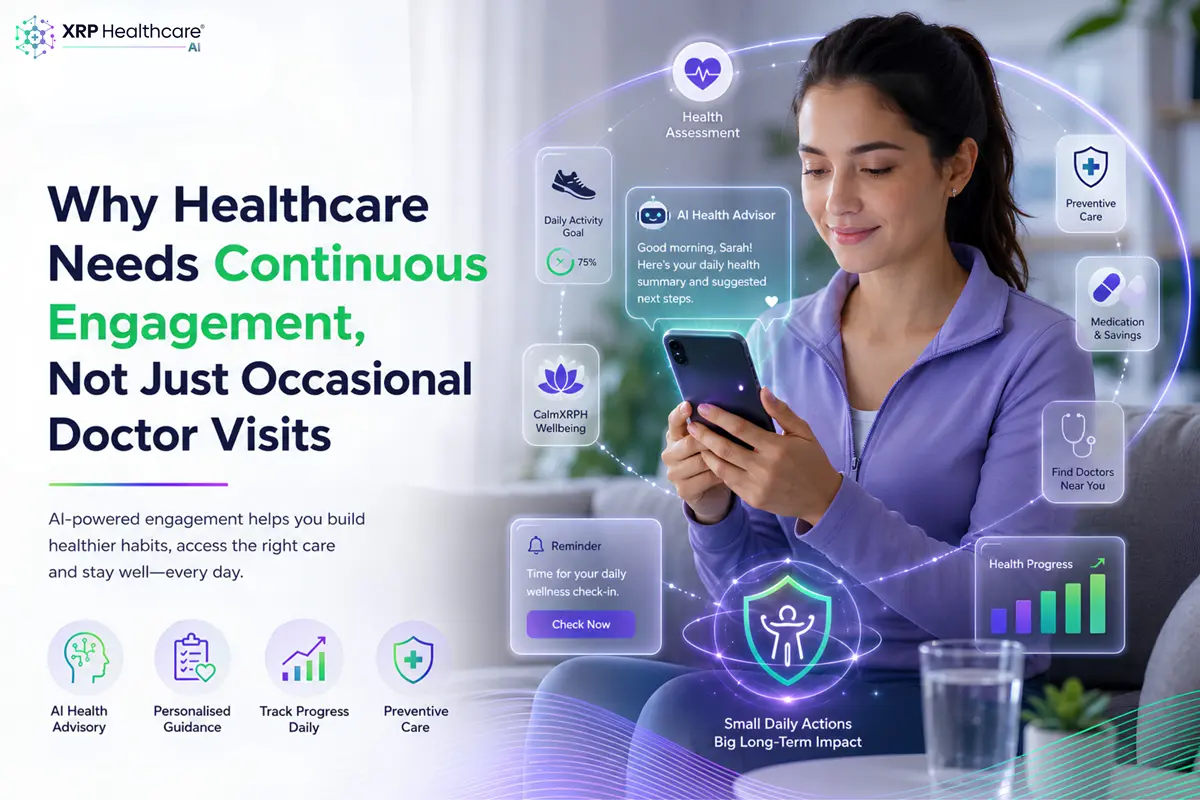
Why Healthcare Needs Continuous Engagement, Not Just Occasional Doctor Visits
Discover why continuous healthcare engagement powered by artificial intelligence can improve wellness, encourage healthier habits and transform preventive healthcare worldwide.
Why Healthcare Needs Continuous Engagement, Not Just Occasional Doctor Visits
For generations, healthcare has largely followed the same pattern.
People become ill.
They schedule an appointment.
A diagnosis is made.
Treatment begins.
While this approach has saved countless lives, it was never designed to encourage people to actively engage with their health every day. Between appointments, many individuals receive little guidance, limited follow-up and minimal encouragement to build healthier long-term habits.
Today, artificial intelligence is beginning to change that model.
Rather than waiting until illness develops, modern healthcare is increasingly moving towards continuous engagement - helping people make better health decisions every day instead of only when problems arise.
This shift has the potential to improve healthcare accessibility, encourage preventive care and empower individuals to take a more active role in their long-term wellbeing.
Reactive Healthcare Has Served Society Well - But It Has Limits
Healthcare professionals remain central to delivering diagnosis, treatment and clinical expertise. However, healthcare systems around the world continue to face significant challenges.
Growing populations.
Increasing rates of chronic disease.
Ageing demographics.
Limited healthcare resources.
Long waiting times.
At the same time, many of the world's leading health challenges-including cardiovascular disease, type 2 diabetes, obesity and hypertension-are strongly influenced by lifestyle and behaviour.
These are areas where small daily decisions often have a far greater long-term impact than a single annual appointment.
Healthcare therefore needs more than excellent treatment.
It also needs sustained engagement.
The Opportunity for Continuous Healthcare Engagement
Continuous healthcare engagement is based on a simple idea.
Rather than interacting with healthcare only when problems occur, individuals receive ongoing support throughout their everyday lives.
That support may include:
Daily health assessments
Wellness reminders
Educational content
Mental wellbeing support
Preventive healthcare guidance
Healthcare navigation
Medication savings information
Access to healthcare providers
Progress tracking
Personalised recommendations
The objective is not to replace clinicians.
It is to help people remain actively engaged with their own health between clinical interactions.
Why Small Daily Actions Matter
Healthcare outcomes are rarely determined by one single decision.
Instead, they are often shaped by thousands of small choices made over many years.
Examples include:
Choosing healthier food.
Managing stress.
Sleeping consistently.
Taking medication correctly.
Remaining physically active.
Seeking medical advice earlier.
Monitoring changes in wellbeing.
Learning more about personal health.
Each action may appear small in isolation.
Collectively, however, these behaviours can significantly influence long-term health outcomes.
Artificial intelligence has the potential to support these habits by providing timely encouragement and making healthcare resources easier to discover and use.
Artificial Intelligence Is Changing Healthcare Engagement
The first generation of healthcare AI focused primarily on answering questions.
Today's technology is becoming far more capable.
Modern AI systems are increasingly able to help individuals navigate complex healthcare ecosystems, discover relevant services and maintain consistent engagement over time.
Instead of simply responding to questions, intelligent healthcare platforms can guide users through personalised wellness journeys based on their goals, interests and previous interactions.
This represents an important evolution from static information towards intelligent healthcare guidance.
Healthcare Engagement Is Becoming Personal
No two people have identical healthcare needs.
A young athlete.
A parent managing family health.
Someone living with a chronic condition.
An older adult focusing on preventive care.
Each person benefits from different information, different reminders and different healthcare resources.
Artificial intelligence allows healthcare experiences to become increasingly personalised without overwhelming users with unnecessary information.
Instead of presenting dozens of disconnected features, intelligent systems can recommend the most relevant next step based on each person's circumstances and preferences.
This creates a healthcare experience that feels simpler, more accessible and easier to maintain over time.
The Next Evolution: AI Health Advisors
Artificial intelligence is now moving beyond simply answering questions.
The next generation of healthcare AI is focused on intelligent guidance.
Rather than waiting for users to decide what they need, AI Health Advisors can help people navigate healthcare more effectively by recommending relevant next steps based on previous activity, healthcare goals and available services.
For example, after completing a health assessment, an intelligent healthcare platform may suggest additional educational resources, wellness activities, medication savings tools or healthcare provider options that are relevant to the individual's situation.
This creates a connected healthcare experience where every interaction has the potential to lead to another positive action.
Over time, this type of intelligent guidance can help simplify healthcare while encouraging greater long-term engagement.
The Role of Memory and Personalised Guidance
One of the most exciting developments in artificial intelligence is the ability to create more personalised experiences over time.
Rather than treating every interaction as completely new, intelligent healthcare systems are increasingly able to build on previous conversations and user preferences, providing guidance that becomes more relevant and useful.
When implemented responsibly with appropriate privacy protections, this allows healthcare experiences to become more personalised without compromising user control.
Instead of repeatedly searching through menus or remembering where particular features are located, users can receive intelligent recommendations based on their own healthcare journey.
This represents a significant shift from static healthcare applications towards truly adaptive healthcare experiences.
Behavioural Science Meets Artificial Intelligence
Medical knowledge alone does not always change behaviour.
People generally understand the importance of exercise, healthy eating and regular health checks.
The challenge is maintaining consistency over months and years.
Behavioural science has shown that positive reinforcement, measurable progress and achievable goals can significantly improve long-term engagement.
Artificial intelligence provides an opportunity to deliver these principles at scale.
Through intelligent reminders, personalised recommendations and meaningful encouragement, AI can help users remain engaged with healthy routines while reducing the complexity often associated with healthcare.
Rather than replacing human motivation, AI can help reinforce it.
Building Long-Term Healthcare Habits
Healthy lifestyles are rarely built through dramatic changes.
They are usually created through small actions repeated consistently over time.
Examples include:
Completing regular health assessments.
Monitoring wellbeing.
Practising stress management.
Learning more about personal health.
Accessing healthcare resources earlier.
Maintaining healthier routines.
When these actions become part of everyday life, they contribute to stronger long-term health outcomes.
Artificial intelligence provides an opportunity to support these routines by making healthcare easier to engage with on a daily basis.
Connecting Healthcare Into One Intelligent Experience
Modern healthcare applications often include many valuable features.
The challenge is helping people discover and use them effectively.
Instead of presenting disconnected tools, future healthcare platforms are increasingly expected to connect these services into one intelligent experience.
For example, a user may begin by completing a health assessment before receiving recommendations to explore educational resources, wellness activities, medication savings opportunities or healthcare providers.
Artificial intelligence helps organise these journeys in a logical way that reduces friction and encourages continued participation.
This creates a healthcare experience that feels connected rather than fragmented.
A Future Built Around Healthcare Engagement
The future of healthcare is unlikely to be defined by a single technological breakthrough.
Instead, it will be shaped by how effectively technology helps people engage with their health every day.
Artificial intelligence, digital health platforms and intelligent healthcare guidance all have the potential to improve accessibility while encouraging more proactive healthcare behaviours.
Rather than waiting until illness develops, healthcare can increasingly support individuals throughout their everyday lives.
This shift represents one of the most significant opportunities in modern healthcare.
XRP Healthcare's Vision
XRP Healthcare believes the future of healthcare lies in intelligent engagement rather than isolated interactions.
Through the XRPH AI App, the Company continues to develop AI-powered healthcare technologies that help users access healthcare resources, complete health assessments, discover healthcare providers, improve wellbeing and engage more consistently with their health.
Existing features such as Doctor Finder, Prescription Savings, CalmXRPH, Proof Of Health™ and AI-powered assessments already provide users with valuable healthcare tools.
As the platform continues to evolve, intelligent guidance will increasingly help users navigate these services more naturally through personalised healthcare journeys.
The long-term objective is straightforward:
To make healthcare more accessible, more engaging and easier to navigate through responsible artificial intelligence.
Conclusion
Healthcare is moving beyond occasional appointments toward continuous engagement.
Artificial intelligence is helping make this possible by encouraging healthier habits, improving healthcare accessibility and simplifying how people interact with healthcare resources.
The future of healthcare will not simply depend on better treatments.
It will also depend on better engagement.
Intelligent healthcare platforms have the potential to help millions of people become more active participants in their own wellbeing while supporting healthcare professionals through improved accessibility and earlier engagement.
As healthcare continues to evolve, continuous healthcare engagement may become one of the defining characteristics of next-generation digital health.
Continuous healthcare engagement encourages individuals to remain actively involved with their health through regular interaction, education, wellness activities and preventive healthcare rather than only seeking medical care when they become ill.
How can artificial intelligence improve healthcare engagement?
Artificial intelligence can personalise healthcare experiences, recommend relevant resources, encourage healthy habits and help users navigate healthcare services more effectively.
Will AI replace healthcare professionals?
No. AI is designed to complement healthcare professionals by improving accessibility, education and patient engagement while supporting informed healthcare decisions.
Why is preventive healthcare becoming more important?
Preventive healthcare focuses on reducing future health risks through healthier behaviours, early intervention and ongoing engagement rather than waiting until illness develops.
What is an AI Health Advisor?
An AI Health Advisor is an intelligent digital healthcare assistant designed to guide users through healthcare resources, wellness activities and personalised healthcare journeys while encouraging long-term engagement.