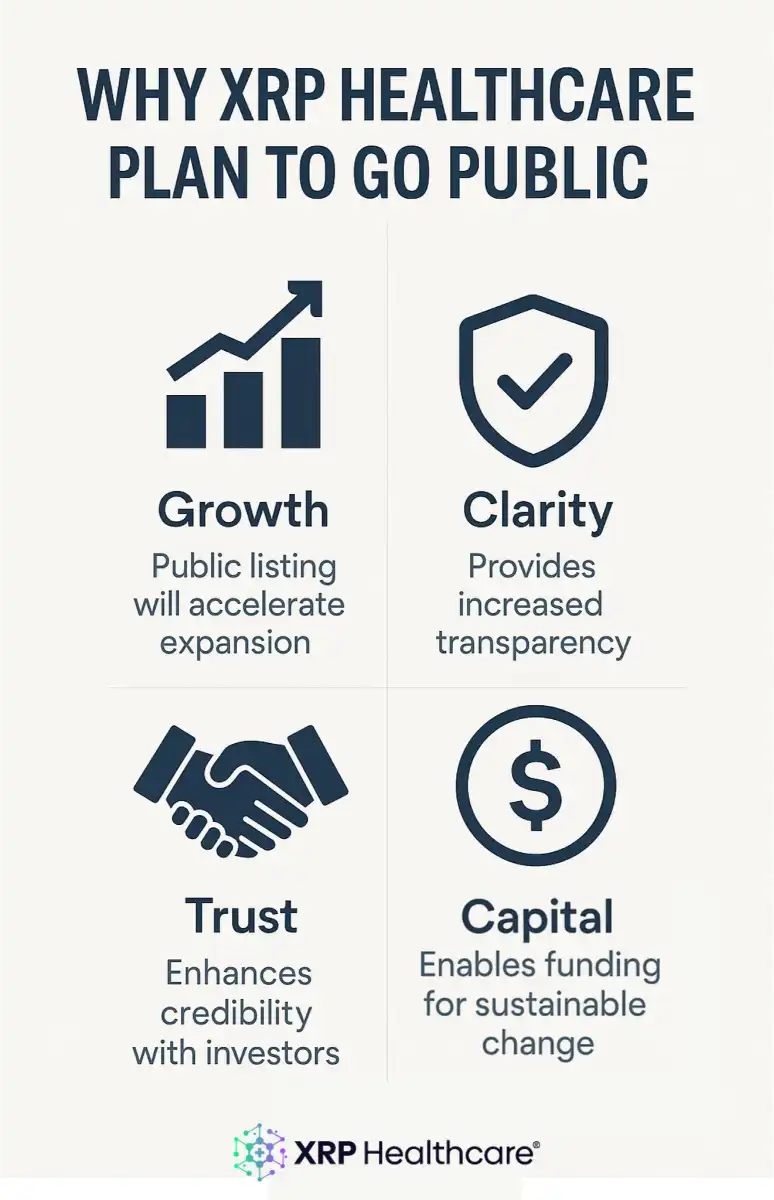
In today’s world of transparency and empowered investors, few milestones reflect trust like a public listing.
For XRP Healthcare, going public on the TSX Venture Exchange (TSXV) isn’t just symbolic, it’s transformative.
It’s designed to reshape how healthcare is delivered across both developing regions and advanced economies.
From Uganda’s villages to U.S. cities, this listing is not just about recognition.
Rather, it’s about fueling growth, enhancing accountability, and unlocking the resources needed to scale intelligent healthcare worldwide.
Why the TSXV Listing Matters
The TSX Venture Exchange in Canada is a launchpad for emerging global innovators.
Therefore, XRP Healthcare’s upcoming listing brings several critical advantages:
Enhancing Credibility & Trust
Public companies must meet strict disclosure requirements.
Consequently, this transparency builds investor confidence and strengthens global partnerships.
Accessing Capital to Scale
The listing unlocks access to institutional and retail capital.
This funding will, in turn, expand pharmacy operations and boost AI development.
Monetizing the XRPH AI App
Currently free, the XRPH AI app is set to launch premium features by 2026.
For example, expect AI diagnostics, triage, and data-driven tools, enabled by listing-generated momentum.
Solidifying Leadership in Africa
The listing helps position the XRPH AI app as Africa’s top AI health assistant.
Meanwhile, expansion into North America will continue alongside this leadership.
A Proven Ecosystem Already in Motion
Unlike many IPO-bound startups, XRP Healthcare has traction, users, and live products.
As a result, its go-to-market strategy is grounded in real-world outcomes.
Pharmacies in Uganda
XRP Healthcare has acquired a chain of pharmacies in Uganda.
These will be rebranded under the XRP Healthcare name in Q4 2025.
This provides infrastructure for medication delivery and AI-driven services.
XRPH AI App - Live and Evolving
The app is designed for mobile-first users.
It offers multilingual health support, AI assistance, and doctor connectivity.
In addition, a prescription scanner will help decode medication, set reminders, and alert families.
By 2026, it will include diagnostics and personalized health plans.
U.S. Market Integration
In the U.S., the XRPH Prescription Savings Card is accepted at 68,000+ pharmacies.
That includes CVS, Walgreens, and Walmart, cutting drug costs for millions.
Thus, XRPH is becoming a cross-border healthtech solution.
Why Now: Market Timing and Global Opportunity
Mobile Growth in Africa
Smartphone use in Sub-Saharan Africa will exceed 88% by 2030.
Therefore, mobile health solutions are no longer optional, they’re critical.
Exploding Healthcare Demand
Africa’s healthcare market is projected to surpass $259 billion by 2030.
This is due to population growth, urbanization, and increasing demand for modern services.
U.S. Need for Cost-Cutting Tools
Prescription prices in the U.S. keep rising.
As a result, tools like savings cards and health apps are becoming essential.
What the Public Listing Will Unlock
Strategic M&A Across Africa
New capital and liquidity will drive pharmacy acquisitions in Kenya, Rwanda, and beyond.
Moreover, it will enable faster integration of AI-based services across these regions.
Investment in XRPH AI
The listing supports app development, AI diagnostics, telehealth, encrypted health records, and more.
Consequently, users will benefit from increasingly personalized and secure digital health experiences.
Attracting Global Talent
Being public improves visibility.
Therefore, top developers, partners, and institutions are more likely to join the mission.
Brand Expansion
IPO funds will power aggressive marketing campaigns.
In turn, XRPH AI will grow as a go-to health companion in Africa and a trusted tool in the U.S.
Final Thought: From Vision to Verified Value
XRP Healthcare’s public listing isn’t just hype.
Rather, it’s about real, measurable change.
From pharmacy chains in East Africa to affordable digital tools in the U.S., XRP Healthcare is building a real-world ecosystem.
It’s driven by AI, guided by trust, and fueled by purpose.
Ultimately, the TSXV listing turns vision into infrastructure, and ambition into action.
The future of global healthcare isn’t coming.
In fact, it’s already being built.