Mar 11, 2026
Mobile-First Healthcare: Why AI Health Platforms Are Built for the Smartphone Era
Discover why mobile-first healthcare is rising fast as smartphone adoption expands, and how XRPH AI is built for the next era of digital health access.
Retail network access is facilitated through agreements with United Networks of America (UNA). Display of pharmacy brand marks does not imply ownership, endorsement, or direct partnership with XRP Healthcare M&A Holding Inc.
Technology partnerships reflect collaborative or project-based cooperation. Display does not imply equity ownership or endorsement unless expressly stated.
Pharmaceutical and supply relationships reflect existing commercial arrangements within acquired operating entities. Display does not imply exclusivity or endorsement beyond standard commercial supply agreements.
Advisors provide professional services to XRP Healthcare M&A Holding Inc. No partnership or ownership interest is implied unless publicly disclosed.
All third-party trademarks remain the property of their respective owners. Display does not imply endorsement, ownership, or partnership unless expressly stated.
Mar 11, 2026
Discover why mobile-first healthcare is rising fast as smartphone adoption expands, and how XRPH AI is built for the next era of digital health access.
The future of healthcare will not begin only in hospitals, clinics, or urban medical centres. For millions of people, it will begin on a smartphone. That shift is already underway. Around the world, mobile connectivity has become one of the fastest-distributed forms of infrastructure in modern history. Internet use continues to rise globally, mobile broadband coverage is now close to universal, and emerging markets are seeing continued growth in mobile access even where traditional healthcare access remains limited.
This matters because when a smartphone becomes affordable, connected, and widely used, it also becomes a gateway to education, payments, communication, and increasingly, healthcare guidance. This is the environment XRPH AI has been built for.
For years, healthcare access depended heavily on physical proximity. If someone lived too far from a doctor, could not afford a consultation, or lacked easy access to structured medical guidance, they were often left with few reliable options.
Smartphones are changing that reality. A connected mobile device puts computing power, translation tools, image capture, voice interaction, and digital access into the hands of everyday people. In many emerging markets, the smartphone is not a secondary device. It is the primary digital interface for daily life. That is why the next era of healthcare access is increasingly mobile-first.
When a person can access guidance, information, and healthcare support through a phone they already own, the barrier to first-line health engagement falls dramatically. The conversation around healthcare begins to move from access delayed to access available.
Emerging markets sit at the centre of this transformation. In many parts of Africa, Asia, and Latin America, mobile growth has advanced faster than traditional healthcare infrastructure. In these regions, smartphone adoption and mobile internet expansion are creating a practical foundation for digital health tools to scale quickly. At the same time, affordability remains critical.
A digital health platform only matters if people can realistically reach it through devices and connectivity they already use. That is what makes affordable smartphones such an important part of the story. As devices become more accessible, the addressable audience for mobile-first healthcare expands with them. Every increase in smartphone penetration can compound access to digital health education, symptom guidance, pharmacy tools, and support resources.
This is especially relevant in regions where visiting a doctor may be delayed by distance, cost, waiting time, or lack of local availability. XRPH AI is positioned directly within that reality.
Digital health is no longer a niche concept. It is becoming part of how health systems strengthen access, efficiency, and reach. The opportunity is not simply to put medical information online. The opportunity is to create practical, privacy-conscious, mobile-native tools that people can use in real life.
That means designing around the way users actually behave:
they search from their phones
they speak in different languages
they use voice and images, not only text
they need help understanding symptoms before a clinic visit
they need affordable support options
they need trust, privacy, and accessibility
Mobile-first healthcare platforms that understand these realities will define the next wave of digital health adoption.
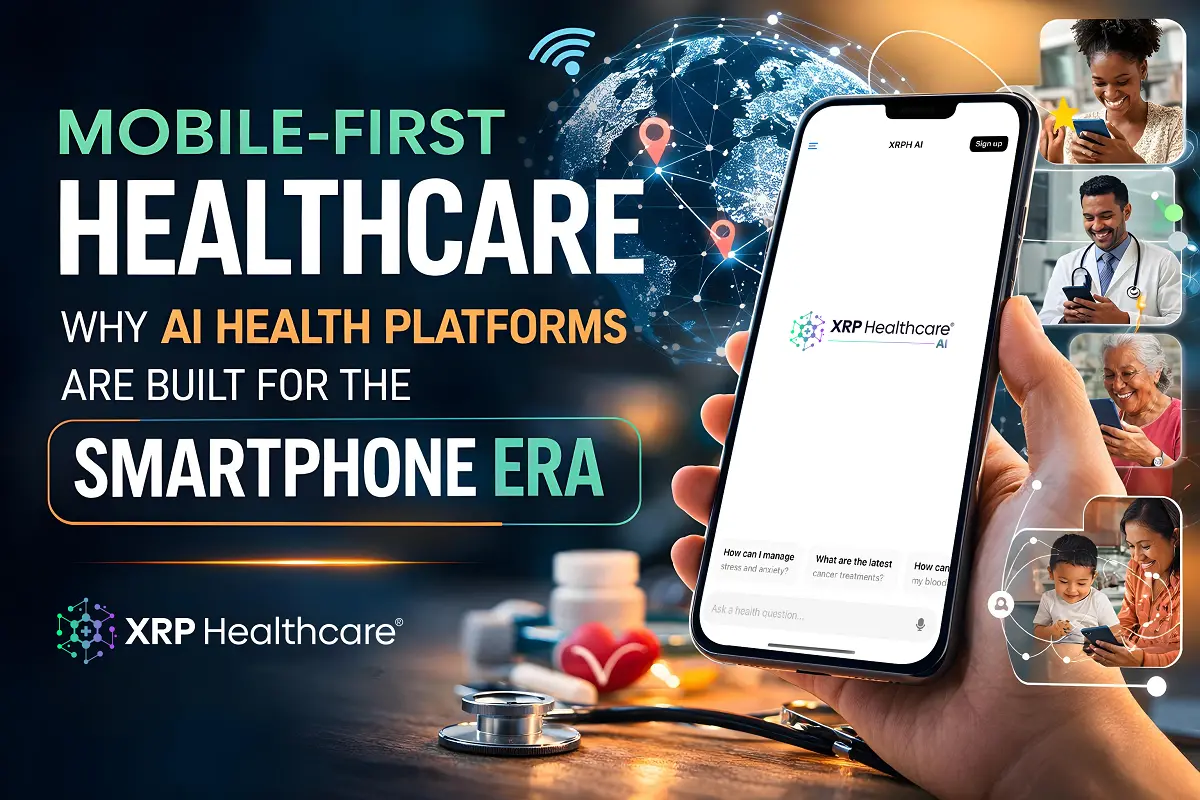
XRPH AI has been developed as a mobile-first healthcare platform designed to support people where access to timely health guidance may otherwise be limited.
Current XRPH AI capabilities include:
AI-powered health guidance for general wellness and health support
multilingual communication to improve accessibility across regions and languages
image-based visible-condition guidance for concerns such as skin, throat, or nail issues
CalmXRPH wellness support
local doctor search and connection features
integrated prescription savings support through the XRP Healthcare Prescription Savings Card, accepted at 68,000+ pharmacies in the United States
These features matter because they reflect how people increasingly engage with healthcare: through the device already in their hand. XRPH AI is not built around the assumption that every user can instantly visit a doctor. It is built around the reality that many people first need structured, accessible, smartphone-based support that helps them understand, prepare, and take the next step.
As healthcare becomes more digital, privacy becomes more important, not less. A mobile health platform must do more than offer convenience. It must build trust. That is why privacy-first design matters so much.
XRPH AI is positioned with a HIPAA-grade security standard and a privacy-led framework that emphasizes protection of sensitive health-related information and no PHI storage within the platform architecture. In practice, this supports a safer, more responsible user experience for people accessing healthcare guidance digitally. In a world where trust determines adoption, privacy is not a side issue. It is core infrastructure.
The most powerful part of the smartphone healthcare story is not just the number of devices already in circulation. It is the compounding effect. When smartphone affordability improves, connectivity grows, and digital confidence rises, healthcare platforms gain multiplied reach.
That means:
more first-time users can access healthcare guidance
more people can explore health concerns earlier
more families can access support without immediate clinic dependence
more users can engage across languages and regions
more people can reach relevant health features through a single app environment
This compounding effect is what makes smartphone growth in emerging markets such a powerful long-term healthcare story. The next wave of healthcare access will not be built only by constructing more physical sites. It will also be built by meeting users through mobile infrastructure that already scales.
The world is moving toward a healthcare environment that is more digital, more mobile, more multilingual, and more accessible. That shift does not replace doctors, pharmacists, clinics, or real healthcare systems. It strengthens the path toward them. It supports earlier engagement, broader reach, and more informed users. XRPH AI fits into that future because it has been designed for the smartphone era, not adapted to it later.
As emerging markets continue to adopt affordable smartphones at scale, the number of people able to access mobile-first healthcare guidance will continue to rise. That is why this moment matters. Healthcare is becoming more connected to the devices people already trust, carry, and use every day. And that is exactly why platforms like XRPH AI are built for what comes next.
What is mobile-first healthcare?
Mobile-first healthcare refers to healthcare guidance, tools, and support that are primarily accessed through smartphones and mobile devices rather than desktop systems or in-person-only channels.
Why are smartphones important for healthcare access?
Smartphones combine connectivity, voice, cameras, language support, and app access in one device, making them an effective gateway for digital healthcare guidance and support.
How does XRPH AI support mobile-first healthcare?
XRPH AI provides AI-powered health guidance, multilingual communication, image-based support, CalmXRPH wellness features, local doctor search, and prescription savings access in a mobile-first environment.
Does XRPH AI store PHI?
XRPH AI is positioned around a privacy-first architecture and HIPAA-grade security standard, with no PHI storage stated within its platform framework.
Why is mobile healthcare especially relevant in emerging markets?
Because smartphone adoption can expand faster than traditional healthcare infrastructure, mobile-first platforms can help more people access health guidance even where doctor access may be limited by cost, location, or waiting times. XRPH AI App is operated by XRP Healthcare M&A Holding Inc., focused on healthcare delivery, pharmacy integration, and subscription monetization. XRP Healthcare LLC owns the relevant intellectual property and licenses related infrastructure and technology rights across the broader XRP Healthcare ecosystem. XRPH AI provides informational guidance only and does not diagnose, treat, or replace licensed medical professionals.