Mar 26, 2026
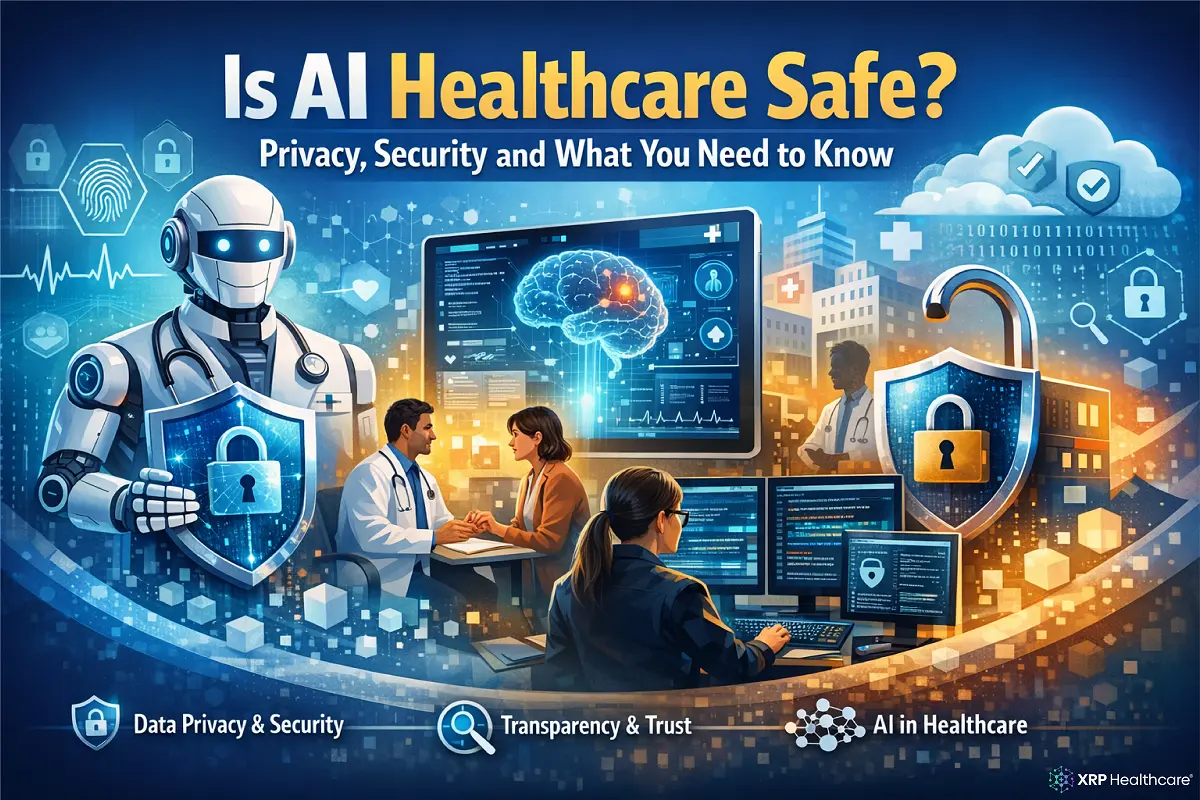
Is AI Healthcare Safe? Privacy, Security and What You Need to Know
As artificial intelligence becomes more integrated into healthcare, one of the most important questions users ask is:
Retail network access is facilitated through agreements with United Networks of America (UNA). Display of pharmacy brand marks does not imply ownership, endorsement, or direct partnership with XRP Healthcare M&A Holding Inc.
Technology partnerships reflect collaborative or project-based cooperation. Display does not imply equity ownership or endorsement unless expressly stated.
Pharmaceutical and supply relationships reflect existing commercial arrangements within acquired operating entities. Display does not imply exclusivity or endorsement beyond standard commercial supply agreements.
Advisors provide professional services to XRP Healthcare M&A Holding Inc. No partnership or ownership interest is implied unless publicly disclosed.
All third-party trademarks remain the property of their respective owners. Display does not imply endorsement, ownership, or partnership unless expressly stated.
Mar 26, 2026
As artificial intelligence becomes more integrated into healthcare, one of the most important questions users ask is:
As artificial intelligence becomes more integrated into healthcare, one of the most important questions users ask is:
The video above explores the realities of privacy, security, and trust in AI-powered healthcare systems, highlighting both the opportunities and the responsibilities that come with this technology. While AI offers significant benefits in accessibility, efficiency, and insight, its success ultimately depends on how well platforms protect users and handle sensitive information.
Healthcare is one of the most sensitive industries when it comes to personal data. Users need to trust that:
Their information is handled securely
Their privacy is respected
Their interactions remain confidential
Without this trust, even the most advanced healthcare platforms will struggle to gain adoption.
AI healthcare safety involves more than just data protection. It includes:
Accuracy of information
Responsible use of AI insights
Clear boundaries between guidance and diagnosis
Reliable system performance
AI healthcare platforms are designed to support users-not replace qualified medical professionals.
Privacy is central to user trust. Modern AI healthcare apps are increasingly designed with:
Minimal data exposure
On-device or secure processing approaches
Clear separation of sensitive information
Controlled user interactions
This helps reduce risk while maintaining usability.
Security ensures that systems remain protected from misuse or breaches. Key elements include:
Encrypted data handling
Secure infrastructure
Controlled access to systems
Ongoing monitoring and updates
Strong security frameworks are essential for platforms operating at scale.
Transparency plays a critical role in building trust. Users should understand:
What the platform does
What it does not do
How their data is handled
Where limitations exist
Clear communication reduces confusion and increases confidence.
AI healthcare platforms must balance innovation with responsibility. While AI enables:
Faster insights
Improved accessibility
Better decision support
…it must also be implemented carefully to ensure:
Ethical use
Safe interactions
Reliable outputs
This balance is key to long-term success.
Behind secure healthcare platforms is a robust infrastructure layer. Technologies such as the XRP Ledger contribute by enabling:
Efficient system performance
Scalable operations
Secure digital interactions
This supports the delivery of healthcare services in a reliable and controlled environment.
XRPH AI is designed with a focus on user trust and practical safety. This includes:
Clear separation between healthcare guidance and professional diagnosis
Secure handling of user interactions
A structure that separates infrastructure and application layers
A focus on accessible, responsible AI use
Importantly: 👉 The platform is designed to support users with information and guidance, while encouraging professional medical consultation where needed.
Is my data safe in AI healthcare apps? Modern platforms use secure systems and privacy-focused approaches to protect user information. Can AI replace doctors? No. AI supports healthcare but does not replace qualified professionals. Is AI healthcare reliable? AI can provide useful insights, but it should always be used alongside professional medical advice. Why Trust Will Define Adoption As AI healthcare continues to grow, trust will become the deciding factor for users. Platforms that demonstrate:
Strong privacy practices
Reliable systems
Clear communication
Responsible use of AI
…will lead adoption in the digital healthcare space.
The future of AI healthcare will focus on:
Stronger privacy frameworks
Improved security systems
Greater transparency
Enhanced user confidence
This will enable AI healthcare platforms to scale while maintaining trust.
Is AI healthcare safe to use?
AI healthcare apps are designed to be safe, but users should always combine them with professional medical advice.
How is user data protected in AI healthcare apps?
Through encryption, secure systems, and privacy-focused design approaches.
Can AI make medical decisions?
AI provides guidance and insights but does not replace professional diagnosis.
Why is privacy important in healthcare apps?
Because healthcare data is sensitive and requires strong protection to maintain trust.
What should users look for in a safe AI healthcare app?
Security, transparency, reliability, and responsible use of AI.