Jul 9, 2026
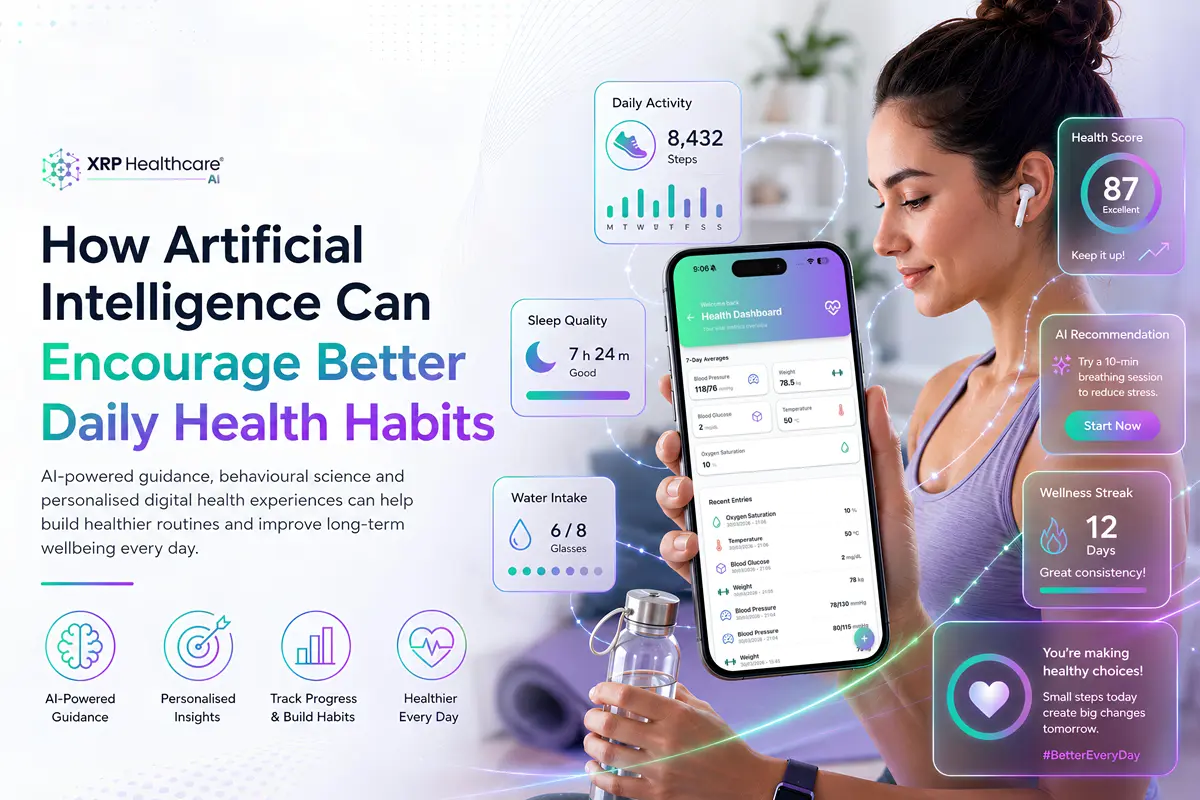
How Artificial Intelligence Can Encourage Better Daily Health Habits
Discover how artificial intelligence is helping people build healthier daily habits through personalised guidance, healthcare engagement and preventive care.
Retail network access is facilitated through agreements with United Networks of America (UNA). Display of pharmacy brand marks does not imply ownership, endorsement, or direct partnership with XRP Healthcare M&A Holding Inc.
Technology partnerships reflect collaborative or project-based cooperation. Display does not imply equity ownership or endorsement unless expressly stated.
Pharmaceutical and supply relationships reflect existing commercial arrangements within acquired operating entities. Display does not imply exclusivity or endorsement beyond standard commercial supply agreements.
Advisors provide professional services to XRP Healthcare M&A Holding Inc. No partnership or ownership interest is implied unless publicly disclosed.
All third-party trademarks remain the property of their respective owners. Display does not imply endorsement, ownership, or partnership unless expressly stated.
Jul 9, 2026
Discover how artificial intelligence is helping people build healthier daily habits through personalised guidance, healthcare engagement and preventive care.
Every day we make hundreds of decisions that influence our long-term health.
Some are obvious.
Choosing nutritious food.
Going for a walk.
Getting enough sleep.
Managing stress.
Others seem insignificant at the time.
Drinking another glass of water.
Taking a short break from work.
Completing a health assessment.
Practising a few minutes of mindfulness.
Yet over months and years these seemingly small decisions often have a greater impact on long-term wellbeing than a single dramatic lifestyle change.
The challenge has never been understanding that healthy habits matter.
The challenge has always been maintaining them consistently.
This is where artificial intelligence is beginning to transform healthcare.
Rather than simply answering medical questions, AI is evolving into an intelligent companion that can encourage healthier routines, guide users through healthcare resources and help people remain engaged with their wellbeing every day.
Many people think healthcare begins in a doctor's office.
In reality, healthcare begins long before that.
It begins with everyday behaviour.
Long before symptoms develop, daily choices are already influencing cardiovascular health, mental wellbeing, physical fitness, sleep quality and overall quality of life.
Healthcare therefore should not only focus on treating illness.
It should also support healthier daily living.
Artificial intelligence provides a unique opportunity to make this possible on a much larger scale than ever before.
Most people begin a new health routine feeling highly motivated.
Unfortunately motivation changes.
Life becomes busy.
Work increases.
Family responsibilities grow.
Stress appears.
The routine slowly disappears.
Behavioural scientists have consistently found that successful long-term change is rarely driven by motivation alone.
Instead, it is built through systems.
Small actions.
Positive reinforcement.
Achievable milestones.
Regular encouragement.
Artificial intelligence can strengthen each of these elements by providing timely guidance that adapts to the individual rather than treating every user the same.
For years healthcare applications focused on providing information.
Articles.
Videos.
Health libraries.
Educational resources.
While valuable, information alone does not necessarily change behaviour.
People often know what they should do.
The challenge is taking the next step.
Modern artificial intelligence is beginning to close this gap.
Instead of simply presenting information, intelligent healthcare platforms can recommend appropriate actions based on context, helping users move naturally from learning to doing.
For example, someone completing a health assessment may be encouraged to continue their wellness journey by exploring stress management, preventive healthcare resources or other relevant health tools.
This creates a connected experience that feels supportive rather than overwhelming.
No two healthcare journeys are identical.
Someone training for a marathon has different needs from someone managing blood pressure.
A university student experiences different challenges from a retiree.
Parents often prioritise family healthcare, while young professionals may focus on fitness, stress or nutrition.
Artificial intelligence enables healthcare platforms to become increasingly personalised by recognising these differences and providing guidance that reflects individual goals rather than generic advice.
Personalisation helps people stay engaged because recommendations become more relevant over time.
Instead of navigating dozens of unrelated features, users receive guidance that feels connected to their own healthcare journey.
Artificial Intelligence and Positive Reinforcement
One of the most powerful concepts within behavioural science is positive reinforcement.
People are more likely to continue behaviours when they experience visible progress and meaningful encouragement.
Artificial intelligence makes this possible at scale.
Rather than waiting for an annual medical appointment, users can receive regular recognition for healthy actions, progress towards personal goals and continued participation in their healthcare journey.
Over time, these small moments of encouragement help transform isolated actions into lasting habits.
Healthcare professionals have long recognised that many of the world's leading health challenges are influenced by everyday behaviour rather than isolated events.
Regular physical activity, better nutrition, improved sleep, stress management and routine health monitoring all contribute to better long-term outcomes.
The difficulty is not understanding these principles-it is consistently applying them.
Digital healthcare is increasingly shifting towards supporting these everyday behaviours rather than only responding when illness occurs.
Artificial intelligence can play an important role by helping individuals remain engaged through simple, achievable actions that become part of everyday life.
Rather than encouraging dramatic lifestyle changes, AI can help people focus on small, sustainable improvements that are easier to maintain over time.
One of the biggest challenges facing modern healthcare applications is feature discovery.
Many healthcare platforms include valuable tools, but users often don't know where to find them or when they should be used.
As more healthcare services become available digitally, the need for intelligent navigation becomes increasingly important.
Artificial intelligence has the potential to simplify this experience by helping users discover the right feature at the right time.
For example, after completing a wellness assessment, an intelligent healthcare platform may recommend stress management resources, educational content, healthcare providers or medication savings based on the user's needs.
Instead of searching through menus, users are guided naturally through their healthcare journey.
Reducing this friction makes healthcare more accessible while encouraging greater long-term engagement.
Healthcare is not static.
People's goals, lifestyles and priorities evolve throughout their lives.
Someone may begin by focusing on improving fitness before later becoming interested in nutrition, stress management or preventive healthcare.
Intelligent healthcare platforms should evolve alongside those changing needs.
Artificial intelligence is making this increasingly possible by providing more personalised experiences that adapt over time.
When implemented responsibly with appropriate privacy controls, AI can help remember previous interactions, understand user preferences and recommend more relevant healthcare resources.
The result is a healthcare experience that feels increasingly personalised rather than repetitive.
Building a Healthcare Journey Instead of Individual Features
Historically, healthcare applications have often been designed as collections of separate tools.
One screen provides educational content.
Another offers health assessments.
Another connects users with healthcare providers.
While each feature may provide value individually, users often benefit most when these services work together as part of one connected healthcare journey.
Artificial intelligence enables these experiences to become more intelligent by helping users transition naturally between different healthcare resources based on their needs.
This creates a healthcare platform that feels less like a collection of features and more like a trusted digital health companion.
Behavioural psychology consistently demonstrates that visible progress and positive reinforcement encourage continued participation.
Healthcare is no exception.
When individuals can clearly see their progress and receive encouragement for maintaining healthy routines, they are more likely to continue those behaviours.
Digital healthcare platforms increasingly incorporate progress tracking, wellness milestones and meaningful feedback to support long-term engagement.
Artificial intelligence enhances these experiences by recognising patterns, celebrating consistency and recommending achievable next steps that help users continue moving forward.
The objective is not simply to reward activity, but to encourage sustainable healthy behaviours over time.
As healthcare technology continues to advance, users increasingly expect a connected experience rather than isolated services.
Artificial intelligence provides an opportunity to bring together health assessments, healthcare navigation, wellness activities, medication savings, healthcare providers and other digital health resources into one cohesive ecosystem.
Instead of forcing users to decide what to do next, intelligent healthcare platforms can guide them towards relevant actions based on context and previous engagement.
This creates a more natural healthcare experience while helping individuals make greater use of available healthcare services.
XRP Healthcare believes that artificial intelligence should make healthcare simpler, more accessible and more engaging.
Through the XRPH AI App, users already have access to AI-powered health assessments, Doctor Finder, Prescription Savings, CalmXRPH, Proof Of Health™ and additional healthcare engagement tools.
As the platform continues to evolve, intelligent guidance is expected to play an increasingly important role in helping users discover features, build healthier habits and navigate personalised healthcare journeys.
The long-term vision extends beyond creating another healthcare application.
It is to develop an intelligent healthcare engagement ecosystem where artificial intelligence helps people become more active participants in managing their own health while making healthcare resources easier to discover and use.
Healthcare is entering a new era.
Artificial intelligence is no longer limited to answering questions.
It is beginning to support healthier lifestyles, improve healthcare accessibility and encourage continuous engagement through personalised guidance.
The future of digital healthcare will be defined not simply by the number of available features, but by how intelligently those features work together to support each individual.
Platforms that successfully combine artificial intelligence, behavioural science and connected healthcare experiences have the potential to improve health engagement on a global scale.
Building healthier habits has always required consistency.
Artificial intelligence now provides an opportunity to make that consistency easier to achieve through intelligent guidance, personalised healthcare journeys and continuous engagement.
Rather than replacing healthcare professionals, AI has the potential to complement existing healthcare systems by helping people stay connected with their health every day.
As digital healthcare continues to evolve, intelligent engagement may become one of the defining characteristics of next-generation healthcare platforms.
How can artificial intelligence encourage healthier habits?
Artificial intelligence can provide personalised guidance, timely reminders, educational resources and intelligent recommendations that encourage users to maintain healthier daily routines.
Why are daily health habits important?
Many long-term health outcomes are influenced by consistent daily behaviours such as physical activity, nutrition, sleep, stress management and preventive healthcare engagement.
What is healthcare engagement?
Healthcare engagement describes how actively individuals participate in managing their own health through education, preventive care, wellness activities and ongoing interaction with healthcare resources.
Can AI replace doctors?
No. Artificial intelligence is designed to complement healthcare professionals by improving accessibility, education and engagement while supporting informed healthcare decisions.
How is XRP Healthcare using artificial intelligence?
XRP Healthcare is developing AI-powered healthcare technologies that support intelligent health assessments, healthcare navigation, personalised guidance and continuous healthcare engagement through the XRPH AI App.