Jul 14, 2026
How AI Is Transforming Healthcare Navigation and Patient Experience
Discover how artificial intelligence is improving healthcare navigation, simplifying patient experiences and creating more connected digital healthcare journeys.
Retail network access is facilitated through agreements with United Networks of America (UNA). Display of pharmacy brand marks does not imply ownership, endorsement, or direct partnership with XRP Healthcare M&A Holding Inc.
Technology partnerships reflect collaborative or project-based cooperation. Display does not imply equity ownership or endorsement unless expressly stated.
Pharmaceutical and supply relationships reflect existing commercial arrangements within acquired operating entities. Display does not imply exclusivity or endorsement beyond standard commercial supply agreements.
Advisors provide professional services to XRP Healthcare M&A Holding Inc. No partnership or ownership interest is implied unless publicly disclosed.
All third-party trademarks remain the property of their respective owners. Display does not imply endorsement, ownership, or partnership unless expressly stated.
Jul 14, 2026
Discover how artificial intelligence is improving healthcare navigation, simplifying patient experiences and creating more connected digital healthcare journeys.
Healthcare has never offered more opportunities for people to take control of their wellbeing.
Patients can now access educational resources, digital health tools, virtual consultations, prescription services, wellness programmes and healthcare providers directly from their smartphones.
This represents tremendous progress.
However, it has also introduced a new challenge.
Healthcare has become increasingly complex to navigate.
Knowing which service to use, where to begin and what to do next can be confusing-even for individuals who regularly engage with digital healthcare.
Artificial intelligence is helping solve this challenge.
Rather than expecting users to navigate increasingly sophisticated healthcare ecosystems on their own, AI can intelligently guide them towards the most relevant resources based on their individual needs and goals.
The result is a simpler, more personalised healthcare experience.
Most people do not want dozens of healthcare features.
They want solutions.
Someone concerned about stress wants practical wellbeing support.
Someone looking for healthcare providers wants reliable recommendations.
Someone interested in preventive healthcare wants clear next steps.
The value of digital healthcare lies not in the number of available features but in how easily people can discover and use them.
Artificial intelligence helps reduce unnecessary complexity by making healthcare easier to navigate.
Healthcare technology has evolved rapidly.
Many applications now include:
Health assessments.
AI-powered health information.
Doctor directories.
Mental wellbeing resources.
Medication support.
Prescription savings.
Educational content.
Wellness tracking.
Each feature may provide genuine value.
However, many users only discover a small percentage of what is available.
Features remain hidden.
Useful tools go unused.
Healthcare journeys become fragmented.
Artificial intelligence helps solve this problem by intelligently introducing users to relevant services when they are most likely to benefit from them.
Healthcare navigation is often viewed as a technical challenge.
In reality, it is a patient experience challenge.
Every unnecessary click.
Every confusing menu.
Every abandoned healthcare journey represents a missed opportunity to help someone improve their wellbeing.
Artificial intelligence has the potential to transform navigation into a supportive healthcare experience.
Instead of asking users to search for the right resource, intelligent systems can recommend appropriate next steps based on their healthcare goals and previous engagement.
This reduces frustration while encouraging continued participation.
Healthcare decisions are rarely identical from one person to another.
Someone focusing on improving sleep has different priorities from someone managing long-term stress.
An individual beginning a wellness journey requires different support from someone who regularly engages with preventive healthcare.
Artificial intelligence enables healthcare platforms to personalise navigation by recognising these differences.
Instead of presenting identical menus to every user, intelligent systems can surface the most relevant healthcare resources at the appropriate moment.
This makes healthcare easier to understand while improving the overall user experience.
Traditional healthcare applications rely heavily on users discovering features for themselves.
Future healthcare platforms are likely to adopt a different approach.
Rather than expecting individuals to know what they need, artificial intelligence can guide users through connected healthcare journeys.
Completing a health assessment may naturally lead to educational resources.
Learning about stress management may lead to wellbeing activities.
Exploring preventive healthcare may lead to healthcare providers or additional support services.
Each recommendation builds naturally upon previous engagement.
The result is a healthcare experience that feels intelligent rather than overwhelming.
Healthcare often requires people to make many decisions.
Which service is most appropriate?
What should happen next?
Which information is relevant?
Too many choices can lead to decision fatigue, causing users to disengage before taking meaningful action.
Artificial intelligence helps reduce this burden by narrowing the options to those that are most relevant at that particular moment.
Rather than overwhelming users with possibilities, intelligent healthcare guidance provides clarity.
This encourages greater confidence while helping people remain engaged with their healthcare journey.
Healthcare is changing from a reactive model to one that is increasingly proactive and personalised.
Artificial intelligence is central to this evolution.
Traditional AI systems typically respond when users ask questions.
AI Health Advisors represent the next step by helping users navigate healthcare more intelligently.
Rather than waiting for someone to search for the next feature or healthcare resource, AI Health Advisors can recommend relevant actions based on previous engagement, current goals and the user's position within their healthcare journey.
This transforms digital healthcare from a passive experience into one that actively supports healthier decision-making.
As digital healthcare platforms continue to grow, adding more features alone is not enough.
The real value comes from intelligently connecting those features together.
A Healthcare Intelligence Layer enables artificial intelligence to coordinate multiple healthcare services into one seamless experience.
For example, after completing a health assessment, a user might naturally be guided towards educational content, wellbeing activities, healthcare providers or additional preventive healthcare resources.
Each recommendation builds upon previous engagement.
Instead of navigating disconnected menus, users experience one continuous healthcare journey.
This reduces complexity while improving long-term engagement.
Healthcare has always been personal.
No two individuals have identical health goals, lifestyles or priorities.
Artificial intelligence enables healthcare platforms to reflect these differences by delivering guidance that is increasingly relevant to each person.
Someone interested in stress management may receive different recommendations from someone focused on preventive healthcare or long-term wellness.
This level of personalisation helps reduce information overload while making healthcare feel more approachable and easier to navigate.
Over time, these personalised experiences encourage stronger engagement and greater confidence.
Many healthcare applications struggle with retention because users often interact once before failing to return.
One reason is that users are unsure what to do next.
Artificial intelligence addresses this challenge by providing clear, relevant recommendations that encourage continued participation.
Rather than ending each interaction, AI Health Advisors can help users continue their healthcare journey by suggesting practical next steps aligned with their interests and previous activity.
Small moments of intelligent guidance create more opportunities for long-term engagement.
Healthcare journeys evolve over time.
Someone who has previously explored wellbeing resources may later become interested in preventive healthcare, fitness or educational content.
Artificial intelligence becomes more valuable when it understands this progression.
Responsible AI memory allows healthcare platforms to provide increasingly relevant guidance by recognising previous interactions while respecting user privacy and transparency.
Instead of repeating the same generic recommendations, intelligent systems can adapt to changing needs and provide more meaningful support throughout the healthcare journey.
Healthcare works best when individual services support one another.
Health assessments.
Wellbeing.
Healthcare providers.
Medication savings.
Educational resources.
Preventive healthcare.
Artificial intelligence can connect these experiences into one intelligent ecosystem.
Rather than viewing each service independently, users experience a coordinated healthcare journey that evolves with their needs.
This approach improves usability while helping people gain greater value from the healthcare tools available to them.
Artificial intelligence is designed to complement healthcare professionals rather than replace them.
Doctors, pharmacists, nurses and other healthcare providers remain central to diagnosis, treatment and clinical care.
AI helps by making healthcare easier to access, easier to understand and easier to navigate.
Through education, intelligent guidance and continuous engagement, artificial intelligence can help people remain actively involved in managing their health between clinical interactions.
The combination of human expertise and intelligent technology creates opportunities to improve both patient experience and healthcare accessibility.
XRP Healthcare believes the future of digital health lies in intelligent engagement rather than isolated interactions.
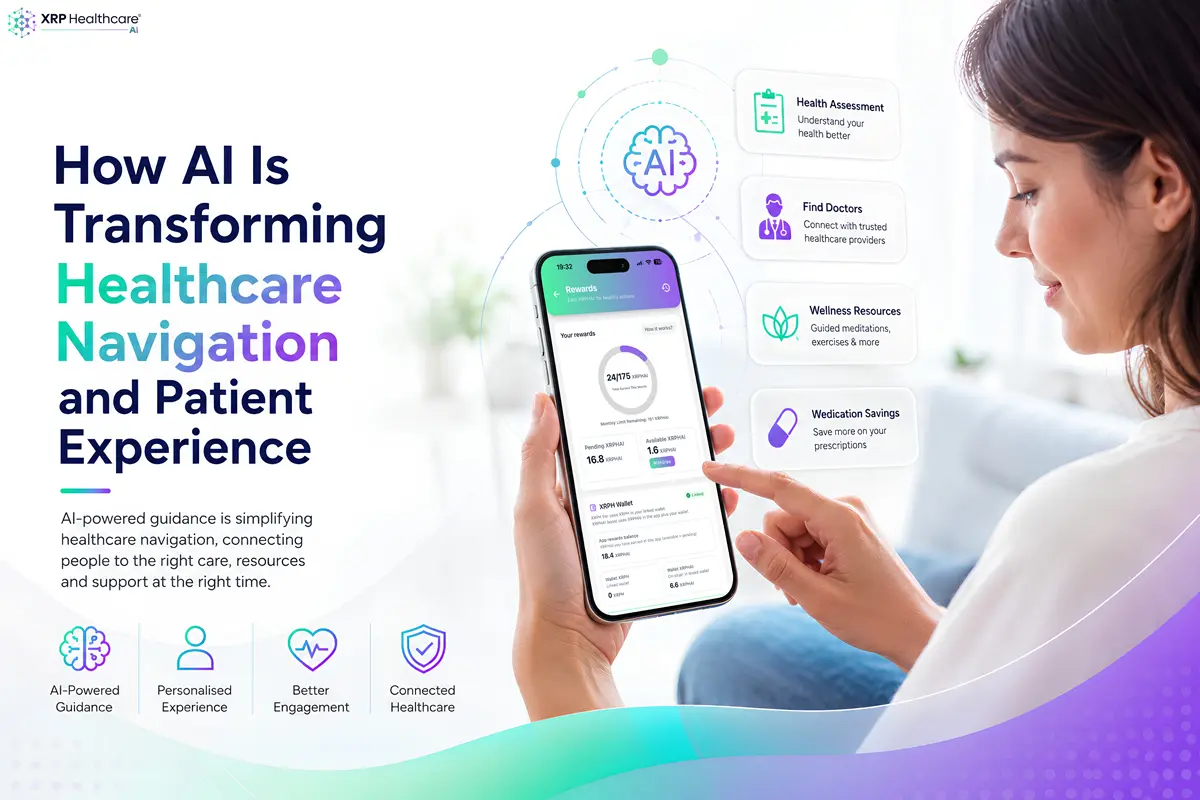
Through the XRPH AI App, users already have access to AI-powered health assessments, Doctor Finder, Prescription Savings, CalmXRPH, Proof Of Health™ and other healthcare engagement tools.
As the platform continues to evolve, artificial intelligence will increasingly help users discover these services through personalised recommendations, intelligent navigation and connected healthcare journeys.
The long-term vision is to build an AI-powered healthcare ecosystem where intelligent guidance helps individuals take greater control of their health while making valuable healthcare resources easier to access.
Healthcare continues to become more digital, more connected and more personalised.
Artificial intelligence is helping simplify this transformation by making healthcare easier to navigate and more relevant to each individual.
Rather than overwhelming users with features, AI Health Advisors help create intelligent healthcare journeys that encourage continuous engagement and healthier daily decisions.
As healthcare technology continues to evolve, intelligent navigation may become one of the defining characteristics of next-generation digital healthcare platforms.
The future of healthcare will not simply depend on having more digital tools.
It will depend on making those tools work together intelligently for every individual.
What is AI healthcare navigation?
AI healthcare navigation uses artificial intelligence to help individuals discover relevant healthcare resources, services and next steps through personalised guidance rather than requiring users to search manually.
Why is healthcare navigation important?
As healthcare becomes increasingly digital, good navigation helps people find the right resources more quickly, reduces confusion and improves the overall patient experience.
How do AI Health Advisors improve navigation?
AI Health Advisors recommend relevant healthcare actions based on user goals, previous engagement and available healthcare services, making digital healthcare more intuitive and easier to use.
Can AI personalise healthcare journeys?
Yes. Artificial intelligence can provide increasingly relevant recommendations by understanding user preferences and previous interactions while respecting privacy and maintaining user control.
How is XRP Healthcare improving healthcare navigation?
XRP Healthcare is developing AI-powered technologies through the XRPH AI App that help users access health assessments, wellbeing tools, Doctor Finder, Prescription Savings, Proof Of Health™ and other healthcare resources through intelligent engagement.