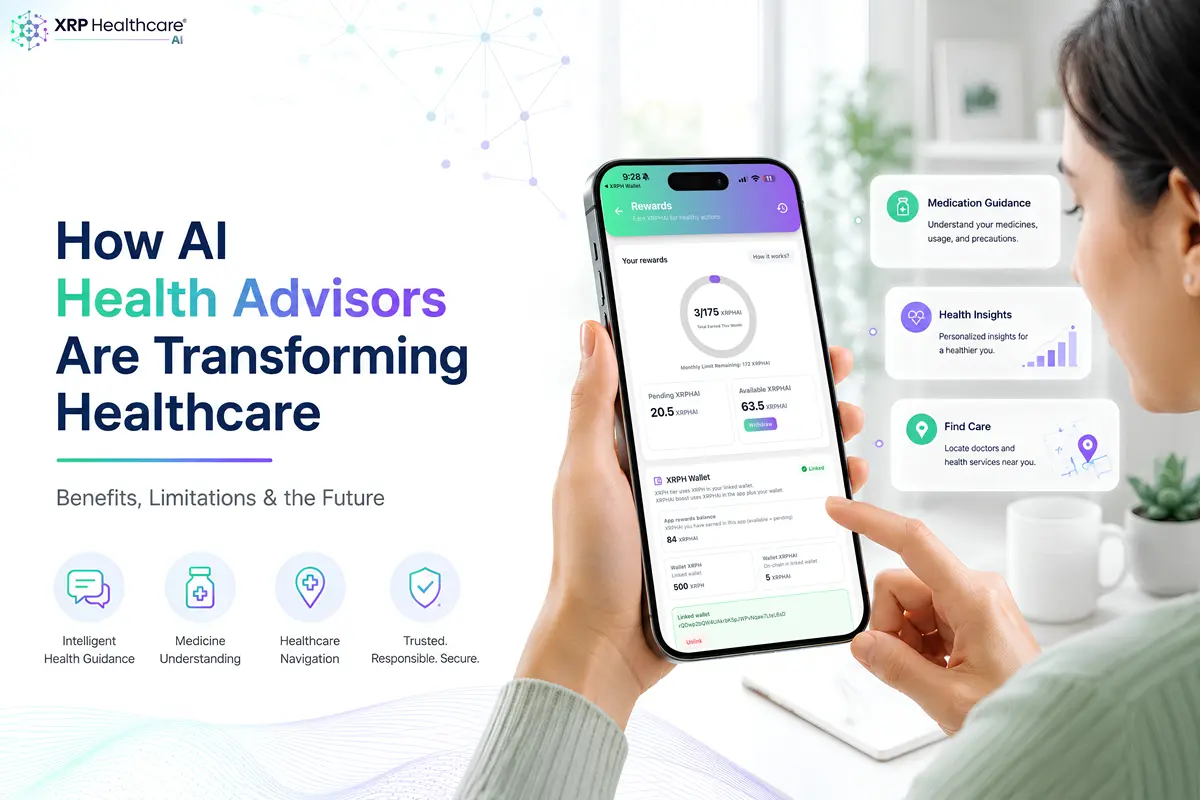
Healthcare has always relied on access to accurate information, timely decisions and trusted medical professionals. Yet for millions of people around the world, obtaining clear healthcare guidance can still be confusing, time-consuming and, in some cases, overwhelming.
Questions about medicines, prescriptions, common illnesses and healthy lifestyle choices often arise outside of a doctor's appointment. Many people turn to internet searches, online forums or social media for answers, where the quality of information can vary significantly.
Artificial intelligence is beginning to change this landscape.
A new generation of intelligent healthcare assistants-commonly referred to as AI Health Advisors-is helping people access reliable healthcare information more quickly while encouraging them to seek appropriate professional medical advice when necessary.
Rather than replacing healthcare professionals, these systems are designed to support patients throughout their healthcare journey by improving understanding, simplifying complex information and making healthcare services easier to navigate.
This evolution represents one of the most significant developments in digital healthcare and is helping shape a future where healthcare information becomes more accessible, more personalised and easier to understand.
To explore how intelligent healthcare technologies fit into the wider future of digital medicine, visit our comprehensive AI Healthcare Platform guide.
What Is an AI Health Advisor?
An AI Health Advisor is an intelligent software system designed to help people understand healthcare information through natural conversation.
Unlike a traditional search engine, which simply returns a list of websites, an AI Health Advisor can interpret questions, maintain context throughout a conversation and explain healthcare topics in clear, easy-to-understand language.
For example, instead of searching multiple websites to understand a medication, users can ask an AI Health Advisor direct questions about its purpose, general usage, common side effects or when they should speak with a healthcare professional.
The objective is not to provide medical diagnoses or replace clinical expertise. Instead, the goal is to improve health literacy by making reliable healthcare information easier to access and understand.
This approach can help users feel more confident when preparing for appointments, discussing treatment options or managing everyday healthcare decisions.
Why AI Health Advisors Matter
Modern healthcare systems face increasing pressure from ageing populations, growing demand for services and rising healthcare costs.
At the same time, patients expect faster access to information and more personalised experiences.
AI Health Advisors can help bridge this gap by providing immediate educational guidance while allowing healthcare professionals to focus on diagnosis, treatment and patient care.
Some of the ways these systems can assist include:
- Explaining medical terminology in plain English.
- Helping users understand medicines and their intended purpose.
- Providing educational information about common health conditions.
- Encouraging preventative healthcare and healthier daily habits.
- Helping users prepare relevant questions before visiting a healthcare professional.
- Supporting people as they navigate healthcare services.
By making healthcare information easier to understand, AI Health Advisors have the potential to improve patient confidence and encourage more informed conversations with qualified medical professionals.
From Search Engines to Intelligent Healthcare Guidance
For many years, searching for healthcare information meant entering keywords into a search engine and browsing through dozens of articles, discussion forums and medical websites.
Although this approach provides access to enormous amounts of information, it often requires users to determine which sources are trustworthy and which advice is relevant to their situation.
AI Health Advisors introduce a different model.
Instead of simply presenting links, they are designed to interpret questions, provide context, explain complex medical concepts in plain language and guide users towards appropriate next steps.
For example, someone asking about a prescription medicine may also want to understand:
- What the medicine is commonly used for.
- General guidance on how it should be taken.
- Possible side effects they should discuss with a healthcare professional.
- Whether there are participating pharmacies offering prescription savings.
- What questions they should ask during their next appointment.
Rather than treating these as separate searches, an AI Health Advisor can present them as part of one connected conversation, making the experience simpler and more intuitive.
The Importance of Responsible Healthcare AI
As AI becomes more capable, responsible design becomes increasingly important.
Healthcare information should always be presented in a way that encourages users to seek professional medical advice whenever appropriate.
A well-designed AI Health Advisor should recognise its role as an educational and navigational tool-not a substitute for qualified healthcare professionals.
Responsible AI healthcare platforms should:
- Clearly explain that AI does not replace medical diagnosis.
- Encourage users to consult healthcare professionals for treatment decisions.
- Present healthcare information in clear, understandable language.
- Help users prepare for discussions with doctors, pharmacists and other clinicians.
- Support better health literacy rather than self-diagnosis.
These principles help ensure that AI strengthens the relationship between patients and healthcare professionals instead of attempting to replace it.
Introducing the XRPHAI App's AI Health Advisor
The XRPHAI App is being developed to provide an intelligent AI Health Advisor that supports users throughout different stages of their healthcare journey.
Rather than acting as a standalone chatbot, the AI Health Advisor forms part of a broader AI Healthcare Platform that brings together healthcare guidance, medicine information, prescription savings, Doctor Finder and future intelligent health services.
Its objective is to help users make better-informed decisions by providing accessible healthcare information while encouraging appropriate professional care.
As the platform continues to evolve, additional intelligent capabilities will further improve the way users navigate everyday healthcare questions, making digital healthcare more practical, connected and user-focused.
END OF PART 1
Excellent. Below is Part 2 of Blog #2, completing the developer-ready package.
Real-World Applications of AI Health Advisors
The value of an AI Health Advisor becomes most apparent when applied to everyday healthcare situations. Many health-related questions arise outside a clinical setting, often at times when immediate access to a healthcare professional is not available.
An AI Health Advisor can provide educational support in a variety of scenarios, including:
- Understanding what a prescribed medicine is commonly used for.
- Explaining medical terminology in simpler language.
- Helping users prepare questions before visiting a doctor.
- Providing general information about common health conditions.
- Supporting healthier lifestyle choices through educational guidance.
- Helping users navigate available healthcare services.
By reducing confusion and improving access to understandable healthcare information, AI Health Advisors can empower users to take a more active role in their own health while recognising the importance of professional medical care.
Helping Users Better Understand Medicines
Medicines are among the most common reasons people search for healthcare information online.
Questions such as:
- What is this medicine for?
- How should it be taken?
- What are the common side effects?
- Are there any precautions I should discuss with my doctor?