Jul 30, 2026
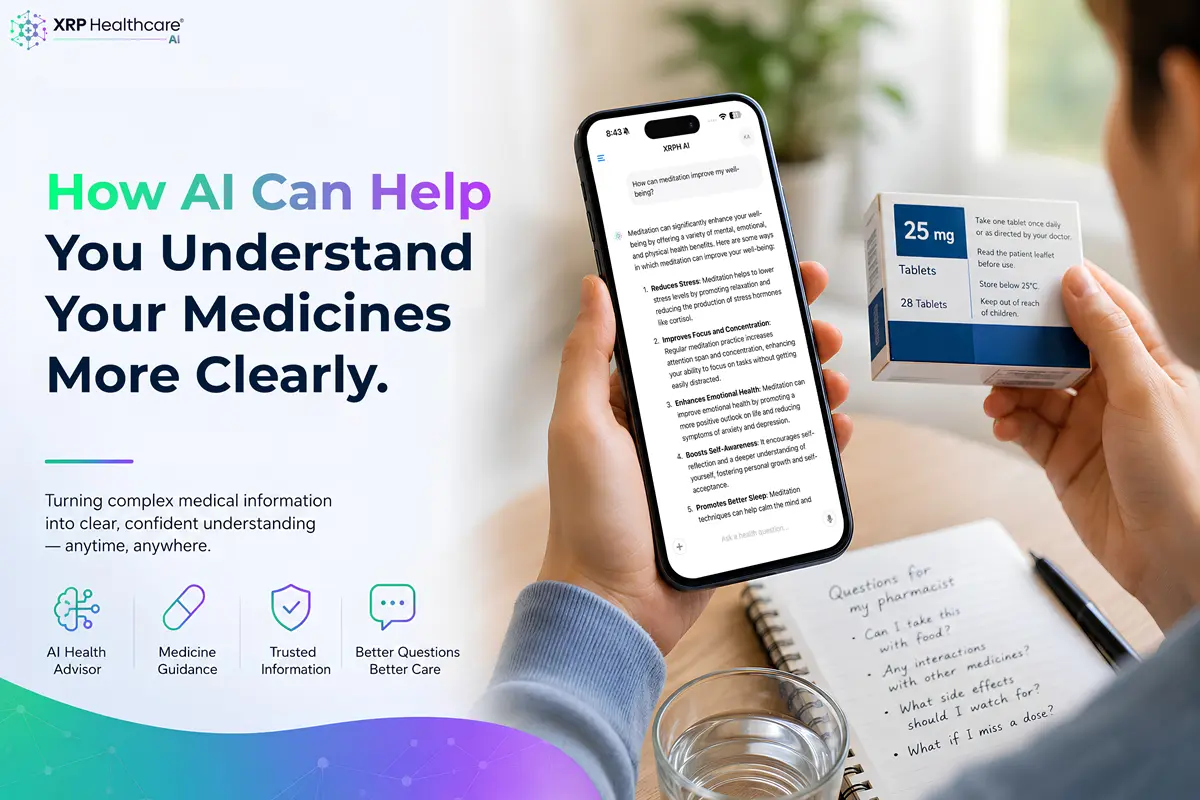
How AI Can Help You Understand Your Medicines More Clearly
Learn how AI-powered medicine guidance helps explain medications, improve health literacy and support informed conversations with healthcare professionals.
Retail network access is facilitated through agreements with United Networks of America (UNA). Display of pharmacy brand marks does not imply ownership, endorsement, or direct partnership with XRP Healthcare M&A Holding Inc.
Technology partnerships reflect collaborative or project-based cooperation. Display does not imply equity ownership or endorsement unless expressly stated.
Pharmaceutical and supply relationships reflect existing commercial arrangements within acquired operating entities. Display does not imply exclusivity or endorsement beyond standard commercial supply agreements.
Advisors provide professional services to XRP Healthcare M&A Holding Inc. No partnership or ownership interest is implied unless publicly disclosed.
All third-party trademarks remain the property of their respective owners. Display does not imply endorsement, ownership, or partnership unless expressly stated.
Jul 30, 2026
Learn how AI-powered medicine guidance helps explain medications, improve health literacy and support informed conversations with healthcare professionals.
Medicines play an essential role in modern healthcare, helping millions of people manage illnesses, control long-term conditions and recover from injury or disease.
Yet many patients leave a doctor's surgery or pharmacy with unanswered questions.
They may wonder:
What exactly does this medicine do?
How should I take it?
What if I miss a dose?
Can I take it with food?
What side effects should I be aware of?
When should I contact my doctor?
These are common and understandable concerns.
Healthcare professionals work hard to explain medicines clearly, but appointments are often short, and patients may not remember every detail once they return home.
Artificial intelligence is helping bridge this gap by making medicine information easier to understand, more accessible and available whenever users need it.
Rather than replacing doctors or pharmacists, AI acts as an educational companion that helps people better understand their prescribed medicines and prepare informed questions for healthcare professionals.
To learn more about how intelligent healthcare technologies are reshaping patient education, explore our comprehensive AI Healthcare Platform guide.
Taking medicines correctly is one of the most important parts of successful treatment.
However, misunderstanding medication instructions remains surprisingly common.
People may forget:
Why a medicine was prescribed.
How often it should be taken.
Whether it should be taken with food.
What to do if they miss a dose.
When to seek medical advice.
These misunderstandings can reduce the effectiveness of treatment and create unnecessary anxiety.
Helping people better understand their medicines improves confidence, supports adherence to prescribed treatment plans and encourages more productive conversations with healthcare professionals.
Medicine information often contains unfamiliar medical terminology.
Words such as contraindications, interactions, dosage schedules and therapeutic indications may be difficult for many people to interpret without explanation.
Even patient information leaflets, while comprehensive, can feel overwhelming.
Artificial intelligence helps translate complex medical language into clear, everyday explanations that are easier for people to understand.
This improved accessibility contributes to better health literacy and allows patients to feel more confident managing their treatment.
AI medicine guidance is an educational feature that helps users understand medicines through natural language conversations.
Instead of searching multiple websites or reading lengthy documentation, users can ask straightforward questions such as:
What is this medicine used for?
How does it work?
Why has my doctor prescribed it?
What are commonly reported side effects?
What questions should I ask my pharmacist?
The AI responds with educational information presented in an easy-to-understand format while encouraging users to seek personalised advice from qualified healthcare professionals.
This conversational approach makes healthcare information more approachable for people with different levels of medical knowledge.
Artificial intelligence does not replace the expertise of doctors, nurses or pharmacists.
Instead, it helps patients prepare for more meaningful discussions.
For example, after reading educational information about a medicine, a patient may ask their pharmacist:
Is this medicine suitable alongside my other prescriptions?
Should I avoid certain foods or drinks?
What should I do if I experience a side effect?
When should I expect the medicine to begin working?
Better-informed questions often lead to better-informed patients.
Healthcare professionals remain responsible for diagnosis, prescribing and treatment decisions, while AI helps improve communication and understanding.
One of artificial intelligence's greatest strengths is making healthcare information available whenever people need it.
Rather than waiting until the next appointment, users can access educational guidance at any time to reinforce what they have already been told by their healthcare professional.
This accessibility can be particularly valuable for:
Older adults managing multiple medicines.
Individuals newly diagnosed with long-term conditions.
Parents caring for children.
People supporting elderly relatives.
Anyone prescribed a new medication.
By making trustworthy healthcare education easier to access, AI helps people feel more confident throughout their treatment journey.
The XRPHAI App has been developed to make healthcare information easier to understand through intelligent, conversational guidance.
Medicine education forms part of a wider AI Healthcare Platform that also includes:
AI Health Advisor.
Prescription Savings.
Doctor Finder.
Continue Health Journey.
Voice AI.
Personalised healthcare engagement.
Future Proof of Health™ initiatives.
By connecting these services within one platform, XRP Healthcare aims to support users throughout their healthcare journey while always encouraging appropriate professional medical care.
Health literacy is the ability to find, understand and use health information to make informed decisions.
When people understand their medicines, they are more likely to:
Follow prescribed treatment plans.
Recognise when to seek advice.
Communicate effectively with healthcare professionals.
Feel confident managing their health.
Artificial intelligence cannot replace medical expertise, but it can make healthcare information significantly easier to understand.
Improving health literacy is one of the most important ways AI can positively support patients around the world.
Artificial intelligence is helping make medicine information easier to understand by providing educational guidance in a conversational format. Rather than replacing healthcare professionals, AI supports patients by helping them better understand their treatment and prepare for informed discussions with their doctor or pharmacist.
Here are some practical examples.
A patient has just been prescribed a medicine for high blood pressure. After returning home, they realise they have forgotten some of the information discussed during the appointment.
Using an AI Health Advisor, they can learn:
What the medicine is generally used for.
Why controlling blood pressure is important.
Questions they may wish to ask at their next appointment.
General information about taking the medication as directed.
The AI reinforces educational information while encouraging the patient to follow their doctor's instructions.
Someone experiences mild nausea after beginning a new prescription.
Instead of assuming the medication is unsuitable, they use AI to learn about commonly reported side effects and understand when they should contact their pharmacist or healthcare professional.
The AI provides educational guidance while making it clear that persistent, severe or concerning symptoms should always be assessed by a qualified clinician.
A patient collecting a prescription wants to make the most of their conversation with the pharmacist.
Before visiting, they use AI to generate useful questions, such as:
Should this medicine be taken with food?
Are there any commonly reported interactions I should ask about?
How should I store this medicine?
What should I do if I accidentally miss a dose?
Better preparation often leads to more productive conversations and greater confidence in managing treatment.
One of the biggest challenges in healthcare is medication adherence-the extent to which patients take medicines exactly as prescribed.
People sometimes miss doses because they:
Forget why the medicine is important.
Do not fully understand the treatment plan.
Feel uncertain about instructions.
Become concerned after reading conflicting information online.
Artificial intelligence cannot guarantee adherence, but it can support it by helping people better understand the purpose of their medication and reinforcing educational information provided by healthcare professionals.
When patients understand why a medicine has been prescribed, they are often more confident in following their treatment plan.
Used responsibly, AI medicine guidance offers a number of important benefits.
These include:
Explaining medicines in plain, everyday language.
Improving health literacy.
Helping patients prepare for medical appointments.
Supporting conversations with pharmacists.
Reinforcing healthcare education after appointments.
Making reliable medicine information easier to access.
Reducing confusion caused by fragmented internet searches.
Encouraging informed healthcare decisions.
By improving understanding rather than replacing clinical care, AI contributes to a more informed and engaged patient experience.
Artificial intelligence has become an increasingly valuable educational tool, but it also has clear limitations.
AI cannot:
Replace a doctor's diagnosis.
Prescribe medicines.
Adjust prescribed dosages.
Decide whether a medication is appropriate for a particular individual.
Interpret every aspect of a person's medical history.
Replace advice from a pharmacist.
Healthcare professionals consider many factors that AI cannot fully assess, including physical examinations, laboratory results, medical history and clinical judgement.
For this reason, medication decisions should always be made with appropriately qualified healthcare professionals.
The most effective healthcare combines technology with professional expertise.
Artificial intelligence works best when it helps people become more informed participants in their own healthcare.
Patients should always:
Take medicines exactly as prescribed.
Read official patient information supplied with their medication.
Discuss concerns with their pharmacist or doctor.
Never stop or change medication without professional advice.
Seek urgent medical attention if they experience signs of a serious allergic reaction or other medical emergency.
Responsible AI supports these behaviours by encouraging users to work closely with healthcare professionals rather than relying solely on technology.
Artificial intelligence is expected to make medicine education increasingly personalised over the coming years.
Future developments may include:
More natural voice conversations.
Improved multilingual medicine guidance.
Better explanations tailored to different levels of health literacy.
Smarter educational journeys based on previous interactions.
Enhanced support for people managing multiple medicines.
Improved integration with trusted healthcare services.
These advances have the potential to make medicine information more accessible while continuing to prioritise safety, privacy and responsible use.
The XRPHAI App has been designed to help people better understand healthcare information through intelligent, accessible education.
Rather than functioning as a standalone medicine database, it forms part of a broader AI Healthcare Platform that brings together:
AI Health Advisor.
Medicine guidance.
Prescription Savings.
Doctor Finder.
Continue Health Journey.
Voice AI.
Personalised healthcare engagement.
Future Proof of Health™ initiatives.
By integrating these capabilities into a single platform, XRP Healthcare aims to make healthcare information easier to access, easier to understand and easier to act upon-while always recognising the essential role of qualified healthcare professionals.
Understanding medicines is an essential part of effective healthcare.
Artificial intelligence is helping bridge the gap between medical appointments and everyday life by making medicine information more understandable, accessible and available whenever people need it.
Rather than replacing doctors or pharmacists, AI supports health literacy by explaining healthcare concepts in plain language, helping users prepare for conversations with healthcare professionals and encouraging responsible medication use.
The XRPHAI App brings these capabilities together within one connected AI Healthcare Platform, combining medicine guidance with AI Health Advisor, Prescription Savings and personalised healthcare tools to help people become more informed and confident participants in their own healthcare.
As digital healthcare continues to evolve, better medicine education has the potential to improve patient understanding, strengthen communication with healthcare professionals and contribute to safer, more informed healthcare decisions.
Discover how the XRPHAI App combines AI-powered medicine guidance, healthcare education and practical healthcare tools to help you better understand your treatment while complementing the advice of qualified healthcare professionals.
Explore how AI-powered medicine guidance, healthcare education and Prescription Savings are working together within the XRPHAI App.
Continue your journey:
AI medicine guidance provides educational information about medicines using conversational artificial intelligence. It helps users understand medications more clearly but does not replace professional medical advice.
AI can explain the general purpose of many medicines and provide educational information, but treatment decisions should always come from your healthcare professional.
No. Pharmacists provide personalised advice based on your prescription, medical history and individual circumstances. AI is designed to support-not replace-their expertise.
Yes. AI can provide educational information about commonly reported side effects while encouraging users to seek professional advice if they experience concerning symptoms.
Always follow the instructions provided with your medicine or contact your pharmacist or prescribing clinician for advice. AI can explain general guidance but should not replace personalised medical recommendations.
Yes. AI can help you organise questions, understand medical terminology and prepare for discussions with your doctor or pharmacist.
Yes. Medicine guidance is one of the core features within the XRPHAI App, alongside the AI Health Advisor, Prescription Savings, Doctor Finder and other healthcare tools.
AI can provide general educational information about medicines, but potential interactions should always be discussed with a pharmacist or healthcare professional who has access to your complete medical history.
AI medicine guidance can improve health literacy for many people, but it should always be used alongside professional healthcare advice.
Visit the AI Healthcare Platform page to discover how XRP Healthcare is using artificial intelligence to make medicine education and healthcare information more accessible.