Jul 16, 2026
How AI Agents Are Transforming Healthcare
Discover how AI agents are transforming healthcare through intelligent guidance, personalised patient engagement and connected digital healthcare experiences.
Retail network access is facilitated through agreements with United Networks of America (UNA). Display of pharmacy brand marks does not imply ownership, endorsement, or direct partnership with XRP Healthcare M&A Holding Inc.
Technology partnerships reflect collaborative or project-based cooperation. Display does not imply equity ownership or endorsement unless expressly stated.
Pharmaceutical and supply relationships reflect existing commercial arrangements within acquired operating entities. Display does not imply exclusivity or endorsement beyond standard commercial supply agreements.
Advisors provide professional services to XRP Healthcare M&A Holding Inc. No partnership or ownership interest is implied unless publicly disclosed.
All third-party trademarks remain the property of their respective owners. Display does not imply endorsement, ownership, or partnership unless expressly stated.
Jul 16, 2026
Discover how AI agents are transforming healthcare through intelligent guidance, personalised patient engagement and connected digital healthcare experiences.
Artificial intelligence is evolving at an extraordinary pace.
Only a few years ago, most people associated AI with chatbots capable of answering questions or generating written content.
Today, a new generation of artificial intelligence is emerging.
These systems are known as AI agents.
Unlike traditional AI assistants, AI agents are designed to understand objectives, make decisions, coordinate tasks and help users achieve meaningful outcomes.
This shift is particularly significant for healthcare.
Healthcare is rarely solved through a single conversation.
It requires continuous engagement, intelligent guidance and the ability to connect many different healthcare services into one cohesive experience.
AI agents are uniquely suited to support this transformation.
An AI agent is more than a chatbot.
Rather than simply responding to prompts, an AI agent works towards achieving a goal.
It can evaluate available information, determine appropriate next steps and coordinate multiple actions while adapting to changing circumstances.
In healthcare, this means artificial intelligence can move beyond answering health questions to actively helping users navigate their healthcare journey.
Instead of acting as an information source, AI agents become intelligent healthcare partners that help people make better use of available healthcare resources.
Healthcare is one of the most complex industries in the world.
Individuals often need to:
Understand health information.
Locate healthcare providers.
Monitor wellbeing.
Build healthier habits.
Access educational resources.
Navigate healthcare systems.
Stay engaged with long-term health goals.
Managing these activities independently can be challenging.
AI agents have the potential to simplify this complexity by intelligently guiding users through healthcare journeys based on their goals and previous engagement.
This creates a more accessible and more personalised healthcare experience.
When people hear the term "AI agent", they often think about automation.
Automation is certainly one capability.
However, the greatest opportunity in healthcare lies elsewhere.
AI agents can help people make better decisions.
They can reduce complexity.
They can personalise guidance.
They can encourage healthier behaviours.
Rather than replacing human judgement, AI agents support users by helping them understand which actions are most relevant at a particular moment.
The emphasis is on intelligent assistance rather than automation alone.
Healthcare is not an event.
It is an ongoing journey.
Someone interested in improving sleep today may later focus on nutrition.
Another person may begin with stress management before exploring preventive healthcare.
Healthcare priorities evolve over time.
AI agents are particularly valuable because they can adapt alongside these changing needs.
Instead of treating each interaction independently, intelligent healthcare systems can provide increasingly relevant guidance that reflects each individual's ongoing healthcare journey.
Every healthcare journey is unique.
Different people require different types of support.
Artificial intelligence allows healthcare experiences to become increasingly personalised by understanding user goals, preferences and patterns of engagement.
This enables AI agents to recommend the most relevant healthcare resources rather than overwhelming users with every available option.
Personalisation reduces friction, simplifies decision-making and encourages greater long-term participation.
Modern healthcare platforms often include many valuable services.
Health assessments
Wellbeing tools
Healthcare providers
Educational resources
Medication savings
Preventive healthcare
The challenge is helping these services work together.
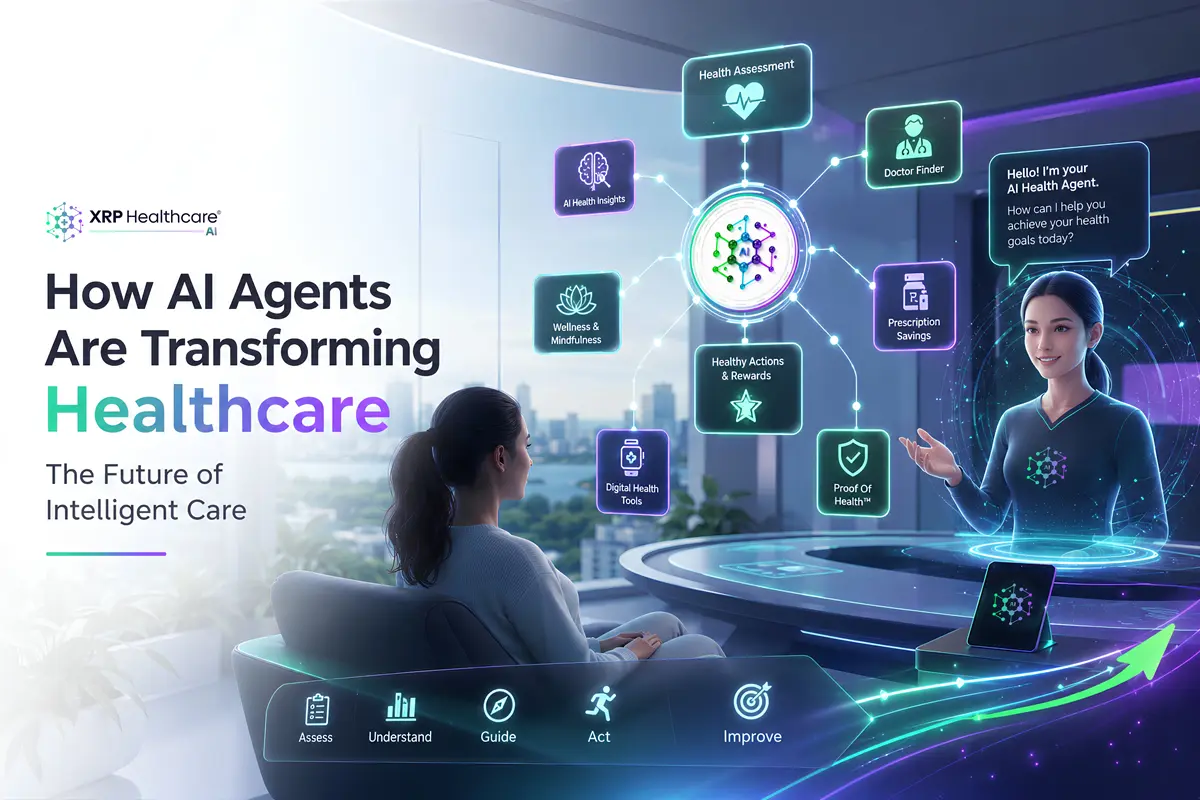
AI agents act as intelligent coordinators that connect these capabilities into one seamless experience.
Instead of presenting isolated features, they help users move naturally through a connected healthcare journey.
This creates a platform that feels intuitive rather than fragmented.
The future of healthcare is not simply about providing more digital tools.
It is about making those tools work together intelligently.
AI agents represent an important step towards this future by helping users engage more consistently with their health while reducing the complexity often associated with healthcare.
Rather than reacting to individual questions, intelligent healthcare systems can proactively support healthier daily engagement.
This represents one of the most exciting opportunities in digital healthcare today.
AI agents become significantly more powerful when they are connected to the right information and healthcare services.
In healthcare, intelligence is not created simply by adding more features.
It comes from intelligently coordinating those features into one connected experience.
This is where a Healthcare Intelligence Layer becomes essential.
Rather than treating health assessments, wellbeing tools, healthcare providers, educational resources and medication savings as separate functions, AI agents can intelligently connect them into personalised healthcare journeys.
Instead of asking users to decide what they should do next, artificial intelligence can recommend relevant actions based on context, previous engagement and individual goals.
This transforms digital healthcare into an experience that feels simpler, more intuitive and more supportive.
Healthcare is dynamic.
People's priorities evolve throughout their lives.
Someone focused on improving fitness today may later become interested in stress management, nutrition or preventive healthcare.
AI agents become more valuable because they can adapt alongside these changing needs.
Rather than treating every interaction independently, intelligent systems can provide increasingly relevant guidance by understanding previous engagement while respecting user privacy and maintaining transparency.
This continuity creates a healthcare experience that grows alongside the individual instead of restarting with every session.
Healthcare often presents people with many choices.
Which resource should they use?
Which healthcare provider is appropriate?
Which educational content is most relevant?
Too many options can create uncertainty.
AI agents help reduce this complexity by recommending actions that are most likely to support each individual's healthcare goals.
Instead of presenting every available feature equally, artificial intelligence can surface the most relevant healthcare resources at the right moment.
This improves confidence, reduces decision fatigue and encourages greater long-term engagement.
Improving health rarely depends upon one major decision.
It is usually the result of many smaller decisions repeated consistently.
Learning about health
Completing assessments
Managing stress
Remaining physically active
Monitoring wellbeing
Building healthier routines
Artificial intelligence supports these behaviours by helping users focus on achievable next steps rather than overwhelming long-term goals.
This approach aligns closely with behavioural science, which demonstrates that sustainable habits are built gradually through consistency and positive reinforcement.
AI agents can help make these healthy routines easier to maintain.
Artificial intelligence should strengthen healthcare, not replace it.
Doctors, nurses, pharmacists and other healthcare professionals remain essential for diagnosis, treatment and clinical care.
AI agents complement this expertise by improving education, navigation and engagement between clinical interactions.
Help individuals access healthcare resources more easily
Encourage preventive healthcare
Simplify digital health experiences
Support healthier daily behaviours
The result is a partnership where intelligent technology enhances accessibility while healthcare professionals continue providing expert clinical care.
Healthcare is becoming increasingly interconnected.
Health assessments
Preventive healthcare
Mental wellbeing
Healthcare providers
Medication savings
Educational resources
Artificial intelligence enables these services to work together as one coordinated ecosystem rather than separate applications.
Instead of isolated interactions, users experience connected healthcare journeys where each activity naturally leads to the next appropriate step.
This improves usability while encouraging greater participation across the healthcare ecosystem.
XRP Healthcare believes the future of healthcare lies in intelligent engagement rather than disconnected digital experiences.
Through the XRPH AI App, users already have access to AI-powered health assessments, Doctor Finder, Prescription Savings, CalmXRPH, Proof Of Health™ and additional healthcare engagement tools.
As the platform evolves, intelligent AI technologies are expected to help users navigate these services through more personalised recommendations, connected healthcare journeys and continuous engagement.
The Company's long-term vision is to create an intelligent healthcare ecosystem where artificial intelligence helps simplify healthcare, encourage healthier daily participation and improve access to valuable healthcare resources.
AI agents represent one of the most significant developments in modern artificial intelligence.
Within healthcare, they offer the opportunity to move beyond simple conversations towards intelligent guidance, connected healthcare journeys and personalised engagement.
Rather than replacing healthcare professionals, AI agents help people make better use of healthcare resources while supporting healthier long-term behaviours.
As healthcare continues to become more digital and more personalised, intelligent AI agents are likely to become an important foundation of next-generation healthcare platforms.
The future of healthcare is not simply about artificial intelligence.
It is about using intelligence responsibly to help people lead healthier lives.
What is an AI agent in healthcare?
An AI healthcare agent is an intelligent software system that helps users navigate healthcare resources, understand information and receive personalised guidance based on their healthcare journey.
How are AI agents different from AI chatbots?
AI chatbots primarily answer questions. AI agents are designed to understand goals, coordinate multiple actions and guide users through more complex healthcare experiences.
Can AI agents improve patient engagement?
Yes. AI agents can encourage continuous healthcare engagement by providing personalised recommendations, simplifying healthcare navigation and helping individuals discover relevant healthcare resources.
Will AI agents replace healthcare professionals?
No. AI agents complement healthcare professionals by improving accessibility, education and engagement while leaving diagnosis and treatment to qualified clinicians.
How is XRP Healthcare using AI agents?
XRP Healthcare is developing intelligent engagement technologies within the XRPH AI App to help users navigate healthcare services, discover valuable resources and build healthier long-term habits through personalised AI guidance.