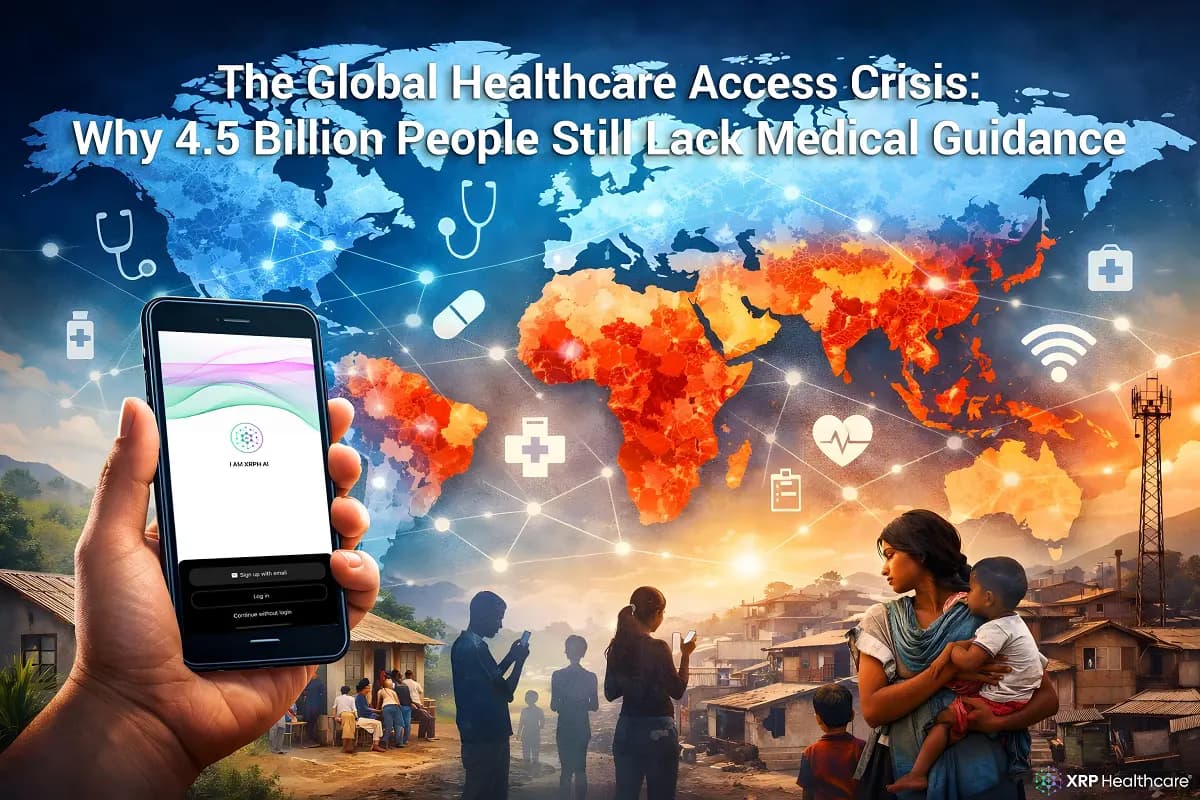
Introduction: The Global Healthcare Gap
Healthcare access remains one of the greatest global challenges of the 21st century. While technology has transformed industries such as banking, communications, and transportation, healthcare delivery remains fragmented, expensive, and unevenly distributed.
Today, over 4.5 billion people worldwide lack access to essential healthcare services. Millions more struggle to obtain reliable medical guidance, affordable medications, and trusted healthcare information. Digital innovation offers hope, but technology alone cannot solve the healthcare access crisis.
Platforms like XRPH AI aim to bridge this gap by combining artificial intelligence, digital healthcare tools, and real-world healthcare infrastructure.
The Scale of the Global Healthcare Problem
Despite massive progress in medical science, healthcare access remains deeply unequal. Several key challenges drive the global healthcare crisis:
Lack of Medical Access
Billions of people live in regions where access to trained healthcare professionals is limited. In many areas, individuals must travel long distances or wait weeks to consult doctors or specialists. This delay in care leads to preventable illnesses, untreated conditions, and unnecessary suffering.
Fragmented Healthcare Systems
Healthcare systems often operate in silos. Hospitals, pharmacies, insurers, and digital tools frequently operate independently, making healthcare navigation difficult for patients. Without integrated infrastructure, people struggle to access the services they need.
Rising Healthcare Costs
Healthcare costs continue to rise globally. Even in developed countries, many people delay treatment due to financial barriers, high medication costs, or lack of insurance coverage. Prescription medications alone can represent a significant burden for families.
Language and Geographic Barriers
Healthcare information is often unavailable in local languages or accessible formats. People may not understand symptoms, treatments, or medication instructions, increasing risks of misdiagnosis or misuse.
Smartphones Have Changed Everything
Despite healthcare access challenges, one statistic reveals enormous opportunity. More than 6.8 billion people worldwide now use smartphones. Mobile technology has become the primary gateway for information, communication, and digital services.
This mobile-first reality opens the door to new healthcare models that combine digital guidance with real-world services. AI-powered healthcare applications can now reach billions of users instantly.
Why Digital Healthcare Alone Is Not Enough
Many digital healthcare tools exist today. However, many suffer from the same limitations:
Standalone applications with no real-world healthcare integration
Lack of trusted medical guidance
No connection to pharmacies or healthcare providers
Limited privacy protection
Digital health tools must connect to real-world healthcare systems to deliver meaningful impact. Healthcare requires infrastructure, not just software.
Introducing the XRPH AI Healthcare Platform
XRPH AI is designed to address these challenges through an integrated digital healthcare model. The platform combines:
AI-powered health guidance
Image-based visible condition analysis
Multilingual healthcare support
Women's health tools
CalmXRPH™ stress management support
Counterfeit medicine awareness
Prescription savings access across 68,000+ U.S. pharmacies
The platform provides informational healthcare guidance only and does not replace licensed medical professionals. Instead, XRPH AI helps individuals better understand symptoms, medications, and healthcare options.
The Importance of Healthcare Infrastructure
One of the major weaknesses of digital health startups is the absence of physical healthcare infrastructure. XRPH AI takes a different approach. The broader strategy includes pharmacy acquisition and healthcare infrastructure expansion, particularly within emerging healthcare markets. This includes:
Licensed pharmaceutical operations
Wholesale medicine distribution centers
Retail pharmacy networks
Participation in regional healthcare supply chains
Infrastructure ensures digital healthcare platforms can support real-world healthcare delivery.
Privacy and Security in Digital Healthcare
Healthcare data is among the most sensitive information a person can share. XRPH AI therefore operates under a privacy-first architecture designed to protect users. Key privacy principles include:
No storage of personal health information (PHI)
HIPAA-grade security standards
Secure digital infrastructure
Transparent system governance
This design enables healthcare guidance without compromising user privacy.
How AI Can Expand Healthcare Access
Artificial intelligence can significantly improve healthcare access by:
Providing instant symptom guidance
Helping users understand medical information
Supporting preventative healthcare decisions
Delivering multilingual medical insights
Connecting users with healthcare providers and pharmacies
AI cannot replace doctors, but it can extend healthcare knowledge to billions of people instantly.
Structured Engagement and Digital Utility
Digital platforms increasingly incorporate engagement systems to encourage participation and long-term adoption. Within the XRPH AI ecosystem, engagement mechanisms are designed around verified user interaction and structured governance controls.
These systems reward meaningful participation rather than passive speculation. Importantly, these mechanisms operate independently from the core healthcare delivery model.
A New Model for Digital Healthcare
The future of healthcare will likely combine three critical components:
AI-powered digital guidance
Real-world healthcare infrastructure
Privacy-first digital systems
Platforms capable of integrating these elements can help close the global healthcare access gap. XRPH AI represents one example of this emerging model.
FAQ SECTION
Why do billions of people lack healthcare access?
Healthcare infrastructure is unevenly distributed globally. Many regions lack doctors, hospitals, pharmacies, and reliable healthcare systems.
Can AI improve healthcare access?
Artificial intelligence can expand healthcare knowledge, symptom guidance, and preventative care by making medical insights accessible via smartphones.
What is XRPH AI?
XRPH AI is an AI-powered healthcare platform providing digital medical guidance, prescription savings access, and healthcare tools through a privacy-first infrastructure.
Does XRPH AI replace doctors?
No. XRPH AI provides informational guidance only and does not replace licensed medical professionals. XRPH AI App is operated by XRP Healthcare M&A Holding Inc., focused on healthcare delivery, pharmacy infrastructure, and subscription monetization.
XRPH AI token is owned and governed by XRP Healthcare LLC and licensed for structured ecosystem utility only. The token does not represent equity, ownership, dividends, governance rights, or profit participation in XRP Healthcare M&A Holding Inc.