Introduction
For much of the first generation of consumer artificial intelligence, the experience has been simple.
A user asks a question.
AI provides an answer.
That model has already transformed how millions of people access information.
But healthcare requires more than answers.
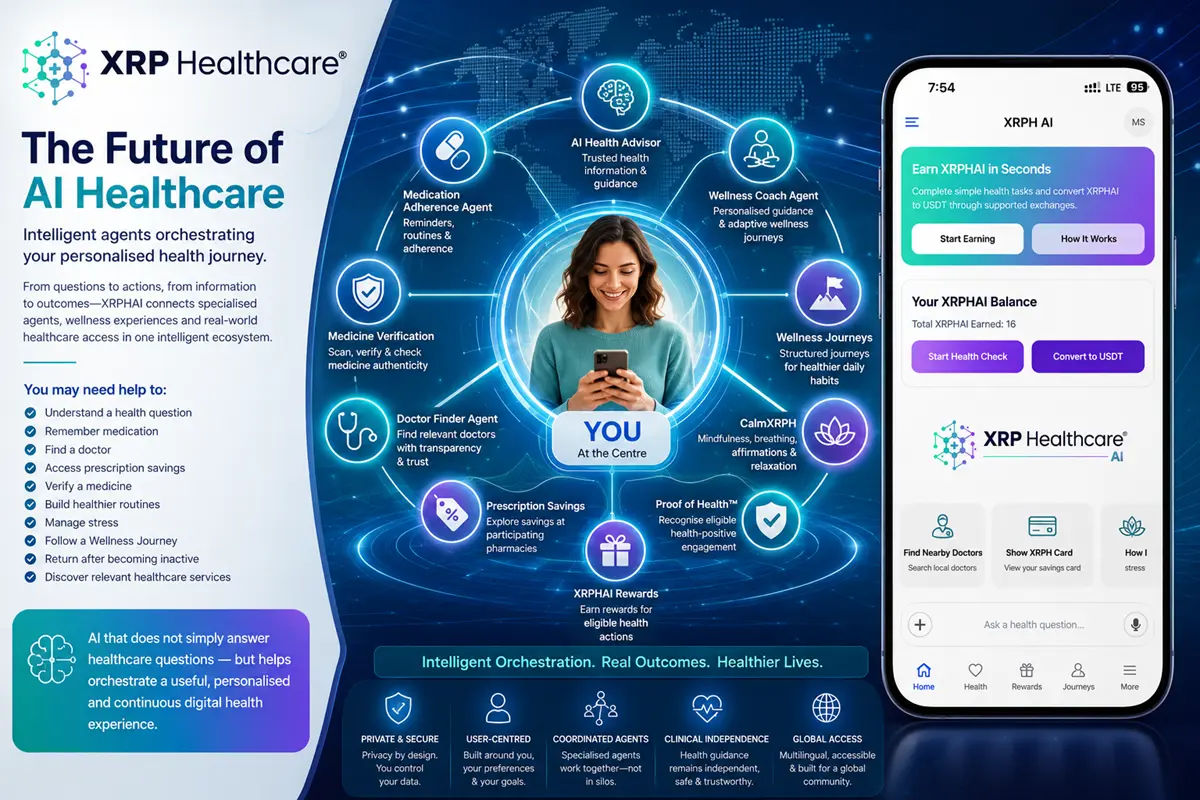
A person may need to:
understand a health question
remember medication
find a doctor
access prescription savings
verify a medicine
build healthier routines
manage stress
follow a Wellness Journey
return after becoming inactive
discover relevant healthcare services
These are not isolated moments.
They are parts of a healthcare journey.
That is why the next evolution of digital health may not simply be a more powerful healthcare chatbot.
It may be a coordinated ecosystem of specialised AI healthcare agents.
Within the evolving XRPHAI App, this creates a larger vision:
AI that does not simply answer healthcare questions - but helps orchestrate a useful, personalised and continuous digital health experience.
What Is the Future of AI Healthcare?
The future of AI healthcare is likely to involve artificial intelligence becoming more deeply integrated into how people:
access health information
navigate healthcare services
manage everyday wellness
understand medication
maintain healthy routines
communicate with healthcare systems
interact with digital health platforms
The most important change may be the transition from:
AI as a tool
to:
AI as an intelligent orchestration layer.
From Chatbots to AI Agents
User
↓
Question
↓
AI
↓
Answer
An agentic healthcare system can potentially look more like:
User Need
↓
AI identifies appropriate task
↓
Relevant specialised agent
↓
Action / Guidance / Experience
↓
Progress
↓
Next appropriate action
This changes AI from a passive information source into a more active support system.
What Is an AI Healthcare Agent?
An AI healthcare agent is an intelligent software system designed to perform or coordinate a defined healthcare-related task.
Depending on its purpose, an agent might help with:
The key principle is specialisation.
One AI does not need to perform every function.
Why Specialised Agents Matter
Healthcare is too broad for one undifferentiated AI system to treat every problem identically.
The intelligence needed to help someone remember medication is different from the intelligence needed to:
find an appropriate doctor
manage a Wellness Journey
reactivate an inactive user
manage enterprise relationships
review an advertiser
Specialisation can make the system easier to:
govern
improve
measure
audit
scale
The User Should Remain at the Centre
Agent architecture should not become technology for technology's sake.
The user should not need to understand:
Which agent is running?
They should experience:
I asked for help and the platform understood what I needed.
The complexity belongs behind the interface.
The AI Orchestration Layer
A future orchestration layer could potentially determine:
what the user needs
which agent is relevant
what context can appropriately be shared
whether human or professional escalation is required
what action should happen next
This becomes the intelligence connecting the ecosystem.
One User, Multiple Needs
Consider a hypothetical user.
They open XRPHAI and ask a general healthcare question.
The AI Health Advisor provides information.
Later, they want help remembering an established medication routine.
Medication Adherence supports them.
They begin a Wellness Journey.
The Wellness Coach helps maintain engagement.
They want a relaxation session.
CalmXRPH opens.
Later, they need to locate a healthcare professional.
Doctor Finder helps.
The user experiences:
one healthcare platform.
Behind the scenes:
multiple specialised capabilities may be working together.
AI Health Advisor
The AI Health Advisor can act as an important information layer.
Its role may include helping users:
explore general health questions
understand health concepts
prepare questions for professionals
navigate appropriate resources
It should not pretend to replace professional diagnosis or emergency care.
Healthcare Information Is Only the Beginning
Information has value.
But knowledge alone does not necessarily change behaviour.
A user may understand that sleep matters.
That does not mean they improve their sleep routine.
A user may know that medication adherence matters.
That does not mean they remember every dose.
The next generation of healthcare AI can potentially help bridge:
knowing
and
doing.
Medication Adherence Agent
The Medication Adherence Agent can potentially help users maintain established medication routines.
Possible functions may include:
It should not independently change prescriptions or medication dosage.
Medication Intelligence and Safety
Medication support may eventually connect with:
But these functions should retain their own safety boundaries.
Commercial relationships should not influence medication-safety results.
Medicine Verification
Medicine Verification can help users examine medication-related information and packaging where supported.
Future capabilities may potentially incorporate:
The goal is to help users make more informed decisions.
Counterfeit Medicine Advisor
Counterfeit medicines remain a serious global healthcare problem.
AI can potentially help users identify warning signs and navigate appropriate next steps.
However, AI should not create false certainty.
Where authenticity cannot be established, users may need to verify with:
licensed pharmacies
manufacturers
regulators
healthcare professionals
Doctor Finder
Healthcare information eventually needs to connect with real healthcare.
Doctor Finder helps bridge:
digital healthcare
and
professional healthcare access.
The platform can help users discover healthcare professionals while maintaining transparency around:
sponsored providers
partner networks
location
availability
relevance
Paid placement should never automatically mean clinical superiority.
Prescription Savings
Healthcare access also has an affordability dimension.
Prescription Savings can help eligible users explore potential savings at participating pharmacies where supported.
Savings vary.
Availability varies.
Eligibility and programme terms matter.
The important strategic point is that AI healthcare can potentially help connect:
information
with:
affordable access.
Nearby Pharmacy
Nearby Pharmacy functionality can further connect digital healthcare with physical healthcare infrastructure.
Medication Question
↓
Medicine Information
↓
Verification
↓
Nearby Pharmacy
↓
Prescription Savings where eligible
This creates a more complete user pathway.
Wellness Journeys
Healthcare is not only about illness.
It is also about the routines that shape everyday wellbeing.
Wellness Journeys can organise health-positive activities into structured experiences.
Potential journey lengths may include:
Activities can be drawn from a configurable wellness library rather than hard-coded into isolated modules.
Wellness Journeys as an Orchestration Layer
A Wellness Journey does not need to rebuild every healthcare capability.
Instead, it can orchestrate existing experiences.
Today's Journey Activity
↓
Complete a short CalmXRPH breathing session
↓
Take a short movement break
↓
Complete a gratitude activity
This allows the platform to combine existing tools into meaningful sequences.
Wellness Coach Agent
The Wellness Coach Agent can potentially personalise these journeys.
Rather than giving every user exactly the same programme, the coach can consider appropriate factors such as:
preferences
completed activities
engagement
chosen goals
available features
The result can become more adaptive over time.
CalmXRPH
CalmXRPH can become an important action layer within the wellness ecosystem.
Potential experiences may include:
affirmations
breathing
mindfulness
relaxation
soundscapes
morning sessions
evening sessions
Users may eventually choose preferences such as:
affirmation category
duration
voice
soundscape
breathing style
Personalised CalmXRPH
Different users may want different experiences.
Confidence affirmations
Gratitude
Sleep and relaxation
Wealth and abundance mindset
Peace and calm
AI can potentially personalise these experiences while still giving users direct control.
From Recommendation to Action
AI understands user need
↓
AI recommends appropriate action
↓
User launches activity
↓
User completes activity
↓
Progress is recognised
↓
Next useful action
This is more powerful than simply generating text.
Proof of Health™
Proof of Health™ can potentially provide a framework for recognising eligible health-positive engagement.
The principle is not:
prove that you are healthy.
It is:
recognise eligible actions that support positive healthcare or wellness engagement.
This distinction matters.
Proof of Health™ Is Not a Medical Score
Proof of Health™ should not become:
diagnosis
clinical risk score
employer health score
insurance health score
It should remain a framework for eligible engagement.
XRPHAI Rewards
Eligible activity may potentially connect with XRPHAI rewards according to actual programme rules.
Learn
↓
Act
↓
Complete
↓
Build Streak
↓
Proof of Health™
↓
Eligible XRPHAI Reward
↓
Continue
The objective is to support sustained engagement.
Rewards Should Support Health, Not Distort It
Rewards should not encourage:
The health-positive action remains primary.
The reward remains secondary.
Reactivation Agent
Even useful apps lose users.
People become busy.
They forget.
Their priorities change.
The Reactivation Agent can potentially identify appropriate opportunities to help inactive users return.
The objective should not be:
send more notifications.
It should be:
provide a useful reason to return.
Intelligent Reactivation
A good reactivation experience might reconnect a user with:
an unfinished Wellness Journey
a useful CalmXRPH session
an established medication routine
a relevant health feature
Reactivation should remain permission-aware and respectful.
Revenue Optimisation Agent
A sustainable healthcare platform also needs sustainable economics.
The Revenue Optimisation Agent can potentially analyse where commercial value aligns with user value.
Potential channels may include:
Premium
partnerships
enterprise
marketplace activity
advertising
The objective is not simply to extract more money from users.
It is to identify sustainable monetisation without damaging healthcare value.
Premium Conversion Agent
Some users may benefit from enhanced functionality.
The Premium Conversion Agent can potentially identify appropriate opportunities to explain premium value.
This should remain transparent.
The system should not manufacture health anxiety to create subscriptions.
Free Healthcare Value Must Remain Real
A freemium healthcare platform should not deliberately make free healthcare information unsafe or unusable to force upgrades.
Premium should add value.
It should not hold essential safety guidance hostage.
AI Referral & Ambassador Agent
Healthcare platforms can grow through trusted communities.
The AI Referral & Ambassador Agent can potentially support:
referral programmes
ambassador relationships
attribution
campaign management
community growth
Trust and disclosure remain important.
Healthcare Referrals Are Different
Healthcare referrals should not encourage people to make unsupported medical claims simply to earn rewards.
Ambassadors should clearly distinguish:
personal experience
from:
medical advice.
Partner Marketplace Agent
Users often need services beyond the platform itself.
The Partner Marketplace Agent can potentially help connect users with appropriate external providers and services.
Potential categories may include:
pharmacies
telemedicine
wellness providers
healthcare services
approved partners
Commercial relationships should remain transparent.
Marketplace Relevance vs Payment
A partner paying the platform should not automatically mean:
best healthcare option.
The system should distinguish:
relevance
sponsorship
availability
commercial relationship
Transparency protects trust.
Enterprise Agent
Healthcare AI also has an institutional opportunity.
The Enterprise Agent can potentially support relationships with:
employers
healthcare networks
pharmacy groups
insurers
universities
wellness organisations
institutional partners
This can help distribute digital healthcare tools to larger populations.
Enterprise Healthcare Without Surveillance
Enterprise scale must not compromise individual privacy.
An employer sponsoring XRPHAI access should not automatically receive:
Organisation-level reporting should use appropriate aggregate or authorised information.
Advertiser Agent
Advertising may become another sustainable revenue channel.
The Advertiser Agent can potentially manage:
advertiser suitability
campaign quality
contextual placement
disclosure
frequency
brand safety
performance
But healthcare advertising requires strong boundaries.
Sometimes the Correct Advertisement Is No Advertisement
During:
the system should prioritise:
healthcare safety
over:
commercial opportunity.
An intelligent Advertiser Agent should understand when not to monetise.
The Eight-Agent Commercial and Engagement Architecture
1. Reactivation Agent
Helps inactive users return.
2. Revenue Optimisation Agent
Identifies sustainable commercial opportunities.
3. Premium Conversion Agent
Supports appropriate free-to-premium conversion.
4. AI Referral & Ambassador Agent
Supports community-led acquisition.
5. Wellness Coach Agent
Supports personalised wellness engagement.
6. Partner Marketplace Agent
Connects users with relevant approved services.
7. Enterprise Agent
Supports institutional relationships and programmes.
8. Advertiser Agent
Manages appropriate advertising and sponsored opportunities.
These agents should remain specialised.
Commercial Intelligence Must Remain Separate From Clinical Intelligence
This is one of the most important principles in the architecture.
A Revenue Optimisation Agent should not determine:
what medication a user needs.
An Advertiser Agent should not determine:
which treatment is recommended.
A Premium Conversion Agent should not exaggerate:
health risk to sell a subscription.
An Enterprise Agent should not expose:
private employee health activity.
Commercial intelligence and healthcare intelligence should have clear boundaries.
One Platform, Multiple Intelligence Layers
Healthcare Intelligence
Wellness Intelligence
Wellness Journeys
Wellness Coach
CalmXRPH
Streaks
Proof of Health™
Engagement Intelligence
Reactivation
Rewards
Referral & Ambassador
Commercial Intelligence
Revenue Optimisation
Premium Conversion
Partner Marketplace
Enterprise
Advertiser
The user experiences one ecosystem.
The underlying intelligence remains specialised.
AI Agent Coordination
The greatest opportunity may not be any single agent.
It may be how agents coordinate.
User becomes inactive
↓
Reactivation Agent identifies an appropriate return opportunity
↓
User resumes Wellness Journey
↓
Wellness Coach recommends CalmXRPH activity
↓
User completes activity
↓
Proof of Health™ recognises eligible engagement
↓
Eligible XRPHAI reward
↓
User builds streak
No single agent needs to control the entire process.
Another Example: Healthcare Access
User asks a health-related question
↓
AI Health Advisor
↓
Identifies that professional care may be appropriate
↓
Doctor Finder
↓
User explores providers
↓
Potential appointment pathway
↓
Follow-up Wellness Journey or other appropriate support
The digital experience can help bridge information and real-world care.
Another Example: Medication
Medication Adherence Agent
↓
Reminder
↓
User has packaging concern
↓
Medicine Verification
↓
Potential counterfeit concern
↓
Counterfeit Medicine Advisor
↓
Appropriate pharmacy / professional guidance
↓
Nearby Pharmacy
↓
Prescription Savings where eligible
The ecosystem becomes more useful because the components connect.
The AI Healthcare Flywheel
User Need
↓
AI Understanding
↓
Specialised Agent
↓
Useful Action
↓
Completion
↓
Progress
↓
Personalisation
↓
Greater Relevance
↓
Continued Engagement
↓
More User Value
This is the healthcare AI flywheel.
Personalisation Over Time
An intelligent platform may become more useful as it understands user-selected preferences and permitted interaction history.
For example, it may learn:
preferred wellness activities
preferred session duration
language
notification preferences
commonly used features
accessibility preferences
Personalisation should remain proportionate and privacy-aware.
User Control Must Remain Central
AI should not become an invisible system making every health decision for the user.
Users should retain meaningful control over:
preferences
notifications
health information
personalisation
wellness choices
marketing
data permissions
The platform should assist.
The user remains the person living the healthcare journey.
Privacy by Design
Agentic AI can create more data flows.
That makes privacy architecture even more important.
Principles should include:
Not every agent needs access to every piece of information.
Least-Privilege Agents
A useful architectural principle is:
each agent receives only the information it needs.
For example:
The Advertiser Agent should not require a user's complete medication history.
The Enterprise Agent should not require private AI conversations.
The Referral Agent should not require diagnosis information.
This reduces unnecessary exposure.
Explainable Agent Actions
Where practical, users should understand why meaningful actions occur.
For example:
Why did XRPHAI recommend this Wellness Journey?
Why am I seeing this sponsored content?
Transparency can improve trust.
Human Oversight
AI healthcare should not remove humans from healthcare.
Human professionals remain essential for:
AI can support the journey around these services.
AI as Healthcare Infrastructure
The long-term opportunity is larger than an AI chatbot.
AI can potentially become an intelligent infrastructure layer connecting:
information
behaviour
wellness
medication
professional care
pharmacy access
affordability
engagement
partners
This is a platform-level opportunity.
Global Healthcare Access
AI also has the potential to reduce some information barriers across geography.
A smartphone can reach places where specialist healthcare access may be limited.
But AI cannot solve healthcare infrastructure alone.
People still need:
professionals
hospitals
medicines
pharmacies
diagnostics
emergency services
Digital healthcare should strengthen access to the real healthcare system, not pretend it does not exist.
Multilingual AI Healthcare
Language can be a major barrier to healthcare information.
Multilingual AI can potentially help users interact in languages they understand more comfortably.
This may become particularly valuable across diverse global populations.
Accuracy, cultural context and safety still require careful implementation.
Voice AI
Healthcare interaction may also become increasingly conversational.
Users may prefer to speak rather than type.
Voice AI can potentially make digital healthcare more accessible for:
older users
users with limited literacy
people with accessibility needs
users who simply prefer conversation
Voice should complement other interaction modes.
AI and Visual Healthcare Inputs
Future digital health experiences may increasingly combine:
Multimodal AI can potentially make the platform more useful in real-world situations.
AI Should Know Its Limits
One of the most important capabilities of healthcare AI is recognising uncertainty.
A strong system should be able to say:
I do not have enough information.
This requires a healthcare professional.
Seek urgent medical attention.
Confidence without evidence is dangerous in healthcare.
Safety Before Engagement
Safety
↓
Healthcare Value
↓
User Experience
↓
Engagement
↓
Commercial Value
Not the reverse.
Trust Is the Core Healthcare Asset
Healthcare users share information because they expect the platform to act responsibly.
Trust can be destroyed quickly by:
Trust should therefore be treated as a strategic asset.
The XRPHAI Intelligent Healthcare Loop
User
↓
AI Healthcare Understanding
↓
Appropriate Specialised Agent
↓
Personalised Action
↓
Wellness Journey / CalmXRPH / Healthcare Access / Medication Support
↓
Completion
↓
Streak / Progress
↓
Proof of Health™
↓
Eligible XRPHAI Reward
↓
Continued Engagement
↓
More Relevant AI Support
Around this core loop operate:
Reactivation Premium Referral & Ambassador Partner Marketplace Enterprise Advertising
These commercial and growth layers should support the healthcare ecosystem rather than control it.
From AI App to Intelligent Healthcare Ecosystem
The strategic transition can be understood as:
Stage 1
AI Answers
AI answers healthcare questions.
Stage 2
AI Tools
AI provides specialised healthcare tools.
Stage 3
AI Coordination
AI coordinates personalised healthcare and wellness experiences.
Stage 4
Agent Collaboration
Specialised agents collaborate across the user journey.
Stage 5
Intelligent Ecosystem
The platform becomes an intelligent healthcare ecosystem.
That is the larger opportunity.
Why XRPHAI Is Building Beyond the Chatbot Model
The value of XRPHAI does not need to depend on a single AI conversation.
Its potential comes from connecting:
This creates multiple reasons for users to return.
The Compounding Effect
Each capability can strengthen another.
AI Health Advisor
↓
Doctor Finder
↓
Wellness Coach
↓
CalmXRPH
↓
Wellness Journey
↓
Proof of Health™
↓
Eligible XRPHAI Rewards
↓
Reactivation
The ecosystem becomes stronger as connections increase.
Sustainable Economics Matter
Healthcare platforms require investment.
AI infrastructure costs money.
Development costs money.
Security costs money.
Compliance costs money.
Support costs money.
Sustainable revenue allows the platform to continue improving.
That is why the commercial agents matter.
But monetisation must remain aligned with user value.
The Sustainable Healthcare AI Model
A diversified model may eventually include:
Premium
+
Partner Marketplace
+
Enterprise
+
Referrals
+
Responsible Advertising
This can create multiple revenue streams around one healthcare ecosystem.
The healthcare experience remains the foundation.
The Future Is Not More Notifications
Agentic healthcare should not become:
more AI = more messages
The real opportunity is:
Better timing Better relevance Better coordination Less friction
Sometimes intelligent AI should act.
Sometimes it should wait.
Sometimes it should escalate.
Sometimes it should show nothing.
The Future Is Intelligent Orchestration
The defining capability may ultimately be orchestration.
The platform understands:
What does this user need now?
Then it identifies:
Which capability is most appropriate?
Then:
What should happen next?
That is different from simply waiting for another question.
Responsible Agentic AI Healthcare
A responsible agentic healthcare platform should aim for:
Usefulness Safety Privacy Transparency Clinical Independence User Control Security Appropriate Human Escalation
These principles should scale with the technology.
What AI Healthcare Should Not Become
The future should not be:
an AI doctor pretending to replace medicine
an advertising engine exploiting health anxiety
an employer surveillance system
a reward system encouraging unhealthy behaviour
a chatbot making unsupported medical claims
The opportunity is much more valuable when these boundaries are respected.
The Bigger Vision
Imagine a healthcare platform that can:
help someone understand a health question
support an established medication routine
help verify medicine information
guide them toward professional care
help locate a doctor
identify prescription savings where eligible
build a personalised Wellness Journey
launch an appropriate CalmXRPH session
recognise eligible health-positive engagement
help them return when they disengage
connect them with appropriate healthcare services
That is not simply a chatbot.
It is an intelligent digital healthcare ecosystem.
Conclusion
The Future of AI Healthcare
The first generation of AI changed how people access information.
The next generation may change how digital experiences are coordinated.
Healthcare is one of the areas where that transition could matter most.
The future of AI healthcare is unlikely to be defined by one enormous chatbot attempting to perform every function.
It may instead be defined by specialised intelligent agents working together around the user.
Within the evolving XRPHAI App, that vision can connect:
AI Health Advisor
Medication Adherence
Medicine Verification
Counterfeit Medicine Advisor
Doctor Finder
Prescription Savings
Nearby Pharmacy
Wellness Journeys
Wellness Coach
CalmXRPH
Proof of Health™
XRPHAI rewards
Reactivation Agent
Revenue Optimisation Agent
Premium Conversion Agent
AI Referral & Ambassador Agent
Partner Marketplace Agent
Enterprise Agent
Advertiser Agent
But the most important component is not an agent.
It is the person at the centre of the system.
Every layer should ultimately answer the same question:
Does this make the user's healthcare experience more useful, accessible, safe and supportive?
If the answer is yes, intelligent agents can become much more than another AI feature.
They can become the orchestration layer for a new generation of digital healthcare.
Frequently Asked Questions
What is the future of AI healthcare?
The future of AI healthcare is likely to move beyond individual chatbot interactions toward coordinated digital health ecosystems where specialised AI systems can support healthcare information, medication, wellness, healthcare access and ongoing engagement.
What is an AI healthcare agent?
An AI healthcare agent is an intelligent software system designed to perform or coordinate a defined healthcare-related task, such as healthcare information, medication adherence, wellness support or healthcare navigation.
What is agentic AI in healthcare?
Agentic AI in healthcare refers to AI systems capable of coordinating specialised tasks and taking appropriate actions within defined boundaries rather than only generating individual responses.
Will AI healthcare agents replace doctors?
AI healthcare agents should support healthcare information, access, navigation, wellness and engagement rather than replace qualified healthcare professionals responsible for diagnosis, treatment, prescribing, emergency care and complex clinical judgement.
How could XRPHAI use intelligent agents?
The evolving XRPHAI ecosystem can potentially connect healthcare guidance, medication adherence, Medicine Verification, Doctor Finder, Prescription Savings, Wellness Journeys, CalmXRPH, Proof of Health™, rewards and specialised engagement agents through a coordinated digital healthcare experience.
Why are specialised healthcare agents useful?
Specialised agents allow different functions to have defined responsibilities, permissions, safety controls and performance measures rather than requiring one AI system to handle every healthcare and commercial task identically.
What is AI healthcare orchestration?
AI healthcare orchestration is the process of identifying a user's need, routing it to the appropriate specialised capability or agent, coordinating necessary handoffs and determining an appropriate next step.
How can AI healthcare agents protect privacy?
Healthcare agent systems can use principles such as data minimisation, purpose limitation, role-based access and least-privilege architecture so that each agent receives only the information reasonably necessary for its function.
What is Proof of Health™?
Proof of Health™ is envisioned as a framework for recognising eligible health-positive engagement within the XRPHAI ecosystem. It should not be interpreted as a diagnosis, medical health score, insurance score or employer health score.
How should commercial AI agents interact with healthcare guidance?
Commercial agents should remain separated from clinical intelligence. Advertising, subscriptions, commissions, enterprise relationships or other revenue objectives should not alter healthcare guidance, medication safety information or emergency escalation.