Artificial Intelligence Is Transforming Healthcare
Artificial intelligence has become one of the fastest-growing technologies in modern healthcare.
Over the past few years, millions of people have become familiar with AI chatbots capable of answering questions, summarising information and generating responses in seconds.
These technologies have transformed how people access information.
Healthcare, however, requires something more sophisticated.
Answering questions is valuable.
Helping people improve their health is far more challenging.
This is where AI Health Advisors represent the next major evolution.
Rather than functioning purely as conversational systems, AI Health Advisors are designed to help users navigate healthcare, encourage healthier behaviours and provide personalised guidance throughout their healthcare journey.
The emphasis shifts from conversation to meaningful engagement.
The First Generation of Healthcare AI
Early healthcare AI focused primarily on information retrieval.
Users asked questions.
The AI responded.
This represented a significant improvement over searching through multiple websites or lengthy medical articles.
However, information alone rarely changes behaviour.
Most people already understand the importance of:
Regular exercise.
Better nutrition.
Stress management.
Preventive healthcare.
Routine medical advice.
The challenge has never been simply accessing information.
The challenge has been applying that knowledge consistently in everyday life.
Healthcare therefore requires something beyond conversation.
It requires intelligent guidance.
The Difference Between Information and Guidance
Imagine two different experiences.
In the first, someone asks an AI chatbot:
"How can I improve my wellbeing?"
The chatbot provides several helpful suggestions.
The conversation ends.
In the second, an intelligent healthcare platform understands that the individual has recently completed a health assessment, has been engaging with stress-management resources and is interested in preventive healthcare.
Instead of providing generic advice, the platform recommends the most appropriate next action based on the individual's ongoing healthcare journey.
The difference is significant.
This distinction is likely to define the next generation of digital healthcare.
Healthcare Is Not a Single Conversation
Unlike many industries, healthcare is rarely solved through one interaction.
People's health changes over time.
Goals evolve.
New challenges emerge.
Progress is rarely linear.
This makes healthcare particularly well suited to artificial intelligence capable of supporting long-term engagement rather than isolated conversations.
AI Health Advisors are designed to become part of an ongoing healthcare journey, helping users remain engaged with their health through continuous guidance and meaningful recommendations.
Rather than treating each interaction independently, intelligent healthcare systems have the potential to build upon previous engagement while respecting user privacy and control.
Healthcare Needs Intelligent Navigation
Modern healthcare offers an increasing number of digital resources.
The challenge is helping individuals know where to begin.
Artificial intelligence is increasingly capable of reducing this complexity by intelligently guiding users towards the healthcare resources most relevant to their current needs.
Instead of asking users to navigate complex systems alone, AI Health Advisors help create a simpler and more intuitive healthcare experience.
Artificial Intelligence Should Encourage Action
One of the most important differences between AI chatbots and AI Health Advisors is purpose.
A chatbot often aims to answer questions.
An AI Health Advisor aims to encourage meaningful action.
This might include:
Completing a health assessment.
Continuing a wellness journey.
Learning more about preventive healthcare.
Discovering healthcare providers.
Exploring medication savings.
Maintaining healthier daily habits.
The objective is not simply to provide knowledge.
It is to help individuals put that knowledge into practice.
The Healthcare Intelligence Layer
Artificial intelligence becomes significantly more valuable when it does more than simply answer questions.
The future of digital healthcare lies in connecting information, guidance and healthcare services into one intelligent experience.
This is where the concept of a Healthcare Intelligence Layer becomes increasingly important.
Rather than treating every healthcare feature as an isolated tool, artificial intelligence can intelligently connect services together, helping users navigate their healthcare journey based on their goals, previous engagement and current priorities.
Instead of asking, "What should I do next?", the platform can intelligently recommend the next most relevant step.
This creates a healthcare experience that feels natural, intuitive and personalised.
From Conversations to Intelligent Healthcare Journeys
Healthcare is not a collection of isolated interactions.
It is an ongoing journey that evolves throughout a person's life.
Someone may begin by exploring general wellness before becoming interested in stress management, preventive healthcare, nutrition or long-term healthy lifestyle improvements.
Artificial intelligence makes it possible to support this journey by connecting individual healthcare interactions into one continuous experience.
Rather than repeatedly starting from the beginning, users can receive recommendations that build upon previous engagement while remaining in control of their own healthcare decisions.
Over time, this creates a healthcare platform that becomes increasingly valuable because it understands where the user is on their personal health journey.
Artificial Intelligence Can Simplify Healthcare
Healthcare systems continue to become more complex.
While increased access is positive, it can also make healthcare more difficult to navigate.
Artificial intelligence has the potential to simplify this complexity.
Instead of expecting users to search through multiple menus or understand every available service, AI Health Advisors can help surface the most relevant information at the appropriate time.
Reducing complexity encourages greater engagement while helping people feel more confident using digital healthcare tools.
Personalised Guidance Encourages Better Engagement
Every healthcare journey is different.
Some individuals are focused on improving fitness.
Others prioritise stress management.
Some are interested in preventive healthcare.
Others may simply want easier access to healthcare information.
Artificial intelligence allows healthcare experiences to become increasingly personalised by adapting guidance according to each individual's interests and ongoing engagement.
Instead of presenting identical recommendations to every user, AI Health Advisors can provide more relevant support based on context.
This improves user experience while encouraging long-term participation.
Behaviour Change Requires Ongoing Support
Knowledge alone rarely changes behaviour.
Most people understand the benefits of healthy eating, physical activity and preventive healthcare.
The challenge is maintaining these behaviours consistently.
Behavioural science demonstrates that positive reinforcement, measurable progress and achievable goals significantly improve long-term engagement.
Artificial intelligence allows these principles to be delivered at scale.
Through intelligent reminders, progress tracking and personalised encouragement, healthcare platforms can support healthier routines without overwhelming users.
The objective is not perfection.
It is consistency.
Small improvements repeated over time often create meaningful long-term health benefits.
Healthcare Is Becoming More Proactive
Historically, healthcare has largely responded to illness.
The future is increasingly focused on supporting wellbeing before problems develop.
Artificial intelligence enables healthcare platforms to encourage regular engagement through health assessments, educational resources, wellness activities and personalised healthcare journeys.
By helping individuals remain connected with their health between clinical visits, AI supports a more proactive approach to healthcare.
This has the potential to improve accessibility, encourage preventive care and help people become more active participants in their own wellbeing.
XRP Healthcare's Vision
XRP Healthcare believes the next generation of digital healthcare will combine artificial intelligence, intelligent guidance and connected healthcare experiences into one ecosystem.
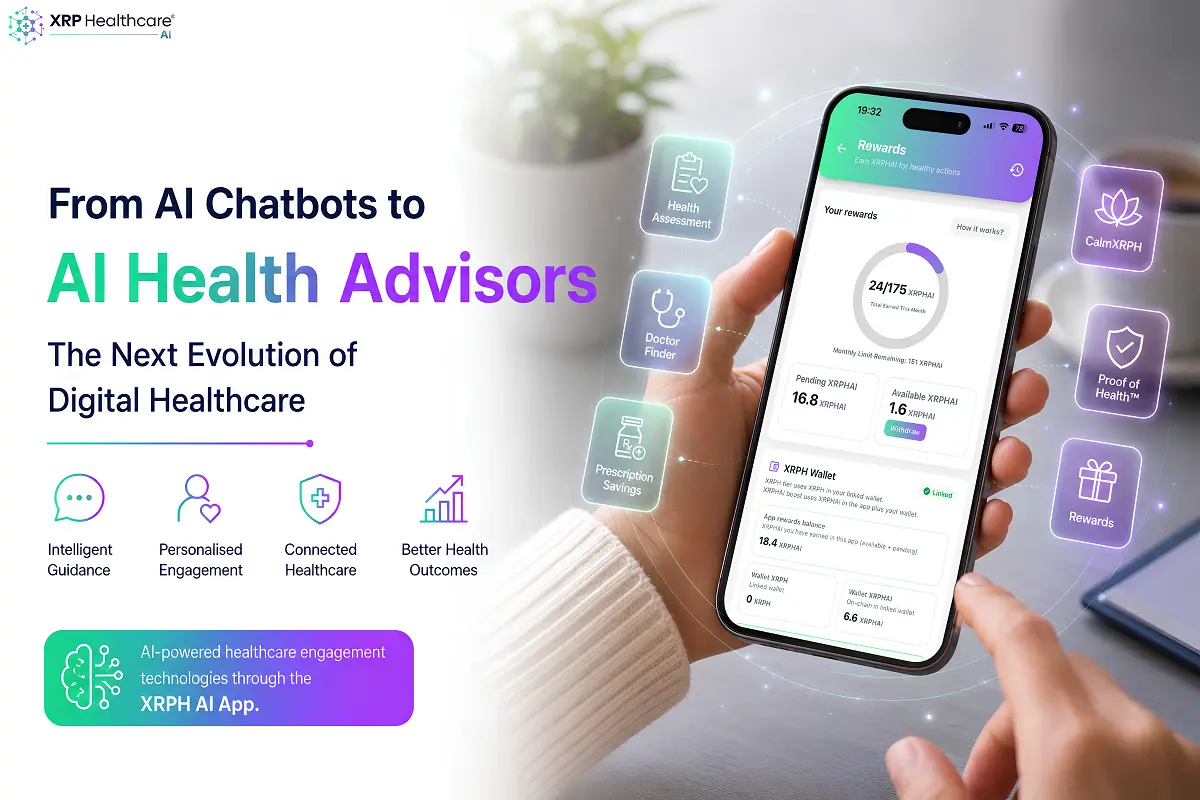
Through the XRPH AI App, users already have access to AI-powered health assessments, Doctor Finder, Prescription Savings, CalmXRPH, Proof Of Health™ and additional healthcare engagement tools.
As the platform continues to evolve, artificial intelligence is expected to play an increasingly important role in helping users navigate these services through personalised guidance, intelligent feature discovery and continuous healthcare engagement.
The Company's long-term vision is to create an intelligent healthcare engagement ecosystem where artificial intelligence helps simplify healthcare, encourage healthier daily habits and improve access to valuable healthcare resources.
Looking Towards the Future
Artificial intelligence is still in the early stages of transforming healthcare.
Over the coming years, healthcare platforms are expected to become increasingly intelligent, personalised and connected.
Rather than acting as standalone assistants, AI Health Advisors may become trusted digital companions that help individuals:
Build healthier habits.
Navigate healthcare services.
Access educational resources.
Discover preventive healthcare opportunities.
Stay engaged with long-term health goals.
Make better-informed healthcare decisions.
This evolution represents one of the most significant opportunities currently emerging within digital healthcare.
Conclusion
Artificial intelligence is moving beyond chatbots.
The future belongs to AI Health Advisors that provide intelligent guidance, personalised healthcare journeys and continuous engagement rather than simply answering questions.
By combining artificial intelligence, behavioural science and connected healthcare experiences, digital health platforms have the potential to make healthcare easier to navigate, more accessible and more engaging for millions of people worldwide.
As this technology continues to mature, AI Health Advisors are likely to become one of the defining innovations shaping the future of healthcare.
Important Links
Frequently Asked Questions
What is an AI Health Advisor?
An AI Health Advisor is an intelligent digital healthcare assistant that helps users navigate healthcare resources, discover relevant services and remain engaged with their long-term health goals through personalised guidance.
How is an AI Health Advisor different from an AI chatbot?
Traditional AI chatbots primarily answer questions. AI Health Advisors go further by providing personalised recommendations, guiding users through healthcare journeys and encouraging meaningful healthcare engagement.
Why is intelligent healthcare guidance important?
Healthcare can be complex. Intelligent guidance helps users discover relevant healthcare resources more easily while encouraging healthier behaviours and long-term engagement.
Can AI improve healthcare engagement?
Yes. Artificial intelligence can provide personalised recommendations, support healthier daily habits, reduce complexity and help users remain actively involved in managing their health.
How is XRP Healthcare using artificial intelligence?
XRP Healthcare is developing AI-powered healthcare technologies through the XRPH AI App that support intelligent health assessments, personalised healthcare engagement, Doctor Finder, Prescription Savings, CalmXRPH and Proof Of Health™.