Jul 30, 2026
Can AI Help You Understand Your Symptoms? What It Can-and Cannot-Do
Learn how AI symptom checkers work, their benefits and limitations, and how AI can support healthcare education while complementing qualified healthcare professionals.
Retail network access is facilitated through agreements with United Networks of America (UNA). Display of pharmacy brand marks does not imply ownership, endorsement, or direct partnership with XRP Healthcare M&A Holding Inc.
Technology partnerships reflect collaborative or project-based cooperation. Display does not imply equity ownership or endorsement unless expressly stated.
Pharmaceutical and supply relationships reflect existing commercial arrangements within acquired operating entities. Display does not imply exclusivity or endorsement beyond standard commercial supply agreements.
Advisors provide professional services to XRP Healthcare M&A Holding Inc. No partnership or ownership interest is implied unless publicly disclosed.
All third-party trademarks remain the property of their respective owners. Display does not imply endorsement, ownership, or partnership unless expressly stated.
Jul 30, 2026
Learn how AI symptom checkers work, their benefits and limitations, and how AI can support healthcare education while complementing qualified healthcare professionals.
When people notice a new symptom, their first instinct is often to search the internet.
A headache, persistent cough, rash, stomach pain or unusual fatigue can quickly lead to dozens of browser tabs, conflicting advice and unnecessary anxiety. Some websites describe the most serious possibilities first, while others provide incomplete or outdated information. The result is often confusion rather than clarity.
Artificial intelligence is changing how people approach these everyday healthcare questions.
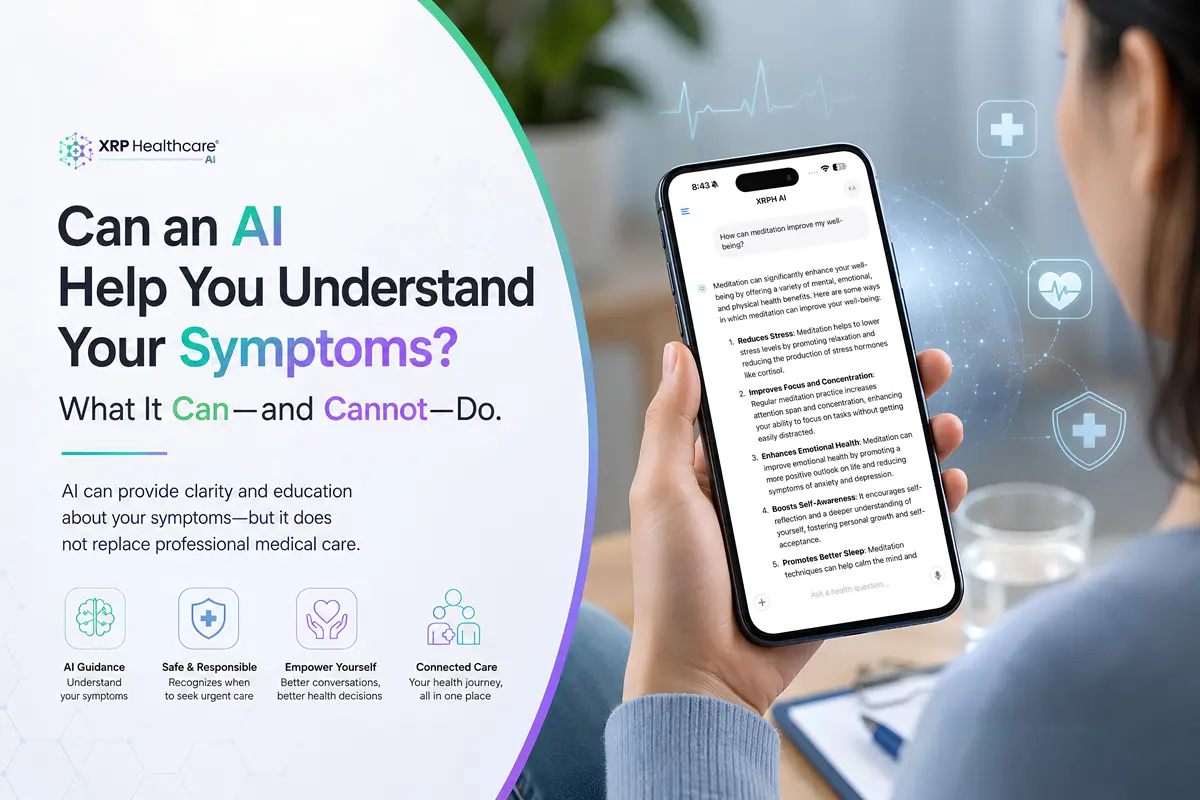
Instead of searching through multiple articles, AI-powered healthcare assistants allow users to describe their symptoms in natural language and receive structured educational guidance. Rather than simply listing possible conditions, modern AI systems can explain what symptoms may indicate in general terms, ask relevant follow-up questions and encourage users to seek appropriate medical advice when necessary.
Importantly, responsible AI healthcare platforms do not diagnose illness.
Their role is to improve health literacy, explain healthcare information clearly and help people make better-informed decisions about when and how to seek professional care.
To learn more about the wider vision behind intelligent healthcare, visit our comprehensive AI Healthcare Platform guide.
Almost everyone has searched for health information online.
People naturally want reassurance, clarity and guidance when something doesn't feel right.
Common questions include:
Why do I have this symptom?
Is this something serious?
Should I see a doctor today?
Could this be a side effect of my medication?
Is there anything I should monitor?
What questions should I ask my healthcare professional?
The challenge is that traditional search engines return thousands of pages, leaving users to decide which information is trustworthy and relevant.
Artificial intelligence offers a different experience by turning fragmented searches into structured conversations.
An AI symptom checker is an educational tool that helps users organise information about their symptoms through a guided conversation.
Instead of asking users to search using medical terminology, AI allows people to describe what they are experiencing in everyday language.
The system may then ask follow-up questions to better understand the situation.
For example:
When did the symptom begin?
Has it become worse over time?
Is it constant or intermittent?
Are there any additional symptoms?
Have you recently started any new medication?
These questions help the AI provide more relevant educational information while encouraging users to consult a qualified healthcare professional where appropriate.
One of the biggest misconceptions about healthcare AI is that it replaces doctors.
It does not.
Healthcare professionals assess far more than symptoms alone.
They consider:
Medical history.
Physical examination findings.
Diagnostic tests.
Family history.
Current medications.
Clinical judgement developed through years of training and experience.
Artificial intelligence cannot replicate these essential aspects of healthcare.
Instead, it helps organise information so that patients can better understand their symptoms before speaking with a healthcare professional.
This often leads to more informed conversations and better healthcare engagement.
AI-powered healthcare platforms can support users by helping them:
Understand medical terminology.
Recognise common healthcare concepts.
Learn when symptoms may require urgent attention.
Prepare for medical appointments.
Organise healthcare information.
Better understand advice received from healthcare professionals.
The emphasis remains on education rather than diagnosis.
This distinction is essential for building trustworthy healthcare AI.
One of the most important characteristics of responsible healthcare AI is knowing when artificial intelligence should step back.
Certain symptoms require immediate medical assessment.
An AI healthcare platform should always encourage users to seek emergency medical attention or contact local emergency services if symptoms suggest a potentially life-threatening situation.
Examples may include:
Severe chest pain.
Difficulty breathing.
Signs of stroke.
Severe allergic reactions.
Sudden loss of consciousness.
Heavy uncontrolled bleeding.
Rather than attempting to interpret these situations, responsible AI should prioritise user safety by directing people to immediate professional care.
The XRPHAI App is being developed to help users better understand healthcare information through an AI Health Advisor that forms part of a wider AI Healthcare Platform.
Instead of focusing solely on symptoms, the platform is designed to support users across multiple stages of their healthcare journey.
Its connected capabilities include:
AI Health Advisor.
Medicine guidance.
Prescription Savings.
Doctor Finder.
Continue Health Journey.
Voice AI.
Personalised healthcare engagement.
Future Proof of Health™ initiatives.
By bringing these services together, the platform aims to help users navigate healthcare information more confidently while always recognising the essential role of qualified healthcare professionals.
Symptoms rarely exist in isolation.
Someone experiencing dizziness, for example, may also have questions about a recently prescribed medicine, hydration, blood pressure or whether they should arrange a medical appointment.
An intelligent AI healthcare platform can help connect these related topics within one educational conversation.
Rather than treating each question separately, AI can maintain context and guide users through a broader healthcare journey, making information easier to understand and more relevant to their situation.
This ability to support connected conversations is one of the defining characteristics of modern Agentic AI.
Artificial intelligence is most valuable when it helps people better understand their health without replacing professional medical advice. Used responsibly, AI symptom guidance can improve health literacy, encourage timely care and help users feel more prepared when speaking with a healthcare professional.
Consider these examples:
A person develops a cough that has lasted several days. Instead of relying on random internet searches, they use an AI Health Advisor to learn about common causes of persistent coughs, understand which symptoms may require prompt medical attention and prepare questions for their GP.
Someone starts a new prescription and later experiences mild dizziness. Rather than assuming the medicine is responsible, they use AI to learn about possible side effects, read educational information and understand why they should discuss any concerns with their pharmacist or prescribing clinician.
A parent notices a child's rash and wants to organise information before visiting a healthcare professional. An AI healthcare assistant helps them record when the rash started, whether there are accompanying symptoms and what observations may be useful to mention during the consultation.
In each example, artificial intelligence supports understanding and communication-it does not diagnose or replace clinical care.
Artificial intelligence can provide educational guidance, but certain symptoms require urgent assessment by qualified healthcare professionals.
Users should seek immediate emergency medical care or contact local emergency services if they experience symptoms such as:
Severe chest pain.
Sudden difficulty breathing.
Signs of a stroke, including facial drooping, arm weakness or speech difficulties.
Loss of consciousness.
Severe allergic reactions with swelling or difficulty breathing.
Heavy, uncontrolled bleeding.
Sudden confusion or seizures.
Serious injuries or suspected fractures.
Responsible AI healthcare platforms should never attempt to manage medical emergencies. Their role is to encourage appropriate action and direct users towards immediate professional care when warning signs are present.
When designed responsibly, AI symptom checkers offer several important benefits.
These include:
Helping people organise their symptoms clearly.
Making healthcare information easier to understand.
Explaining medical terminology in plain language.
Encouraging earlier conversations with healthcare professionals.
Helping users prepare for appointments.
Improving health literacy.
Supporting informed healthcare decisions.
Reducing the confusion caused by fragmented internet searches.
Perhaps most importantly, AI can help people ask better questions, leading to more productive discussions with doctors, nurses and pharmacists.
Artificial intelligence has developed rapidly, but it still has important limitations that users should understand.
AI cannot:
Perform a physical examination.
Measure vital signs directly.
Order or interpret diagnostic tests independently.
Consider every aspect of an individual's medical history.
Diagnose illnesses with certainty.
Prescribe medicines.
Replace the expertise of qualified healthcare professionals.
The information provided by AI should always be considered educational and should never replace professional medical advice, diagnosis or treatment.
Understanding these limitations helps people use AI safely and responsibly.
Healthcare works best when patients are informed, engaged and able to participate in decisions about their care.
Artificial intelligence has the potential to support this by making reliable healthcare information easier to access and easier to understand.
Rather than replacing healthcare professionals, AI can help patients become more confident in asking questions, understanding medical terminology and preparing for appointments.
This collaborative approach strengthens communication between patients and clinicians while supporting better health literacy.
Artificial intelligence continues to evolve rapidly.
Future healthcare platforms are expected to become increasingly personalised, context-aware and capable of supporting users throughout their healthcare journey.
Potential future developments include:
More natural voice conversations.
Greater personalisation based on user preferences.
Integration with wearable health technologies.
Improved educational content.
Smarter healthcare navigation.
Support across multiple healthcare services through connected AI agents.
As these technologies develop, responsible governance, transparency and patient safety will remain essential.
Artificial intelligence should always complement professional healthcare rather than replace it.
Searching online for symptoms has become a routine part of modern life, but traditional internet searches often leave people feeling overwhelmed or uncertain.
Artificial intelligence offers a more structured way to access healthcare information by guiding users through educational conversations, explaining medical concepts in plain language and encouraging appropriate medical advice when necessary.
The goal is not diagnosis.
The goal is understanding.
As AI healthcare platforms continue to develop, they have the potential to improve health literacy, support better conversations with healthcare professionals and help people navigate increasingly complex healthcare systems with greater confidence.
The future of healthcare will always depend on qualified clinicians, but intelligent AI tools can become valuable partners in helping people better understand their health and make more informed decisions.
Explore how AI-powered medicine guidance, healthcare education and Prescription Savings are working together within the XRPHAI App.
Continue your journey:
No. Responsible AI healthcare platforms are designed to provide educational information and guidance, not medical diagnoses. Diagnosis should always be made by a qualified healthcare professional following an appropriate clinical assessment.
No. AI should never replace professional medical advice. It can help you understand healthcare information, organise your symptoms and prepare for appointments, but decisions about diagnosis and treatment should always involve a qualified healthcare professional.
Responsible AI platforms can recognise warning signs that may require urgent medical attention and encourage users to contact emergency services or seek immediate care. They should never attempt to manage or diagnose medical emergencies.
AI symptom checkers can improve health literacy by explaining medical information in plain language, helping users organise symptoms, preparing them for healthcare appointments and encouraging appropriate discussions with healthcare professionals.
The XRPHAI App is being developed as part of a wider AI Healthcare Platform. Through its AI Health Advisor, it aims to provide educational healthcare guidance while integrating additional services such as medicine information, prescription savings, doctor discovery, Voice AI and personalised healthcare support. The platform is designed to complement-not replace-the expertise of qualified healthcare professionals.