Retail network access is facilitated through agreements with United Networks of America (UNA). Display of pharmacy brand marks does not imply ownership, endorsement, or direct partnership with XRP Healthcare M&A Holding Inc.
Strategic Health Technology Partnerships
Technology partnerships reflect collaborative or project-based cooperation. Display does not imply equity ownership or endorsement unless expressly stated.
Pharmaceutical & Supply Partnerships
Pharmaceutical and supply relationships reflect existing commercial arrangements within acquired operating entities. Display does not imply exclusivity or endorsement beyond standard commercial supply agreements.
Advisors
Advisors provide professional services to XRP Healthcare M&A Holding Inc. No partnership or ownership interest is implied unless publicly disclosed.
All third-party trademarks remain the property of their respective owners. Display does not imply endorsement, ownership, or partnership unless expressly stated.
Jul 29, 2026
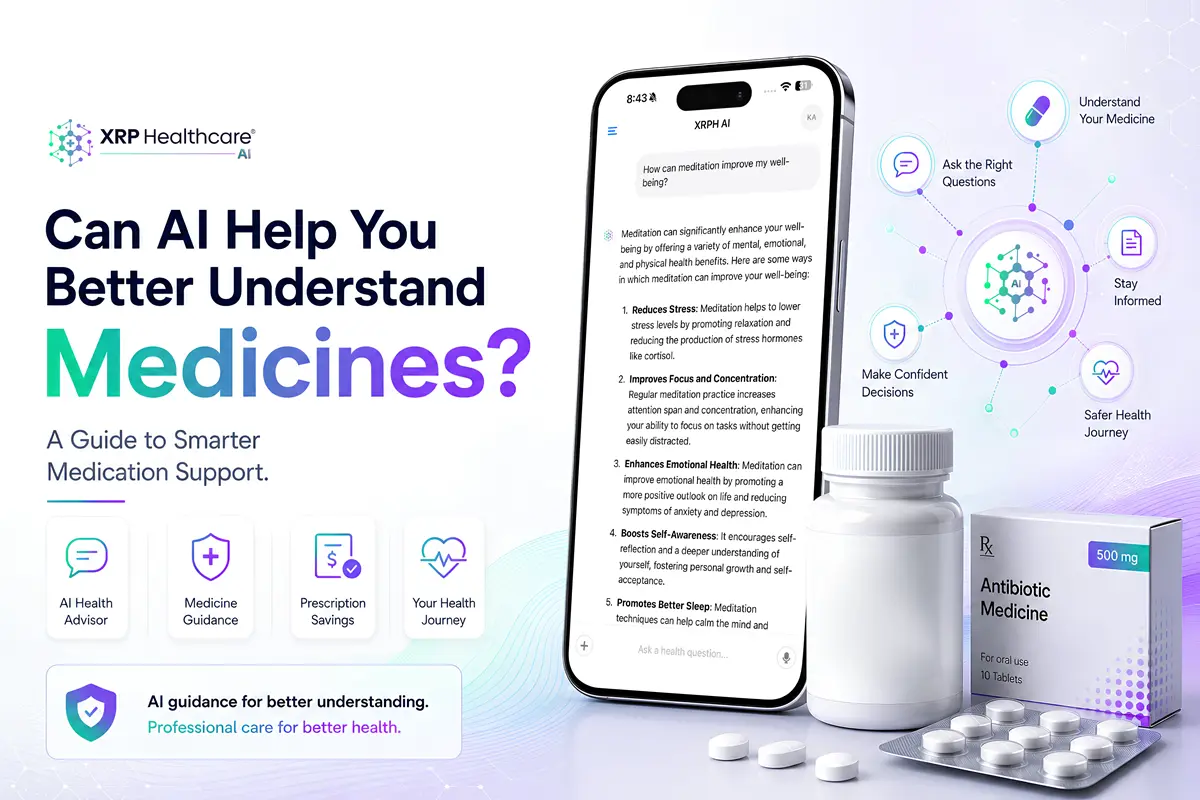
Can AI Help You Better Understand Medicines? A Guide to Smarter Medication Support
Discover how AI can help explain medicines, improve medication understanding and support better healthcare decisions while complementing healthcare professionals.
Can AI Help You Better Understand Medicines? A Guide to Smarter Medication Support
Why Understanding Medicines Matters
Medicines are only effective when they are used correctly.
Unfortunately, misunderstandings about medicines are common and can lead to unnecessary anxiety, poor adherence to treatment plans or avoidable conversations based on misinformation found online.
Patients often want answers to questions such as:
Why has this medicine been prescribed?
How does it work?
What should I know before taking it?
What are the common side effects?
When should I speak to my doctor or pharmacist?
Are there interactions I should ask about?
What happens if I miss a dose?
These are important questions, and understanding the answers helps patients become more confident participants in their own healthcare.
AI cannot replace professional medical advice, but it can make healthcare information easier to understand by explaining publicly available information in simple language and helping users identify questions they may wish to discuss with their healthcare provider.
How AI Is Changing Medicine Education
Traditionally, medicine education relied on printed leaflets, pharmacy consultations and online searches.
While these remain valuable, AI introduces a more interactive way of learning.
Instead of reading lengthy medical documents, users can ask natural questions and receive explanations tailored to their level of understanding.
For example, rather than searching for technical terminology, someone could simply ask:
“What is this medicine used for?”
or
“What questions should I ask my pharmacist about this medicine?”
An AI Health Advisor can interpret these questions and provide educational guidance in clear language, helping users build confidence without replacing professional medical advice.
This conversational approach makes healthcare information more accessible to people with different levels of medical knowledge.
From Medicine Identification to Better Understanding
One of the most practical applications of AI in healthcare is helping users identify medicines and understand what they are looking at.
Modern AI systems can analyse images of medicine packaging and use recognised information to provide educational guidance about that medication.
Rather than stopping after identification, intelligent healthcare platforms can continue supporting the user by explaining:
The medicine's general purpose.
Important safety considerations.
Common questions patients ask.
Why following professional medical advice is essential.
Where to find additional healthcare resources.
This transforms AI from a simple identification tool into a healthcare companion that helps users navigate the next steps responsibly.
Why Context Matters
Understanding a medicine is rarely limited to one question.
Someone learning about a prescription may also want to know:
How should I store this medicine?
Should I take it with food?
What should I ask my pharmacist?
Are there participating pharmacies offering Prescription Savings?
Where can I continue learning about my condition?
This is where intelligent AI systems become particularly valuable.
Rather than treating each question as unrelated, modern AI Health Advisors maintain context throughout the conversation, creating a more natural and supportive healthcare experience.
This approach reflects the growing importance of Agentic AI, where intelligent systems assist users throughout an entire healthcare journey rather than answering isolated questions.
Introducing Medicine Guidance in the XRPHAI App
The XRPHAI App is being developed to help users better understand medicines as part of a broader AI-powered healthcare experience.
Medicine guidance is designed to work alongside other intelligent features, including:
AI Health Advisor
Prescription Savings
Doctor Finder
Continue Health Journey
Voice AI
Personalised healthcare guidance
Rather than functioning as a standalone medicine database, the objective is to create an intelligent healthcare platform that helps users navigate multiple aspects of their healthcare journey from one application.
By combining medicine education with practical healthcare tools, the platform aims to improve health literacy while encouraging users to consult qualified healthcare professionals whenever medical advice or treatment decisions are required.
Medicine Safety and Responsible AI
One of the greatest strengths of artificial intelligence is its ability to make complex information easier to understand. However, when it comes to medicines, responsible use of AI is essential.
An AI healthcare platform should never encourage people to ignore medical advice, stop taking prescribed medication or diagnose medical conditions.
Instead, AI should help users become better informed by explaining publicly available medicine information in clear language while encouraging conversations with qualified healthcare professionals.
This approach supports safer healthcare decisions by helping users understand their medicines without replacing doctors, pharmacists or other clinicians.
Responsible AI medicine guidance should always:
Explain information in plain English.
Encourage users to read medicine packaging and patient information leaflets.
Recommend consulting a doctor or pharmacist whenever medical advice is required.
Recognise situations that require urgent medical attention.
Clearly distinguish educational guidance from professional medical advice.
When designed responsibly, AI becomes an educational partner rather than a substitute for healthcare professionals.
Common Medication Questions AI Can Help Explain
Many medication-related questions are educational rather than diagnostic.
An AI Health Advisor can help users better understand publicly available information by answering questions such as:
What is this medicine commonly used for?
What type of medicine is it?
How does it generally work?
What are some commonly reported side effects?
Why has my healthcare professional prescribed this medicine?
What questions should I ask my pharmacist?
Why is it important to take medicines exactly as prescribed?
When should I seek medical advice?
Providing clear answers to these common questions can improve confidence while helping users prepare for conversations with healthcare professionals.
Turning Information into Action
Understanding a medicine is only one step in the healthcare journey.
Once users understand what a medicine is and why it has been prescribed, they often want practical next steps.
An intelligent healthcare platform can guide users towards actions such as:
Locating participating pharmacies.
Exploring available Prescription Savings where supported.
Finding healthcare providers.
Continuing their personalised health journey.
Learning more about the condition associated with the medication.
Building healthier long-term habits.
Rather than forcing users to leave the application and begin new searches elsewhere, intelligent healthcare platforms can connect these services into one continuous experience.
This is one of the defining characteristics of modern Agentic AI.
How the XRPHAI App Supports Medicine Guidance
Medicine guidance is designed to become one part of a wider healthcare ecosystem within the XRPHAI App.
Instead of treating medicine information as an isolated feature, it works alongside:
AI Health Advisor
Prescription Savings
Doctor Finder
Continue Health Journey
Voice AI
Personalised healthcare support
Future Proof of Health™ initiatives
This integrated approach helps reduce unnecessary complexity.
For example, after learning about a medication, users may choose to continue by checking available prescription prices through supported pharmacy integrations or locating participating pharmacies near them.
By keeping these services connected, the platform aims to create a smoother healthcare experience that saves time while improving understanding.
The Benefits of AI Medicine Guidance
Artificial intelligence has the potential to improve medicine education in several important ways.
Benefits include:
Faster access to understandable healthcare information.
Simpler explanations of complex medical terminology.
Improved health literacy.
Better preparation for discussions with healthcare professionals.
Reduced reliance on unreliable online sources.
Easier navigation of healthcare services.
Greater confidence when managing prescribed medicines.
More personalised educational support.
When combined with professional medical care, these advantages can help patients become more engaged participants in their own healthcare.
Understanding the Limitations
Despite rapid advances in artificial intelligence, medicine guidance provided by AI has important limitations.
AI cannot:
Diagnose illnesses.
Recommend starting or stopping prescription medication.
Replace clinical examinations.
Interpret every individual's complete medical history.
Provide emergency medical treatment.
Replace qualified doctors or pharmacists.
Users should always seek professional medical advice for diagnosis, treatment decisions and concerns about their health.
The purpose of AI medicine guidance is education, not clinical decision-making.
The Future of AI-Assisted Medicine Education
Healthcare is becoming increasingly digital, personalised and proactive.
Future AI medicine guidance may include:
More personalised educational explanations.
Voice-based healthcare conversations.
Improved multilingual support.
Enhanced medicine recognition.
Better integration with healthcare providers.
Smarter healthcare navigation.
More contextual educational guidance.
Stronger support for preventative healthcare.
As these technologies continue to develop responsibly, AI will likely become a trusted educational companion that helps people better understand their healthcare while supporting-not replacing-medical professionals.
Conclusion
Understanding medicines should not be complicated.
Artificial intelligence is helping make healthcare information easier to access by explaining medicines in clear language, improving health literacy and guiding users towards reliable healthcare resources.
The XRPHAI App is being developed with this vision in mind, combining medicine guidance with AI Health Advisor capabilities, Prescription Savings and healthcare navigation to create a more connected healthcare experience.
By bringing these services together within one intelligent platform, XRP Healthcare aims to help people make better-informed healthcare decisions while always recognising the essential role of qualified healthcare professionals.
To learn more, visit our AI Healthcare Platform page or download the XRPHAI App to explore the future of intelligent healthcare.
Learn More About Intelligent Healthcare
Explore how AI-powered medicine guidance, healthcare education and Prescription Savings are working together within the XRPHAI App.
Yes. AI can explain publicly available medicine information in simple language to help users better understand their medication. It should not replace advice from a doctor or pharmacist.
Can AI identify medicines?
Some AI healthcare platforms can analyse medicine packaging or labels to help identify medicines and provide educational information. Accuracy depends on the quality of the image and available reference data.
Can AI tell me whether a medicine is safe for me?
No. Only a qualified healthcare professional can advise whether a medicine is appropriate for your individual medical history and circumstances.
Does AI replace pharmacists?
No. Pharmacists provide professional clinical advice that AI cannot replace. AI is designed to support education and understanding.
Can AI help me prepare questions for my doctor?
Yes. AI can help users better understand medicines and suggest topics they may wish to discuss with a healthcare professional.
What is medicine guidance?
Medicine guidance refers to educational information that helps people understand medicines, their purpose and general usage while encouraging professional medical advice when required.
How does the XRPHAI App support medicine guidance?
The XRPHAI App combines AI-powered medicine guidance with AI Health Advisor, Prescription Savings, healthcare navigation and additional intelligent healthcare services.
Can AI help me compare prescription prices?
Where supported, the XRPHAI App can connect users with participating pharmacy services that provide available prescription pricing information.
Is medicine guidance available at any time?
AI-powered educational guidance is designed to be available whenever users need it, although specific features may vary by country or healthcare partner.
Where can I learn more?
Visit the XRP Healthcare AI Healthcare Platform page to discover how intelligent healthcare technologies are helping improve healthcare accessibility.