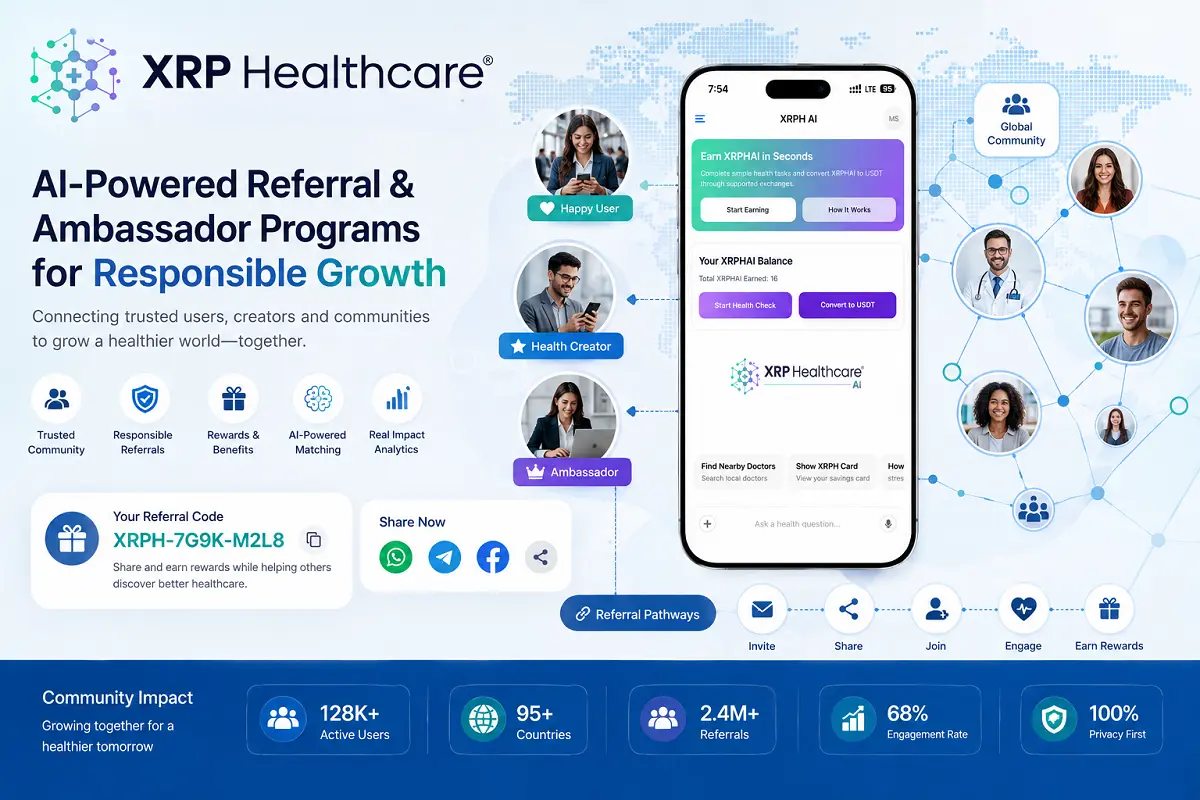
Introduction
People often discover healthcare services through people they trust.
A friend recommends an app.
A creator shares a useful health tool.
A family member sends a referral link.
A healthcare professional mentions a digital resource.
These recommendations can be more powerful than conventional advertising because they come through existing relationships.
This makes referral and ambassador programs an important growth channel for digital health.
But healthcare is not an ordinary referral category.
A user recommending a clothing brand and a user recommending a healthcare platform are not creating the same level of responsibility.
Healthcare recommendations can influence important decisions.
That means growth systems must be designed carefully.
This is where AI referral and ambassador programs in healthcare can become useful.
Within the broader XRPHAI App ecosystem, an intelligent Referral & Ambassador Agent can potentially help identify highly engaged users, relevant creators and authentic advocates while maintaining clear safeguards around health claims, incentives and disclosure.
The objective is not simply:
Get more people to share the app.
It is:
Help the right people share genuine value responsibly.
What Is an AI Healthcare Referral Program?
An AI healthcare referral program uses intelligent systems to support user-led growth.
The platform may help users:
Invite friends
Share referral links
Generate referral codes
Track referrals
Discover relevant referral opportunities
Participate in ambassador programmes
Receive eligible incentives
AI can potentially improve this process by identifying the most appropriate users and timing.
What Is a Healthcare Ambassador Program?
A healthcare ambassador program is a structured community or creator programme where selected individuals help introduce a healthcare platform to wider audiences.
Ambassadors may include:
Ambassadors should represent the platform accurately.
They should not exaggerate medical capabilities.
Referral and Ambassador Programs Are Different
Although related, they serve different roles.
Referral Program
Usually allows ordinary users to share the platform with people they know.
Ambassador Program
Usually involves a more structured relationship with selected advocates, creators or community leaders.
A referral user may occasionally invite someone.
An ambassador may actively help grow awareness over time.
The AI Referral & Ambassador Agent
Within the future XRPHAI agent architecture, the AI Referral & Ambassador Agent is designed to focus on user-led growth.
Its potential responsibilities may include:
Identifying highly engaged users
Detecting likely advocates
Suggesting appropriate referral moments
Managing referral codes
Supporting ambassador onboarding
Tracking referral performance
Detecting referral abuse
Matching ambassadors with relevant campaigns
Helping measure long-term referral quality
The agent should optimise for trusted growth.
Not simply referral volume.
Referral Should Follow Value
The best time to ask someone to recommend a healthcare app is not necessarily immediately after registration.
A stronger sequence is:
User Joins
↓
User Experiences Value
↓
User Returns
↓
User Completes Useful Health Actions
↓
Trust Develops
↓
Referral Opportunity
A user who genuinely understands the product is more likely to make an authentic recommendation.
Asking Too Early Can Damage Growth
Imagine a new user opens the app for the first time.
Before they have even completed a healthcare interaction, they see:
Invite five friends now.
This creates the wrong impression.
The user may not yet know whether the app is useful.
Referral requests should come after demonstrated value.
AI Can Identify Better Referral Moments
AI can potentially recognise signals that suggest a user may be ready to advocate.
Examples might include:
This creates a more relevant referral experience.
Referral After a Positive Milestone
A useful referral moment might occur after a positive experience.
For example:
Health Journey completed
↓
User sees progress
↓
Optional referral invitation
The referral request is connected to something meaningful.
Referrals Should Remain Optional
Users should never feel that healthcare access depends on inviting others.
Referral participation should not become a requirement for:
Referral programs are growth tools.
They should not restrict healthcare utility.
Referral Incentives
Referral programs often use incentives.
Potential incentives may include:
App benefits
Premium access
Eligible XRPHAI rewards
Ambassador recognition
Other approved benefits
The incentive should be clear.
Users should understand what action qualifies and what they receive.
XRPHAI Rewards and Referrals
Eligible referral activity may eventually connect with the wider XRPHAI rewards ecosystem where supported.
This creates another participation pathway.
However, rewards should not encourage:
Growth quality matters more than inflated referral numbers.
Proof of Health™ and Referral Activity
Proof of Health™ is focused on eligible health-positive engagement.
Referral activity is a different category.
These should not automatically be treated as the same thing.
A health activity and a growth activity may exist within the same ecosystem but have different eligibility rules.
This distinction should remain clear.
Referral Fraud
Referral programs can be abused.
Examples include:
Creating fake accounts
Self-referrals
Duplicate accounts
Automated referral farms
Misleading promotion
Incentive manipulation
An intelligent referral system should include anti-abuse controls.
AI and Referral Fraud Detection
AI can potentially help identify unusual patterns.
For example:
Large numbers of referrals from identical devices
Repeated account creation
Abnormal geographic patterns
Very high referral volume with no genuine engagement
Rapid referral behaviour inconsistent with normal users
These signals may require review.
AI should not automatically accuse users of fraud without appropriate verification.
Quality of Referral Matters
A referral is not valuable simply because someone created an account.
A stronger referral is one that leads to:
Genuine onboarding
Useful healthcare engagement
Health Journey participation
Retention
Premium value
Long-term ecosystem participation
This changes how referral success should be measured.
Referral Quality vs Referral Volume
Compare two ambassadors.
Ambassador A
Generates 10,000 sign-ups.
But almost nobody uses the app.
Ambassador B
Generates 1,000 sign-ups.
Many users become engaged and remain active.
The second ambassador may create much more long-term value.
AI can potentially help measure this difference.
The Relationship Between Premium and Referrals
Satisfied premium users may become strong advocates.
They already understand the deeper value of the platform.
This creates the commercial sequence:
Premium Conversion
↓
Premium Value
↓
Retention
↓
Referral Opportunity
This makes Blog 25 a natural continuation from Blog 24.
The Relationship Between Reactivation and Referrals
Reactivated users may also eventually become advocates.
But again, the sequence matters.
A user who has just returned should first regain value.
Referral should come later.
The user should never feel that reactivation exists simply to make them recruit others.
Ambassador Selection
Not every active user should become an ambassador.
Potential selection factors may include:
AI can potentially help identify candidates.
Human review may still be appropriate for formal ambassador relationships.
Healthcare Creators
Healthcare and wellness creators can help introduce digital health tools to relevant audiences.
But creator partnerships require strong standards.
Creators should not make unsupported claims such as:
This app diagnoses every condition
This AI replaces doctors
This app guarantees better health outcomes
XRPHAI rewards are guaranteed financial returns
The platform needs clear ambassador guidelines.
Qualified Healthcare Professionals
Some ambassadors may also be qualified healthcare professionals.
If so, their professional status should be represented accurately.
But the platform should not assume:
Healthcare professional = automatic endorsement
Any commercial relationship should still be disclosed where required.
Ambassadors Must Not Pretend to Be Clinicians
A wellness influencer who is not a doctor should not present themselves as one.
Ambassador content should clearly distinguish:
from:
This boundary is essential.
Referral Disclosure
If someone receives a benefit for referrals, the commercial relationship should be transparent.
Depending on applicable requirements, disclosure may include phrases such as:
Referral partner
Ambassador
Sponsored
Paid partnership
Affiliate
Users should understand that the person may receive a benefit.
Disclosure Builds Trust
Some marketers fear that disclosure reduces conversion.
In healthcare, hidden incentives create much greater risk.
If a recommendation is genuine, transparency strengthens credibility.
Ambassador Content Standards
A formal healthcare ambassador program should provide clear guidance around:
This reduces inconsistent messaging.
AI Can Help Review Ambassador Content
AI may potentially assist with pre-publication checks.
For example, it could flag language such as:
This can improve consistency.
Human review may still be necessary for sensitive content.
Regional Ambassador Programs
Healthcare is global.
An ambassador strategy may include regional advocates who understand:
Local language
Cultural context
Healthcare environment
Digital behaviour
Community expectations
Regional relevance can strengthen adoption.
Multilingual Referrals
AI can also support multilingual referral experiences.
A referral message may be more effective when shared in the recipient's preferred language.
Translations should remain accurate.
Healthcare claims must not become exaggerated during localisation.
Referral Codes
Referral codes create a simple way to attribute growth.
A code may connect:
New User
to:
Referrer / Ambassador
This enables the platform to measure:
Sign-ups
Activation
Retention
Premium conversion
Campaign performance
Attribution should respect privacy.
Referral Links
Referral links can provide similar functionality.
For example:
User shares link
↓
New user visits
↓
App registration
↓
Referral attributed
↓
Engagement tracked at an appropriate aggregate level
The system should avoid unnecessary collection of personal information.
Deep Links
Deep links can improve referral experience.
Instead of sending a new user to a generic homepage, a referral could potentially direct them to:
XRPHAI App
A Wellness Journey
A relevant feature
A campaign landing page
where appropriate.
The destination should accurately reflect what was shared.
Referral Landing Pages
A good referral landing page should explain:
It should not overwhelm the visitor with token or commercial messaging before explaining healthcare value.
Ambassador Landing Pages
Formal ambassadors may eventually have tracked landing pages or codes.
These pages can support attribution.
But the content should remain centrally controlled enough to prevent inaccurate product claims.
Referral and Community Growth
Referrals can create more than user acquisition.
They can help build communities.
For example:
Regional user groups
Ambassador networks
Creator communities
Community can strengthen long-term engagement.
Referral and Health Journeys
Health Journeys may create natural social-sharing moments.
A user may want to share:
Where social sharing is supported, privacy should remain important.
Users should decide what they share.
The app should not automatically expose sensitive health information.
Sharing Progress Safely
A shareable achievement might say:
Completed a 14-day Wellness Journey
rather than revealing:
Users should control the level of detail.
CalmXRPH and Referral Growth
CalmXRPH may also create more shareable wellness experiences.
Users may be more comfortable recommending:
Breathing
Affirmations
Relaxation
Mindfulness
to friends than sharing sensitive clinical interactions.
This can provide a softer community-growth channel.
Referral and Doctor Finder
Users may recommend the app because Doctor Finder helped them locate healthcare access.
However, referral messaging should not make claims about specific doctors that are unsupported.
The platform should distinguish:
recommend the app
from:
provide medical endorsement of a provider.
Prescription Savings and Referrals
Prescription Savings may also create strong word of mouth where users experience genuine value.
Messaging should remain accurate.
Avoid claims such as:
Use actual programme rules.
Ambassador Programs and Prescription Savings
Creators discussing prescription savings should clearly explain:
Eligibility
Participating locations
Geographical limitations
That savings vary
This reduces misleading promotion.
Referrals and Premium Conversion
Referral users should not immediately encounter an aggressive premium wall.
The same value-first principle applies.
A healthy referral funnel is:
Referral
↓
Onboarding
↓
Useful Free Experience
↓
Engagement
↓
Relevant Premium Opportunity
Referral acquisition should not bypass trust-building.
Referral Economics
Referral programs can reduce customer acquisition costs when users bring in other users organically.
But rewards and commissions still need to be economically sustainable.
The platform may evaluate:
Cost per referral
Activation rate
Retention
Premium conversion
Lifetime value
Reward cost
AI can help analyse these relationships.
The Referral Agent Should Optimise for Lifetime Value
The objective should not simply be:
maximum number of sign-ups
A stronger objective is:
high-quality users who find long-term value in XRPHAI.
This aligns growth with retention.
Ambassador Performance Metrics
Potential ambassador metrics may include:
Referred users
Activated users
Retention
Premium conversion
Community engagement
Compliance quality
Content performance
Referral fraud rate
A large audience alone does not guarantee a strong ambassador.
Brand Safety
Healthcare ambassador programs require brand safety.
The platform should avoid partnerships associated with:
Short-term reach can create long-term reputational damage.
Token Promotion and Ambassadors
Because XRPHAI exists within the ecosystem, ambassadors may discuss rewards or token-related functionality.
This requires particular care.
Ambassadors should not claim:
XRPHAI should be explained accurately within its ecosystem context.
Referral Incentives Are Not Investment Returns
A referral reward is an incentive for an eligible action.
It should not be presented as:
Yield
Passive income
Interest
Investment return
The distinction matters.
AI Can Match Campaigns to Ambassadors
A future Referral & Ambassador Agent could potentially identify which ambassadors are most relevant to different campaigns.
For example:
Wellness creator → CalmXRPH campaign
Healthcare technology creator → AI healthcare platform
Regional community advocate → localisation campaign
This can improve relevance.
One Ambassador Should Not Promote Everything
Specialisation improves credibility.
An ambassador who is genuinely interested in wellness may be more credible discussing CalmXRPH than promoting every feature of the platform.
AI can potentially help match message to messenger.
Ambassador Tiers
A structured programme may eventually include different ambassador levels.
For example:
Community Ambassador
Creator Ambassador
Professional Ambassador
Regional Ambassador
Strategic Partner
Any tier system should reflect the actual future programme if implemented.
Do not present hypothetical tiers as live.
Referral and Ambassador Automation
AI can potentially automate parts of programme administration.
This may include:
Human oversight remains useful for higher-risk partnerships.
Referral and Privacy
Referral systems should collect only what is required.
A referrer does not need access to private healthcare information about the person they invited.
They may need to know only that:
Sensitive health activity should remain private.
Referrers Should Not See Health Activity
A referral dashboard should not say:
Your friend completed medication tracking
or:
Your referral searched for a particular condition
That would create an inappropriate privacy exposure.
Referral attribution and healthcare activity should remain separated.
Ambassador Data Access
Ambassadors should receive only the information required to manage their programme participation.
They should not receive:
Health histories
Diagnoses
Medication data
Private AI conversations
Commercial partnerships do not justify access to sensitive health information.
Referral and User Consent
Users should choose whether to:
Participation should be voluntary.
Referral Spam
A referral programme should discourage mass unsolicited outreach.
Users and ambassadors should not be encouraged to:
Responsible growth protects the brand.
The Relationship With the Revenue Optimisation Agent
The Revenue Optimisation Agent may identify that referrals are a useful commercial channel.
The Referral & Ambassador Agent then specialises in executing that channel.
The sequence becomes:
Revenue Optimisation Agent
↓
Referral Opportunity Identified
↓
AI Referral & Ambassador Agent
↓
Relevant Advocate
↓
Referral / Ambassador Activity
↓
New User
↓
Healthcare Value
↓
Retention
This keeps responsibilities clear.
The Relationship With the Premium Conversion Agent
Satisfied premium users may be strong ambassador candidates.
A lifecycle might become:
Free User
↓
Premium Conversion
↓
Premium Retention
↓
High Satisfaction
↓
Referral & Ambassador Opportunity
This makes the commercial agent system progressively connected.
The Relationship With the Reactivation Agent
Ambassador and referral programmes can also support reactivation indirectly.
For example, a user may return after seeing a trusted creator discuss a new feature.
However, direct reactivation and referral growth remain different functions.
The XRPHAI Growth Loop
A responsible growth loop may look like:
Useful XRPHAI Experience
↓
Engaged User
↓
Premium / Long-Term Value
↓
Referral or Ambassador Opportunity
↓
New User
↓
Useful Free Healthcare Experience
↓
Engagement
↓
Retention
↓
Further Advocacy
Growth begins with product value.
AI Should Not Turn Every User Into a Marketer
Not every healthcare user wants to recruit others.
That is fine.
A healthcare app should remain useful even if the user never refers anyone.
Referral is optional.
Healthcare utility is primary.
The Future of AI Referral and Ambassador Programs in Healthcare
Future systems may support:
AI advocate identification
Intelligent campaign matching
Automated compliance checks
Referral-quality scoring
Fraud detection
Multilingual ambassador support
Regional ambassador programmes
Dynamic referral experiences
More sophisticated attribution
Any XRPHAI-specific capabilities should only be described as live once officially implemented.
Why Trusted Growth Matters
Paid advertising can introduce users to a product.
But trust often grows through human recommendation.
In healthcare, this makes authenticity particularly important.
The strongest advocate is not necessarily the person with the largest audience.
It may be the person who can genuinely say:
“I used this, I understood its value, and I think it may be useful to you.”
That is the foundation of responsible referral growth.
Conclusion
AI referral and ambassador programs can help digital healthcare platforms grow through authentic user advocacy rather than relying entirely on paid acquisition.
Within the XRPHAI App, the future AI Referral & Ambassador Agent can potentially connect:
Highly engaged users
Premium users
Creators
Regional advocates
Referral codes
Ambassador campaigns
XRPHAI rewards
Community growth
But healthcare requires stronger boundaries than ordinary referral marketing.
Ambassadors should disclose incentives.
Creators should not make unsupported medical claims.
Referral rewards should not be presented as investment returns.
Sensitive health information should remain private.
Users should never be forced to refer others to access healthcare value.
Most importantly:
Referral should follow genuine value.
When users understand and trust the XRPHAI experience, intelligent referral systems can help turn satisfaction into responsible, scalable community growth.
FAQ
What is an AI healthcare referral program?
An AI healthcare referral program uses intelligent systems to support user invitations, referral attribution, referral timing, incentive management and the measurement of referred-user quality.
What is a healthcare ambassador program?
A healthcare ambassador program is a more structured relationship in which selected users, creators, professionals or community advocates help introduce a digital health platform to relevant audiences.
What is the XRPHAI AI Referral & Ambassador Agent?
The AI Referral & Ambassador Agent is part of the future XRPHAI commercial-agent architecture designed to support trusted referral growth, ambassador management, campaign matching, attribution and anti-abuse controls.
When should a healthcare app ask users for referrals?
Referral requests are generally more appropriate after users have experienced genuine product value and understand the platform well enough to make an authentic recommendation.
Can healthcare ambassadors give medical advice?
Ambassadors should not present themselves as medical professionals unless appropriately qualified. Even qualified healthcare professionals should clearly separate professional medical guidance from commercial ambassador activity.
Should ambassadors disclose referral incentives?
Yes. Material referral, sponsorship, affiliate or ambassador relationships should be clearly disclosed according to applicable requirements.
Can referral rewards be presented as investment returns?
No. Referral incentives or XRPHAI rewards should be described according to the actual programme rules and should not be presented as guaranteed earnings, investment returns, yield or token appreciation.
How can AI help detect referral fraud?
AI can potentially identify unusual referral patterns such as duplicate-account behaviour, abnormal device activity or highly unusual referral volumes that may warrant further review.
Can referrers see the health activity of people they invite?
They should not. Referral attribution should remain separated from private health information such as diagnoses, medications, health searches or personal AI healthcare conversations.
How does the Referral & Ambassador Agent fit into the XRPHAI agent architecture?
It follows the Premium Conversion Agent in the commercial-agent sequence and focuses specifically on user-led growth, referrals, advocates and ambassador programmes rather than clinical decision-making.