Introduction
No two healthcare journeys are the same.
Every individual has different health goals, routines, medications, appointments, questions and preferences.
Traditional healthcare applications often present identical information to every user regardless of their personal circumstances.
Artificial intelligence offers a more personalised approach.
Rather than delivering the same experience to everyone, AI can organise educational information, reminders and digital healthcare tools according to each user's preferences and interactions.
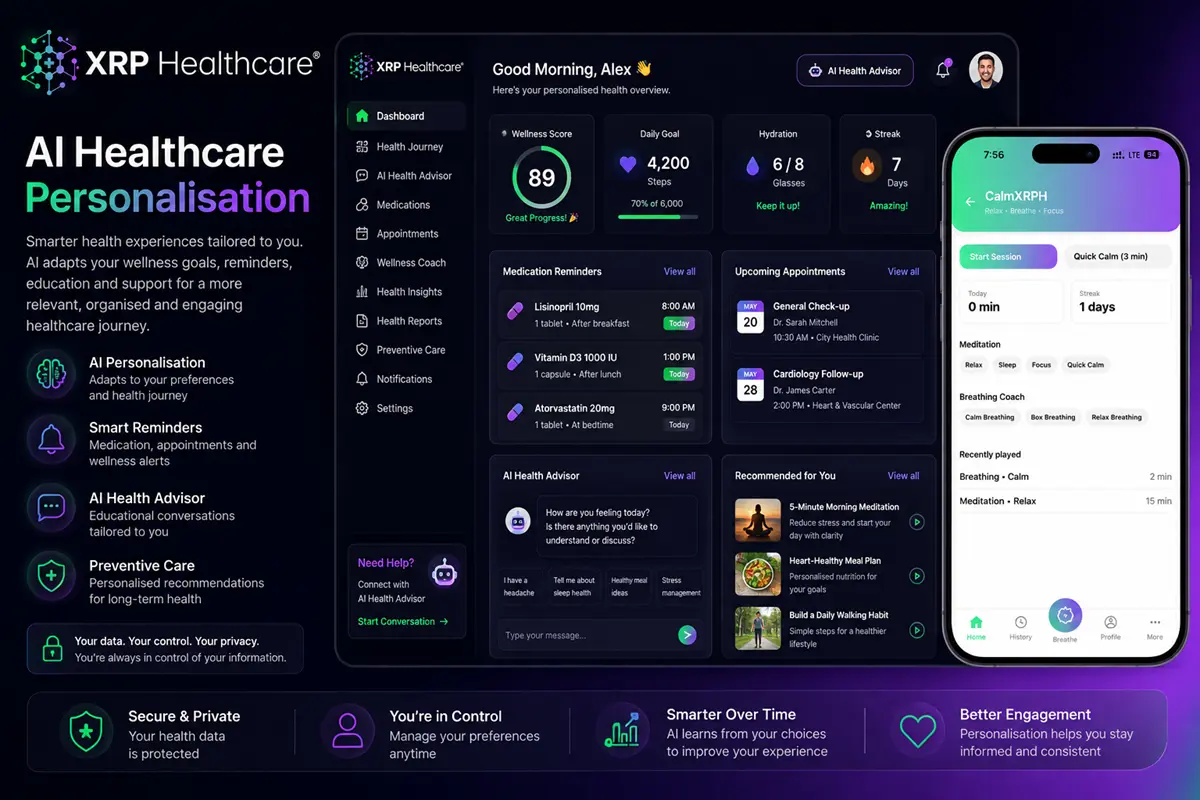
Within the XRPHAI App, AI healthcare personalisation works alongside AI Health Advisor, Continue Health Journey, Medication Reminders, AI Wellness Coaching, Preventive Care Plans and other intelligent healthcare tools to create a more relevant user experience.
The purpose is to improve organisation, accessibility and engagement.
It is not to replace healthcare professionals or create automated clinical decision-making.
What Is AI Healthcare Personalisation?
AI healthcare personalisation refers to adapting digital healthcare experiences according to the information and preferences that users choose to provide.
Depending on available functionality, personalisation may include:
Reminder preferences
Wellness goals
Preferred language
Previous healthcare conversations
Health education topics
Notification settings
Accessibility preferences
User-selected health interests
This creates a healthcare experience that is more relevant while allowing users to remain in control.
Why Personalisation Matters
People engage more effectively with healthcare information when it feels relevant to their own circumstances.
Personalised healthcare experiences can help users:
Find important information more quickly.
Continue previous healthcare journeys.
Organise medication reminders.
Prioritise health education.
Prepare for appointments.
Maintain healthy routines.
Stay engaged over longer periods.
Personalisation improves organisation without changing the role of healthcare professionals.
How AI Creates Personalised Experiences
Artificial intelligence can adapt digital healthcare experiences based on user choices and previous interactions.
Depending on confirmed app functionality, AI may personalise:
Health Dashboard
Displaying the most relevant healthcare information first.
Educational Content
Presenting health topics that match the user's interests or previous interactions.
Reminder Scheduling
Organising reminders according to user-selected preferences.
Continue Health Journey
Returning users directly to previous healthcare conversations.
Wellness Goals
Highlighting healthy habits selected by the user.
Notification Preferences
Delivering reminders according to user-defined notification settings.
The emphasis remains on user control rather than automated clinical judgement.
Personalisation Across the XRPHAI App
Several connected features contribute to a personalised healthcare experience.
AI Health Advisor
Educational healthcare conversations tailored to previous interactions.
Continue Health Journey
Maintaining continuity between healthcare discussions.
AI Medication Reminders
Reminder schedules organised according to user preferences.
AI Wellness Coaching
Supporting individual wellness goals.
AI Preventive Care Plans
Helping users organise preventive healthcare priorities.
AI Health Notifications
Providing relevant healthcare reminders.
AI Health Insights
Presenting organised summaries of healthcare information.
AI Health Reports
Generating structured educational reports.
Together these features create a connected digital healthcare ecosystem that adapts to each user's chosen preferences.
Personalisation Supports Better Engagement
Healthcare applications are most useful when people continue using them over time.
Personalisation can improve engagement by helping users quickly access:
Users spend less time searching and more time focusing on their healthcare.
Personalisation Does Not Mean Clinical Personalisation
It is important to distinguish between digital personalisation and clinical decision-making.
AI healthcare personalisation should not imply that the application:
Instead, personalisation refers to improving the user's digital healthcare experience through organisation and education.
Privacy Comes First
Personalisation depends upon user trust.
Users should always understand:
What information is being used.
Why it is being used.
How it improves their experience.
Which settings they can change.
How their privacy is protected.
Users should remain free to modify or disable personalised features where supported.
Accessibility and Inclusive Design
Personalisation also improves accessibility.
Depending on available functionality, users may be able to customise:
Language preferences.
Notification settings.
Font sizes.
Voice interaction.
Reminder timing.
Health interests.
Dashboard layout.
These improvements make digital healthcare easier for more people to use.
Supporting Preventive Healthcare
Personalised healthcare experiences can encourage users to remain engaged with:
Better organisation often supports better healthcare participation.
Looking Towards the Future
Future AI healthcare platforms may deliver increasingly personalised experiences while maintaining transparency and user control.
Potential developments include:
Smarter educational recommendations.
Improved multilingual support.
Better voice interaction.
Adaptive dashboards.
More connected health journeys.
Greater accessibility options.
User-controlled AI preferences.
Future functionality should always be described accurately and only after it becomes available.
AI Supports-It Does Not Replace-Healthcare Professionals
Artificial intelligence can personalise digital healthcare experiences.
It cannot replace:
Doctors.
Nurses.
Pharmacists.
Medical specialists.
Clinical judgement.
Professional diagnosis.
Treatment planning.
Healthcare professionals remain responsible for medical decision-making.
AI simply helps organise digital healthcare around the individual user.
Conclusion
AI healthcare personalisation makes digital healthcare more relevant, organised and engaging.
By adapting reminders, health education, wellness goals and healthcare journeys to user preferences, artificial intelligence can improve the overall healthcare experience.
Within the XRPHAI App, personalisation works alongside AI Health Advisor, Continue Health Journey, AI Health Reports, AI Health Insights, Medication Reminders, Wellness Coaching and Preventive Care Plans to support long-term healthcare engagement.
Artificial intelligence does not replace professional healthcare.
It helps users experience a more organised, personalised and connected healthcare journey.
Experience More Personalised Digital Healthcare With the XRPHAI App
Discover AI-powered healthcare tools designed to organise your health journey, personalise educational content and support healthier everyday decisions while keeping you in control.
FAQ
What is AI healthcare personalisation?
AI healthcare personalisation adapts digital healthcare experiences according to user-selected preferences and previous interactions.
Does AI healthcare personalisation diagnose illness?
No. Personalisation improves organisation and user experience but does not diagnose medical conditions or replace qualified healthcare professionals.
What can users personalise within an AI healthcare app?
Depending on available functionality, users may personalise reminders, educational topics, notification settings, wellness goals, language preferences and continued health journeys.
Does personalisation improve healthcare engagement?
Personalised digital experiences may help users find relevant information more quickly and remain engaged with long-term healthcare activities.
Does the XRPHAI App replace healthcare professionals?
No. The XRPHAI App supports healthcare organisation and education while healthcare professionals remain responsible for diagnosis and treatment.
How does AI healthcare personalisation connect with other XRPHAI features?
It works alongside AI Health Advisor, Continue Health Journey, AI Health Reports, AI Health Insights, Medication Reminders and Wellness Coaching to provide a connected digital healthcare experience.