Introduction
Healthcare often depends on timing.
A patient may need to remember an appointment, take prescribed medication, complete a follow-up task or return to an ongoing health journey.
Even when people understand what they need to do, busy schedules can make it difficult to remain consistent.
Digital notifications provide a simple way to support better organisation.
Artificial intelligence can make these notifications more useful by helping determine which reminders are most relevant, how they should be presented and when they may be most helpful.
Within the XRPHAI App, AI health notifications can support a broader digital healthcare experience that connects health education, medication organisation, preventive healthcare and continued user engagement.
The goal is not to overwhelm users with alerts.
It is to deliver timely, useful prompts that help people remain informed and organised.
What Are AI Health Notifications?
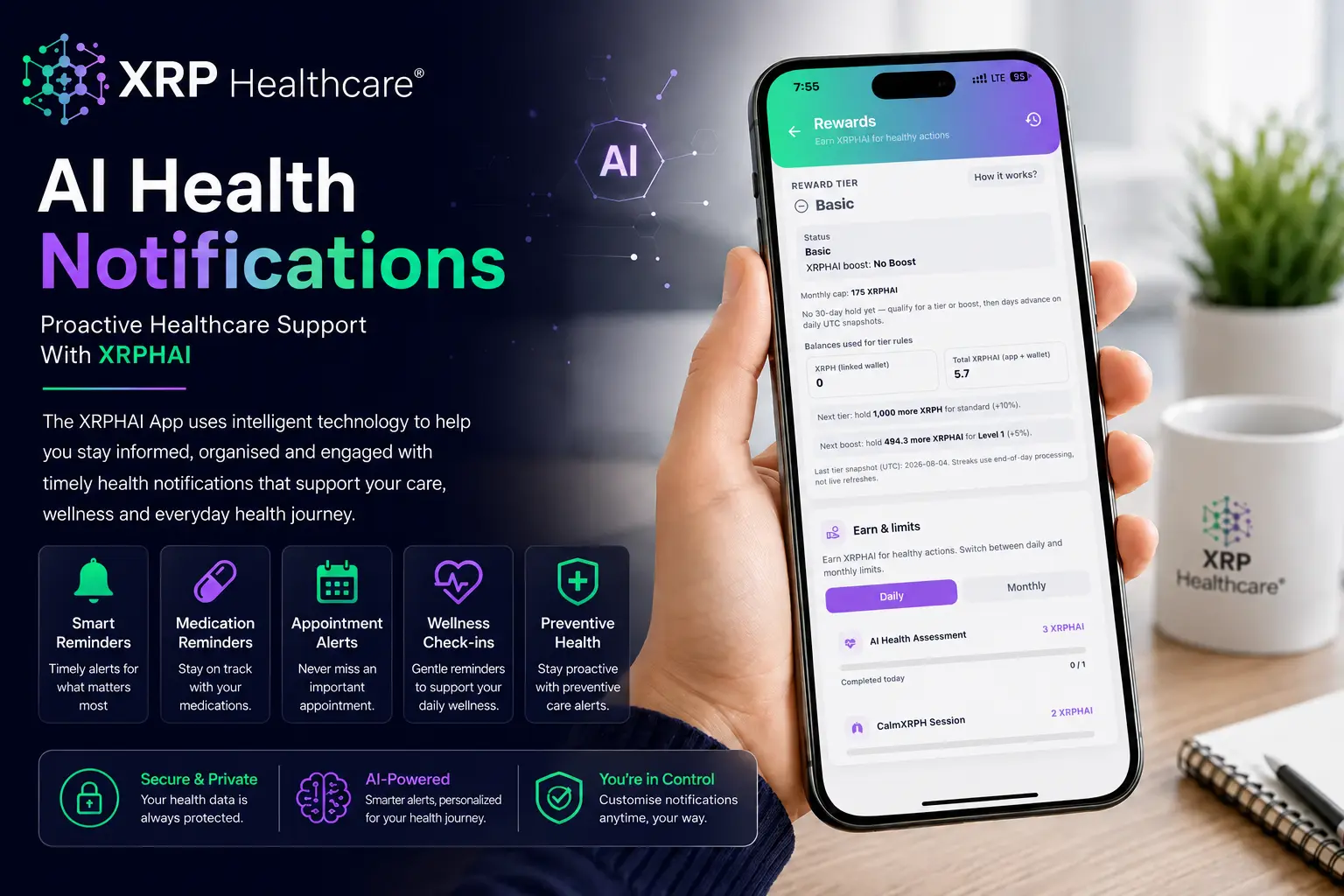
AI health notifications are intelligent digital alerts designed to support users with healthcare-related tasks, reminders and information.
Depending on live application functionality, examples may include:
Unlike a basic alarm, AI can help make notifications more relevant to the user's context and preferences.
How AI Improves Traditional Notifications
Traditional notifications are usually fixed.
They appear at a set time and display the same message regardless of context.
AI-powered notifications can be more adaptive.
Depending on the platform, AI may help:
Prioritise important reminders
Reduce unnecessary notifications
Personalise message content
Adjust notification timing
Group related healthcare tasks
Connect alerts with previous user activity
Recommend an appropriate next step
The purpose is to improve relevance without taking control away from the user.
Why Proactive Healthcare Support Matters
Many healthcare interactions happen only after a problem occurs.
Proactive healthcare focuses on helping users remain engaged before issues become more difficult to manage.
AI health notifications can support proactive healthcare by encouraging users to:
Maintain medication routines
Attend scheduled appointments
Complete recommended follow-up actions
Continue health education
Review preventive healthcare guidance
Return to an unfinished health journey
Seek professional support when appropriate
Notifications do not prevent illness or guarantee better outcomes.
They simply help users stay more organised and aware of important healthcare tasks.
Different Types of AI Health Notifications
Medication Notifications
Users may receive reminders linked to medication schedules they have chosen to organise within the app.
These alerts support consistency but do not change prescribed instructions.
Appointment Notifications
Users may receive prompts before medical appointments, health screenings or follow-up consultations.
These alerts can help reduce missed healthcare engagements.
Preventive Healthcare Notifications
The app may provide educational prompts encouraging users to consider routine screenings, healthy habits or preventive care topics.
Any recommendation should remain general unless supported by qualified professional guidance.
Wellness Check-Ins
Users may receive gentle prompts relating to hydration, sleep, movement or general wellness goals.
These should remain optional and adjustable.
Health Journey Notifications
The XRPHAI App may remind users to return to a previous health conversation or continue an unfinished journey through the Continue Health Journey feature.
This helps create continuity instead of treating every interaction as an isolated event.
Personalisation Without Intrusion
Personalisation can make notifications more useful, but it must be handled carefully.
Users should be able to control:
Which notifications they receive
How often alerts appear
Whether notifications are silent or prominent
Which health topics are relevant
When reminders are paused
Whether health journey prompts are enabled
The app should avoid sending repeated or unnecessary alerts that may cause notification fatigue.
Useful notifications should feel supportive rather than disruptive.
Connecting Notifications With the XRPHAI App
AI Health Advisor
A notification may prompt users to return to educational guidance or continue a general health conversation.
Medication Reminders
Users can receive prompts linked to their chosen medication schedule.
Continue Health Journey
Notifications can help users return to previous health interactions and continue where they stopped.
Doctor Finder
Where professional support is appropriate, a notification may direct users towards finding a relevant healthcare provider.
Preventive Healthcare
Educational alerts can encourage users to explore preventive health information and general wellness guidance.
Medicine Guidance
Users may be prompted to review educational medicine information while continuing to follow professional instructions.
Each notification should lead to a useful action rather than simply generating attention.
AI Notifications and User Safety
Healthcare notifications should be designed around clear safety boundaries.
The feature should not:
Diagnose a medical condition
Change a prescription
Recommend stopping medication
Replace emergency services
Create false urgency
Promise a health outcome
Encourage users to delay professional care
Where a user reports serious or urgent symptoms, the app should direct them towards appropriate professional or emergency support rather than relying on routine notifications.
Privacy and Notification Design
Health-related notifications can reveal sensitive information if displayed openly on a locked screen.
Users should therefore be able to manage notification privacy.
Recommended options include:
Generic notification previews
Hidden sensitive content
Device-level privacy controls
Optional biometric access
Custom notification settings
Clear permission management
A notification should provide enough information to be useful without unnecessarily exposing personal health details.
Avoiding Notification Fatigue
Too many notifications can reduce engagement.
Users may begin ignoring alerts or disable them entirely.
AI can help reduce notification fatigue by:
Prioritising higher-value reminders
Avoiding repeated prompts
Grouping similar alerts
Respecting quiet hours
Learning user preferences where permitted
Allowing easy dismissal or postponement
The most effective notification system is not the one that sends the most alerts.
It is the one that sends the most relevant alerts.
Supporting Better Healthcare Organisation
AI health notifications can help users manage a variety of healthcare activities in one place.
These may include:
Bringing these elements together can create a more organised digital healthcare experience.
AI Supports - It Does Not Replace - Clinical Care
AI health notifications are organisational tools.
They do not replace:
Users should always follow the guidance of qualified healthcare professionals.
Notifications can support responsible healthcare engagement, but medical decisions remain with the patient and their healthcare provider.
Looking Towards the Future
Future AI health notification systems may become more context-aware and better connected with digital healthcare journeys.
Potential future capabilities may include:
Smarter reminder timing
Voice notifications
Multilingual alerts
More personalised preventive health prompts
Wearable-device integration
Progress summaries
Improved notification privacy
Better links between reminders and health journeys
Any future capability should be clearly labelled as planned until it is live.
Conclusion
AI health notifications can help make digital healthcare more organised, timely and proactive.
By connecting reminders with medication management, appointments, wellness goals, preventive healthcare and ongoing health journeys, intelligent alerts can support users throughout everyday healthcare tasks.
Within the XRPHAI App, notifications are most valuable when they lead users towards practical actions through features such as AI Health Advisor, Medication Reminders, Continue Health Journey, Doctor Finder and Preventive Healthcare.
Artificial intelligence does not replace healthcare professionals.
It helps users remain informed, organised and engaged with the healthcare services and routines that matter to them.
Stay Organised With the XRPHAI App
Explore AI-powered tools designed to help users manage health reminders, continue previous healthcare journeys and access relevant digital health guidance.
FAQ
What are AI health notifications?
AI health notifications are intelligent digital alerts designed to help users organise healthcare tasks, reminders and educational health activities.
Can AI health notifications remind users about medication?
Yes, where supported and configured by the user. They can provide organisational reminders but cannot alter prescribed instructions.
Do AI health notifications replace healthcare professionals?
No. They support organisation and engagement but do not replace professional medical advice, diagnosis or treatment.
How can AI reduce notification fatigue?
AI may help prioritise important alerts, group related messages, respect quiet hours and adapt notification frequency to user preferences.
Are health notifications private?
Privacy depends on the app and device settings. Users should be able to control notification previews, categories, frequency and whether sensitive information appears on locked screens.
Can AI health notifications detect emergencies?
They should not be described as emergency detection tools unless that capability is clinically validated and officially supported. Users experiencing urgent symptoms should seek immediate professional help.
How do AI health notifications connect with the XRPHAI App?
They can link users to features such as AI Health Advisor, Medication Reminders, Continue Health Journey, Doctor Finder and Preventive Healthcare.