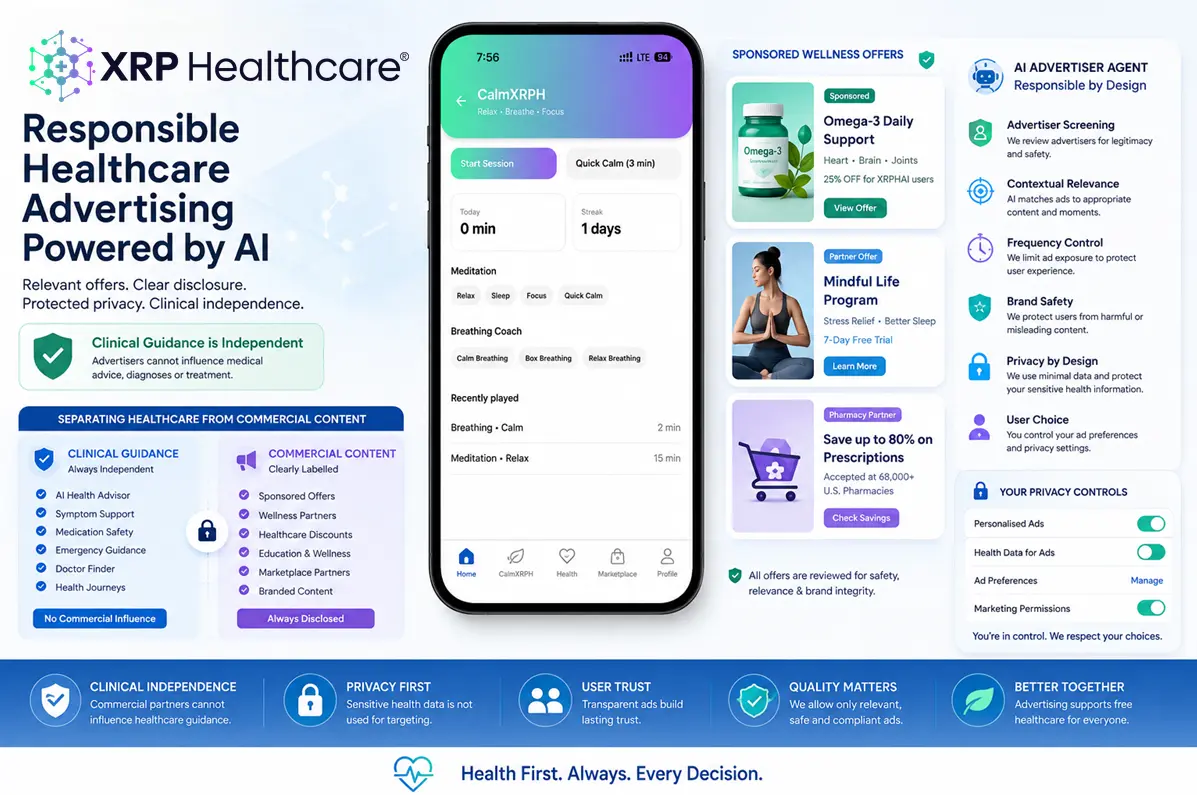
AI Advertiser Agent in Healthcare: Responsible Advertising Within the XRPHAI App
Introduction
Advertising funds a large part of the modern internet.
Search engines use it. Social platforms use it. Media companies use it. Many free mobile applications use it.
Digital healthcare platforms may eventually use advertising too.
But healthcare advertising carries a different level of responsibility.
A person browsing fashion content and a person searching for information about a health concern are in very different situations.
Healthcare users may be:
That context changes how advertising should work.
The goal cannot simply be:
Show the advertisement most likely to generate revenue.
A responsible healthcare advertising system should ask:
Is this advertisement appropriate, relevant, transparent and safe in this context?
Within the broader XRPHAI App ecosystem, the future Advertiser Agent can potentially manage this commercial layer while preserving a clear boundary between healthcare guidance and paid promotion.
What Is an AI Advertiser Agent in Healthcare?
An AI Advertiser Agent is an intelligent system designed to manage advertising opportunities within a healthcare platform.
Its potential responsibilities may include:
Screening advertisers
Matching campaigns to appropriate contexts
Controlling ad frequency
Identifying unsuitable campaigns
Supporting disclosure
Monitoring performance
Protecting user experience
Supporting brand safety
Managing advertiser relationships
The agent should optimise advertising responsibly.
It should not influence clinical decision-making.
Why Healthcare Advertising Needs Stronger Controls
Healthcare advertising can affect decisions that matter.
Poorly governed advertising could promote:
misleading treatments
unsafe supplements
fraudulent health products
unproven therapies
exaggerated wellness claims
inappropriate financial products
The platform therefore needs stronger advertiser standards than a general entertainment app.
Advertising Should Not Look Like Medical Advice
This distinction is essential.
An advertisement might say:
Sponsored wellness service
That is commercial content.
An AI Health Advisor response may provide:
general healthcare information
That is part of the healthcare experience.
These two should never be blended in a way that confuses the user.
Clinical Guidance Must Remain Independent
A commercial partner should not be able to pay to change what the healthcare AI says.
For example, a sponsor should not be able to purchase:
Paid influence must remain outside healthcare reasoning.
The Advertiser Agent
Within the future XRPHAI agent architecture, the Advertiser Agent is designed to manage the advertising layer.
Its potential role may include:
The goal is not simply to maximise impressions.
It is to maximise appropriate commercial value without damaging trust.
Advertiser Agent vs Partner Marketplace Agent
These agents are related but different.
Partner Marketplace Agent
Helps users discover relevant approved external services.
Advertiser Agent
Manages paid promotional inventory and advertiser campaigns.
A marketplace recommendation may be service discovery.
An advertisement is paid promotional content.
The distinction should remain visible.
Advertiser Agent vs Revenue Optimisation Agent
The Revenue Optimisation Agent looks broadly across the commercial model.
It may identify advertising as one possible revenue channel.
The Advertiser Agent then specialises in:
campaign management
ad quality
placement
relevance
advertiser controls
This keeps responsibilities clear.
Advertising Should Follow Healthcare Value
The XRPHAI App should not become an advertising platform with healthcare features attached.
The order should remain:
Healthcare Value
User Trust
Appropriate Commercial Opportunity
Advertising is a supporting business model.
It should not become the primary product experience.
Free Healthcare and Advertising
Advertising can potentially help support free digital services.
A platform may decide to provide useful free healthcare functionality while generating some revenue through appropriate advertising.
This can reduce reliance on subscriptions alone.
However, the trade-off must be managed carefully.
Ad Load Matters
Too many advertisements can damage user experience.
A healthcare app overloaded with ads may feel:
distracting
untrustworthy
commercialised
difficult to use
The Advertiser Agent can potentially help manage frequency.
One Relevant Ad Can Be Better Than Five Irrelevant Ads
Advertising quality matters more than raw volume.
For example, a user exploring general wellness may reasonably see a clearly labelled wellness-related offer.
Showing several unrelated advertisements provides little value.
AI can potentially improve relevance while reducing clutter.
Healthcare Advertising Should Be Context-Aware
Not every app screen is equally suitable for advertising.
Potentially appropriate areas may include:
Less appropriate contexts may include:
Context should determine commercial eligibility.
Emergency Moments Should Be Ad-Free
If a user may need urgent care, advertising should not interfere.
The sequence should be:
Safety Guidance
Appropriate Professional / Emergency Escalation
Not:
Advertisement
Safety Guidance
Commercial content should pause.
Medication Safety and Advertising
Medication-related content requires similar care.
A user asking:
“Can I safely take this medication?”
should not immediately receive a paid advertisement for another product.
Safety comes first.
Advertising should never create confusion around medication decisions.
Counterfeit Medicine Concerns
If the Counterfeit Medicine Advisor identifies a potential concern, the user should first receive appropriate safety information.
The platform should not exploit fear by immediately showing:
Buy this replacement medicine now
simply because a partner pays for placement.
Doctor Finder and Advertising
Doctor Finder must remain especially clear.
A sponsored provider may be displayed where permitted.
But sponsored placement should never automatically mean:
best doctor
or:
clinically superior doctor
The commercial relationship should be obvious.
Sponsored Provider Listings
If sponsored provider listings exist, clearly label them.
For example:
Sponsored Provider
Partner Listing
This helps distinguish paid visibility from relevance-based discovery.
Prescription Savings and Advertising
Prescription Savings may also sit near commercial healthcare relationships.
The user should understand the difference between:
Do not blur these layers.
Advertising and the Partner Marketplace
The Partner Marketplace may include approved service listings.
Some listings may be organic. Others may be sponsored.
The Advertiser Agent can potentially manage the paid layer while the Partner Marketplace Agent manages service relevance.
This distinction helps protect marketplace integrity.
Native Advertising
Native advertising is designed to match the look and feel of surrounding content.
That can improve usability.
But in healthcare, native ads must still be clearly disclosed.
An advertisement should never be disguised as an independent healthcare recommendation.
Sponsored Articles
A healthcare platform may eventually publish sponsored educational content.
Such content should be clearly labelled.
For example:
Sponsored Content
Paid Partnership
The advertiser should not control independent healthcare guidance elsewhere in the platform.
Influencer and Ambassador Advertising
The AI Referral & Ambassador Agent may manage creators and community advocates.
Some ambassador activity may involve paid campaigns.
Where it does, commercial relationships should be disclosed.
An ambassador should not present paid promotion as an independent medical recommendation.
Advertiser Quality Matters
Not every advertiser belongs inside a healthcare ecosystem.
Potential advertiser review criteria may include:
legitimacy
claims
safety
product category
reputation
compliance history
privacy practices
geographic eligibility
High-risk categories should receive deeper scrutiny.
Restricted Categories
A healthcare advertising platform may need to restrict or prohibit categories that create excessive risk.
Examples might include:
fraudulent treatments
dangerous health products
misleading medical devices
unapproved claims
predatory financial-health schemes
products that conflict with platform safety policies
The exact restrictions should reflect applicable laws and product policy.
Health Claims Need Scrutiny
Advertisers may make claims such as:
improves health
supports sleep
reduces pain
clinically proven
These claims should not simply be accepted because the advertiser pays.
Claims may require evidence and review depending on the category.
AI Can Help Screen Claims
The Advertiser Agent can potentially flag language such as:
This can help prioritise human review.
Human Review Remains Important
AI screening is useful.
But some healthcare advertising decisions may require people.
Examples include:
Automation should support accountability.
Advertising and User Privacy
Advertising often relies on targeting.
Healthcare makes targeting sensitive.
A user may reveal information through:
AI conversations
medication queries
Doctor Finder searches
symptom questions
Health Journeys
wellness activity
That does not mean every signal should become advertising data.
Sensitive Health Data Is Not Ordinary Ad Data
A healthcare platform should not treat:
“User asked about a serious health condition”
the same way a retail platform treats:
“User searched for trainers.”
The sensitivity is fundamentally different.
Data Minimisation
Advertiser matching should use the minimum information necessary.
Potentially safer signals might include:
Detailed clinical information should not be used casually.
Contextual Advertising
One alternative to behavioural targeting is contextual advertising.
Instead of targeting the individual based on extensive personal data, the platform can consider the current general context.
For example:
User is viewing: general mindfulness content
The platform may show:
clearly labelled wellness sponsorship
This can reduce reliance on sensitive profiling.
Contextual Advertising vs Behavioural Advertising
Contextual Advertising
Based primarily on the content or screen being viewed.
Behavioural Advertising
Based on information collected about the user's behaviour over time.
Healthcare platforms may need to be especially cautious with behavioural targeting because of health-data sensitivity.
User Control
Users should have meaningful control where supported.
This may include:
ad preferences
privacy controls
marketing permissions
notification settings
personalised-ad settings
Control strengthens trust.
Personalised Ads Should Be Explainable
Where personalised advertising exists, users may benefit from understanding:
Why am I seeing this?
For example:
Shown because you are viewing general wellness content.
This is more transparent than unexplained targeting.
Advertising Should Not Infer Diagnosis
A user who views:
sleep content
should not automatically be classified as:
insomnia patient
A user who views:
stress content
should not automatically become:
anxiety patient
Commercial targeting should avoid converting general interests into unsupported medical labels.
Advertising and Mental Health
Mental-health contexts require particular care.
A user experiencing distress should not be targeted with manipulative commercial messaging.
Advertising should not exploit:
fear
loneliness
anxiety
crisis
vulnerability
Support and safety come first.
Advertising and Wellness Content
Wellness content may provide more appropriate commercial contexts.
Potential categories could include:
Again, relevance and disclosure matter.
CalmXRPH and Advertising
CalmXRPH should not become an interrupted ad environment.
Imagine a user begins a relaxation session and receives an advertisement halfway through.
That would damage the experience.
Advertising around CalmXRPH should be carefully controlled.
Ad-Free Premium
Some platforms use:
free with ads
and:
premium without ads
as part of their business model.
XRPHAI could potentially explore such a structure if aligned with product strategy.
However, this should not be presented as current unless formally launched.
Premium Users and Advertising
If premium eventually includes an ad-free experience, the distinction should be clear.
Users should understand what premium changes.
Do not imply premium changes the clinical quality of AI guidance.
Advertising and Revenue Optimisation
The Revenue Optimisation Agent may evaluate advertising alongside:
subscriptions
partnerships
referrals
enterprise
other revenue channels
The goal is to create a diversified model rather than depend on one source.
Advertising Revenue
Potential models may include:
display advertising
sponsored placements
partner campaigns
sponsored content
marketplace promotion
other approved models
The exact implementation should reflect future product strategy.
Advertiser Agent and Enterprise Agent
The Enterprise Agent manages organisation-level healthcare relationships.
The Advertiser Agent manages advertising relationships.
An organisation can potentially be both:
enterprise customer
advertiser
But those commercial roles should remain operationally distinct.
Enterprise Customers Should Not Automatically Become Advertisers
A company buying an enterprise programme should not automatically receive promotional access to individual users.
Enterprise relationships and advertising permissions are separate.
Advertising to Enterprise Users
Users who access XRPHAI through an employer or institutional programme may have additional expectations.
The platform should clarify:
No Employer-Targeted Health Advertising
An employer should not be able to say:
Show this advertisement only to employees who asked about a particular medical condition
unless an exceptionally specific, lawful and appropriately governed use case exists.
This type of targeting would raise serious privacy concerns.
Advertiser Data Access
Advertisers should receive only the information necessary for campaign operation.
They should not receive:
AI conversation transcripts
diagnoses
medications
Doctor Finder history
individual Health Journey data
private CalmXRPH activity
Campaign reporting should be appropriately limited.
Aggregate Campaign Reporting
Advertisers may need metrics such as:
impressions
clicks
conversions
campaign reach
They do not automatically need the user's healthcare history.
Conversion Tracking
Healthcare conversion tracking should be designed carefully.
A platform may need to know:
Did the user click a sponsored offer?
It may not need to reveal:
What health condition led them to the offer?
Minimise sensitive information.
Advertising Attribution
Attribution helps understand which campaigns work.
Potential methods may include:
campaign IDs
referral parameters
conversion events
Again, attribution should not become an excuse to build excessive health profiles.
Frequency Capping
Repeated advertisements can irritate users.
The Advertiser Agent can potentially apply frequency caps.
For example:
Do not show the same campaign more than X times within a defined period.
The exact logic should be tested and configurable.
Ad Fatigue
If users repeatedly see the same promotion, engagement may decline.
AI can potentially detect ad fatigue and reduce exposure.
This can improve both user experience and advertiser performance.
Campaign Relevance
Relevant campaigns may perform better without requiring intrusive targeting.
The system can potentially consider:
These signals can support matching while limiting sensitive profiling.
Advertiser Brand Safety
Advertisers also care about where their ads appear.
A legitimate wellness brand may not want its advertisement placed beside:
The Advertiser Agent can protect both user and advertiser context.
Two-Way Brand Safety
Brand safety operates in both directions.
Protect the User
Do not show unsafe or misleading advertisers.
Protect the Advertiser
Do not place legitimate campaigns in inappropriate healthcare contexts.
AI can help manage both.
Complaints and Ad Reporting
Users should be able to report problematic advertisements.
Potential reasons might include:
misleading claim
inappropriate content
irrelevant advertisement
scam
offensive content
privacy concern
Reports should feed into advertiser monitoring.
Advertiser Monitoring
Approval should not be permanent.
A platform should potentially monitor:
complaints
campaign changes
landing pages
misleading claims
product changes
regulatory concerns
scam reports
Advertisers can change behaviour after approval.
Landing Page Quality
The advertisement itself may be compliant while the landing page is misleading.
Therefore advertiser review should consider the full experience.
Potential issues include:
hidden charges
false health claims
fake scarcity
deceptive subscriptions
misleading endorsements
Quality control should extend beyond the ad creative.
Advertising and Dark Patterns
The platform should avoid advertisers using:
Healthcare trust should extend to partner experiences.
Ad Personalisation and Consent
Where applicable, personalised advertising should follow appropriate consent and privacy requirements.
The platform should not assume that using an AI healthcare app automatically means the user consents to health-based advertising.
Children's and Sensitive Audiences
If the platform ever serves younger users or other particularly sensitive populations, additional advertising restrictions may be required.
Commercial systems should account for audience vulnerability.
Geography Matters
Healthcare advertising rules differ by country.
An advertisement permitted in one market may be inappropriate or restricted in another.
A future Advertiser Agent may need to consider:
user region
advertiser eligibility
product category
local rules
campaign language
Global advertising requires local awareness.
Pharmaceutical Advertising
Prescription-drug advertising can be highly regulated.
XRPHAI should not treat pharmaceutical advertising like ordinary consumer advertising.
Any future use would require careful legal and regulatory review.
Medical Device Advertising
Similar care may be required for:
Claims and market authorisation should be considered appropriately.
Supplements and Wellness Products
Even seemingly simple wellness products may make exaggerated health claims.
The platform should review:
claim quality
safety
product category
applicable restrictions
Wellness branding does not automatically mean low risk.
Financial Products and Healthcare Users
Healthcare users may also be targeted by financial products related to:
insurance
financing
healthcare payments
These categories require careful separation from medical guidance.
A user's health anxiety should not be exploited to sell financial products.
XRPHAI Token Advertising
Because XRPHAI exists within the wider ecosystem, token-related content needs careful treatment.
Advertising should not claim:
guaranteed token appreciation
guaranteed investment returns
risk-free earnings
guaranteed exchange listing
guaranteed profit
Reward utility and investment claims must remain distinct.
Advertiser Agent and XRPHAI Rewards
Advertisements should not manipulate users into meaningless actions solely to maximise reward-related activity.
XRPHAI rewards should remain connected to eligible ecosystem engagement under actual programme rules.
Advertising Should Not Dominate Proof of Health™
Proof of Health™ should remain focused on eligible health-positive engagement.
It should not become:
Watch ads to prove health.
Commercial interactions and health-engagement frameworks should remain separate unless a specific programme intentionally connects them.
Measuring Advertising Success
Potential commercial metrics include:
impressions
click-through rate
conversion rate
revenue
advertiser retention
But healthcare platforms should also monitor:
A campaign that earns revenue but damages trust may not be successful.
Revenue per Impression Is Not the Only Goal
A high-paying advertiser may still be wrong for the platform.
The Advertiser Agent should consider:
Revenue
alongside:
Safety
Relevance
Trust
User Experience
Advertiser Quality Score
A future internal quality framework could consider:
Do not present such an internal score as medical evidence.
AI Can Improve Ad Placement
AI may eventually help determine:
whether an ad should appear
which campaign is most relevant
when not to show an ad
how often to show it
whether a user has already declined similar content
Sometimes the best advertising decision is:
show nothing.
The Importance of “No Ad”
This is particularly important in healthcare.
The highest-value decision may be to suppress commercial content entirely during:
That restraint can strengthen trust.
The XRPHAI Responsible Advertising Loop
A simplified future flow may look like:
Approved Advertiser
Advertiser Agent
Campaign Safety & Suitability Check
Appropriate Context
Clearly Disclosed Advertisement
User Choice
Optional Partner Interaction
Aggregate Campaign Performance
Ongoing Advertiser Quality Monitoring
Across the entire loop:
Privacy • Clinical Independence • User Control • Brand Safety
The Final Commercial Agent Layer
The planned XRPHAI commercial-agent sequence now includes:
Reactivation Agent
Brings inactive users back.
Revenue Optimisation Agent
Identifies where commercial value can align with user value.
Premium Conversion Agent
Optimises free-to-paid subscription conversion.
AI Referral & Ambassador Agent
Supports trusted user-led growth.
Wellness Coach Agent
Supports ongoing health-positive engagement.
Partner Marketplace Agent
Matches relevant approved services.
Enterprise Agent
Supports institutional relationships.
Advertiser Agent
Manages appropriate advertising and sponsored commercial opportunities.
Each agent has a different objective.
Together they form a broader AI-enabled growth and monetisation architecture around the XRPHAI App.
Commercial Agents Must Remain Outside Clinical Intelligence
None of the commercial agents should independently determine:
diagnosis
treatment
medication
clinical risk
emergency guidance
Commercial logic should never be allowed to rewrite healthcare guidance for economic gain.
This boundary should remain fundamental to the entire architecture.
The Future of AI Healthcare Advertising
Future advertising systems may become more sophisticated through:
contextual matching
stronger brand safety
automated claims review
intelligent frequency control
regional campaign rules
campaign-quality scoring
privacy-conscious attribution
advertiser fraud detection
The strongest systems will not simply become better at targeting.
They will become better at understanding when not to advertise.
Why Responsible Advertising Can Strengthen the XRPHAI Model
A diversified digital healthcare business may eventually generate revenue from:
This reduces reliance on one commercial model.
But diversification only works if each layer respects the healthcare experience.
Advertising should therefore complement:
AI healthcare value
rather than compete with it.
From Monetisation to Sustainable Ecosystem
The broader commercial architecture can be understood as:
Useful Healthcare Experience
Engagement
Retention
Relevant Premium / Partner / Enterprise / Advertising Opportunity
Platform Revenue
Investment in Better XRPHAI Features
More User Value
The cycle starts and ends with healthcare value.
Conclusion
Advertising can help make digital healthcare platforms more commercially sustainable.
But healthcare advertising cannot be treated like ordinary ad technology.
Within the XRPHAI App, the future Advertiser Agent can potentially manage:
The boundaries must remain clear.
Clinical guidance should never be sold.
Sensitive health information should not become ordinary targeting data.
Emergency and medication-safety contexts should take priority over advertisements.
Sponsored content should be clearly disclosed.
Commercial partners should not be presented as medically superior because they pay more.
And sometimes the most responsible AI advertising decision should simply be:
do not show an ad.
When advertising operates within those boundaries, it can support the long-term economics of XRPHAI without weakening the trust that a healthcare platform depends on.
FAQs
What is an AI Advertiser Agent in healthcare?
An AI Advertiser Agent is an intelligent system designed to manage advertiser suitability, contextual placement, disclosure, frequency, campaign quality and advertising performance within a digital healthcare platform.
What is the XRPHAI Advertiser Agent?
The future XRPHAI Advertiser Agent is designed to manage appropriate advertising and sponsored commercial opportunities across the XRPHAI ecosystem while maintaining boundaries between paid promotion, privacy and independent healthcare guidance.
Can advertisers influence XRPHAI healthcare advice?
Commercial relationships should not influence diagnosis, treatment, medication guidance, emergency escalation or independent healthcare information provided through XRPHAI.
Should sensitive health information be used for advertising?
Sensitive healthcare information should not be treated as ordinary advertising data. Healthcare platforms should minimise sensitive-data use and favour appropriate contextual signals where possible.
What is contextual advertising in healthcare?
Contextual advertising uses the general content or experience currently being viewed rather than relying primarily on extensive behavioural profiling. For example, a clearly disclosed general wellness sponsorship might appear alongside appropriate general wellness content.
Should healthcare ads appear during emergencies?
Commercial content should not interfere with emergency, crisis or medication-safety guidance. In high-risk contexts, the appropriate advertising decision may be to show no advertisement.
Can healthcare providers pay for sponsored placement?
Paid provider visibility may be possible where permitted, but sponsored listings should be clearly disclosed and payment should not be presented as evidence that a provider is clinically superior.
How is the Advertiser Agent different from the Partner Marketplace Agent?
The Partner Marketplace Agent focuses on relevant service discovery, while the Advertiser Agent manages paid promotional inventory and advertiser campaigns.
How is the Advertiser Agent different from the Enterprise Agent?
The Enterprise Agent manages institutional programmes and organisation-level relationships, while the Advertiser Agent manages advertising relationships and paid campaigns.
Why might an AI Advertiser Agent choose not to show an advertisement?
Some healthcare contexts are unsuitable for commercial messaging. Suppressing advertising during urgent, sensitive or safety-critical interactions can protect users, clinical independence and long-term platform trust.